
MAKASSAR, Indonesia Mar 11 2026/f-analysis/ – Have you ever stopped to wonder what actually holds our digital world together? Behind every sharp image on your smartphone, every fluctuating stock market graph, and every complex weather prediction lies a hidden architecture of numbers. While most of us only see the final result, mathematicians are busy building the “containers” that allow us to process this information efficiently. A groundbreaking study recently published in the journal Filomat offers a fascinating look into this invisible world, proving that even the most abstract mathematics plays a vital role in our global progress.
Building Better “Mathematical Rooms”
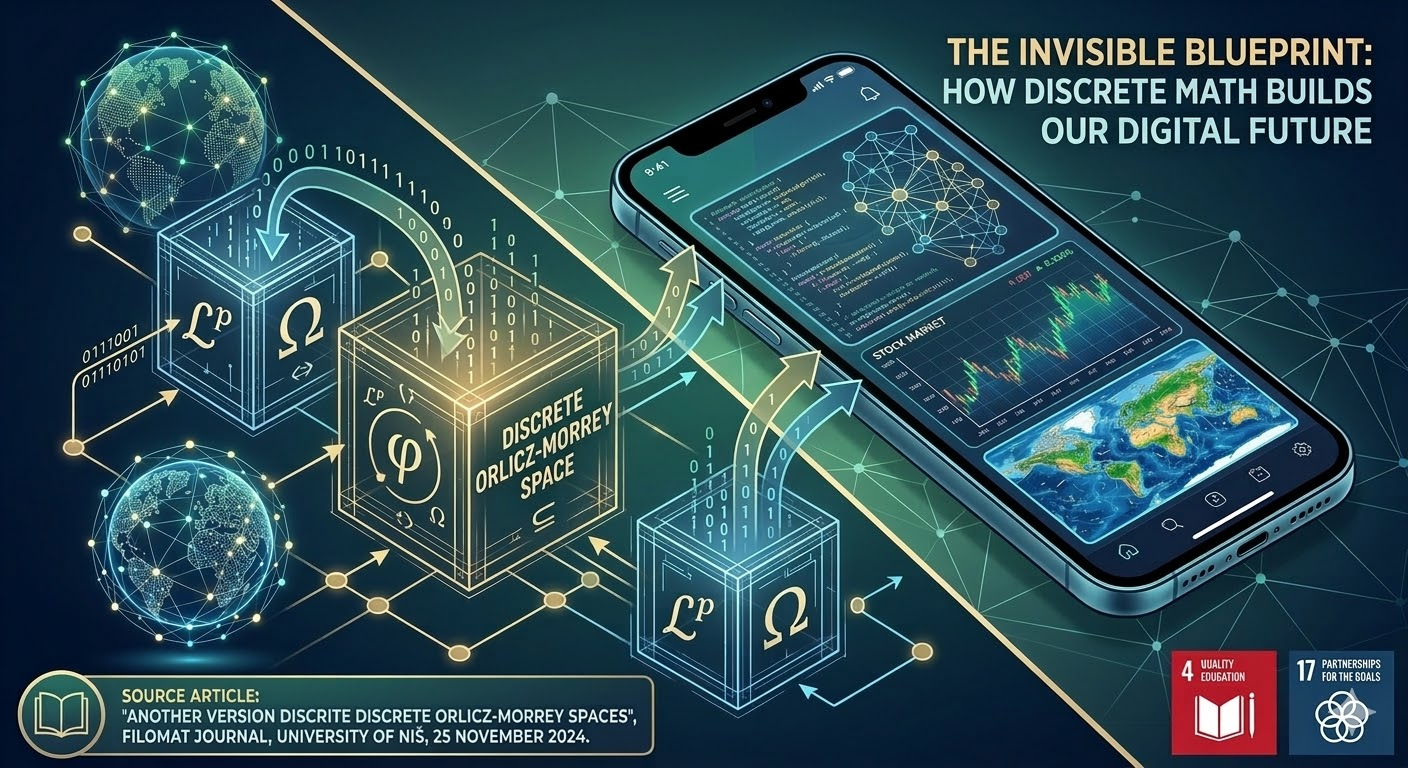
The research, led by Al Azhary Masta, Hemanta Kalita, and Muh Nur , focuses on a specialized area known as Discrete Orlicz-Morrey spaces. To understand this, think of these “spaces” as custom-designed rooms built to hold specific types of data sequences. Just as you wouldn’t store a vast library of books in a tiny refrigerator, mathematicians need different types of spaces to organize and measure different types of numerical information.
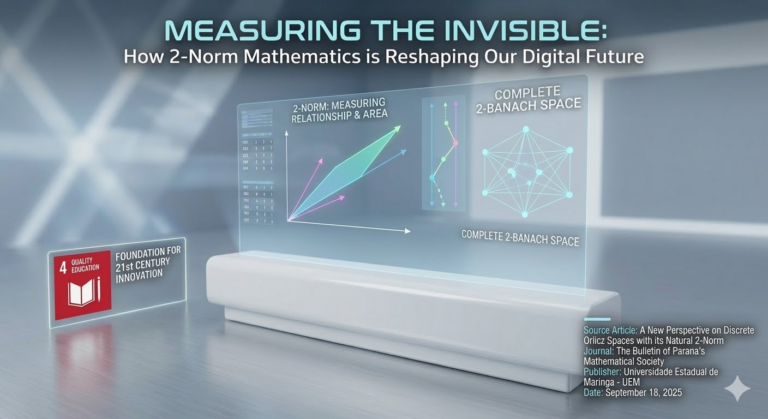
The researchers explored a “new version” of these spaces that deals specifically with discrete data—the kind of “step-by-step” information found in computer code, digital signals, and data packets. Their primary goal was to uncover “inclusion properties”. In simple terms, they were looking for the exact rules that determine when one mathematical “room” is large or flexible enough to fit entirely inside another. By calculating the “norms” of characteristic sequences—the mathematical equivalent of a master ruler—they provided a way to measure the size and capacity of these digital containers.
Advancing Global Goals through Education
While this might seem far removed from daily life, this research is a fundamental pillar of SDG 4 (Quality Education). One of the primary targets of this United Nations goal is to substantially increase the number of youth and adults who have relevant skills for employment and entrepreneurship in technical fields. Advanced mathematical research like this serves as the “teacher’s teacher.” By expanding our understanding of functional analysis, we are not just solving equations; we are strengthening the higher education curriculum and ensuring the next generation of scientists is trained on the most sophisticated frameworks available.
Furthermore, this paper is a shining example of SDG 17 (Partnerships for the Goals). The collaboration between the Indonesia University of Education, Hasanuddin University, and VIT-Bhopal University in India demonstrates how international cooperation in science can bridge gaps and foster innovation across borders. These partnerships ensure that high-level knowledge is shared globally, moving us all closer to a technologically advanced future.
By defining these new spaces and their inclusion rules, the authors have provided a new blueprint for understanding the patterns that govern our digital lives. It is a powerful reminder that the quest for pure knowledge is the foundation of the tools we use every day.
Reference
DOI:
https://doi.org/10.2298/FIL2506821M
Contact:
Dr. Muh. Nur, S.Si., M.Si
+6282187050898
muhammadnur@unhas.ac.id