
MAKASSAR, Indonesia Mar 12 2026/f-analysis/ – In our daily lives, we measure things simply: a ruler for length, a scale for weight, or a clock for time. But in the high-speed digital age, data is far more complex than a single line. This is the premise of a fascinating breakthrough in higher mathematics that moves us beyond one-dimensional thinking. Researcher Muh Nur from Hasanuddin University has introduced a fresh perspective on how we analyze “Discrete Orlicz Spaces,” which are essentially mathematical frameworks used to categorize and manage infinite sequences of information. While these spaces have long been part of the mathematical landscape, the introduction of a “natural 2-norm” allows for a deeper, more relational understanding of data interactions.
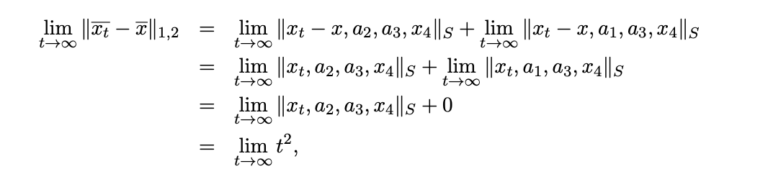
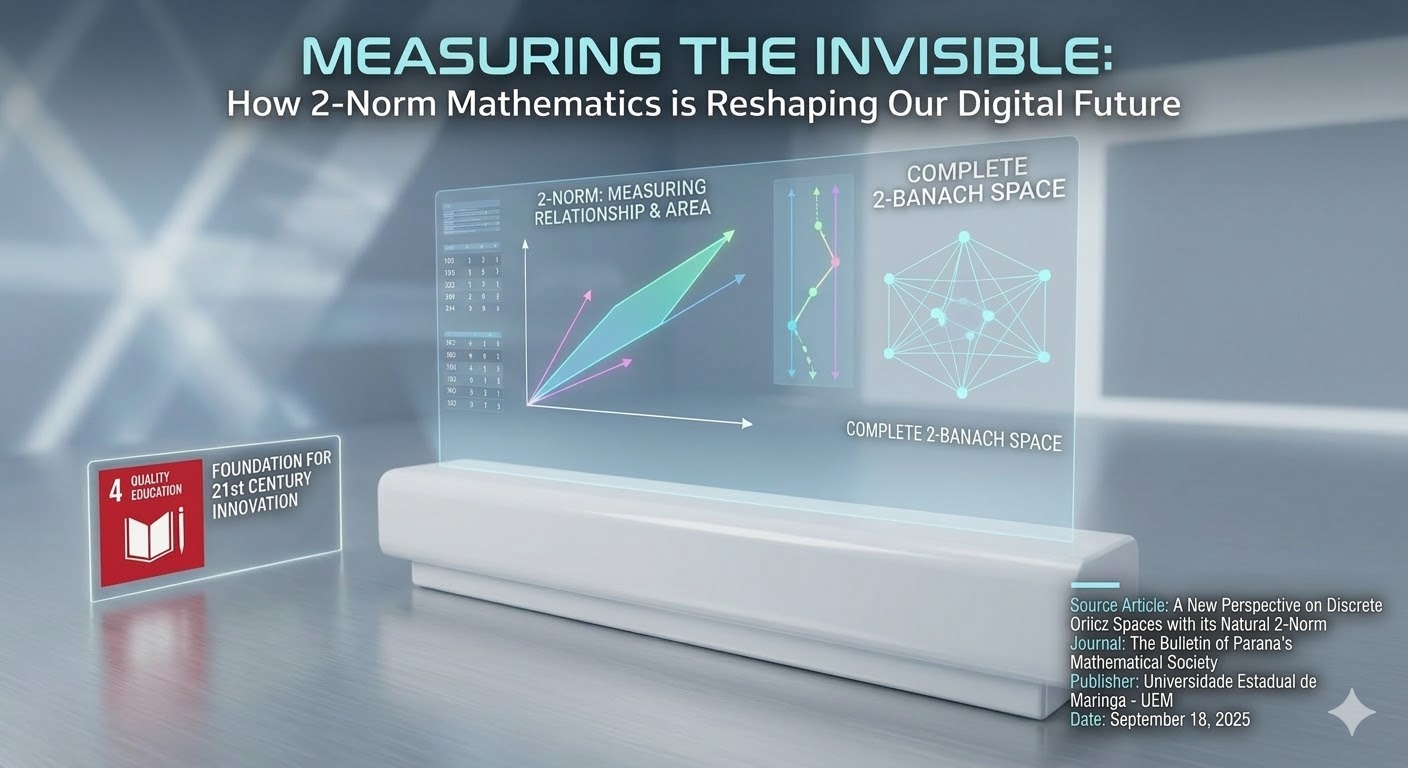
Most traditional mathematics uses a standard norm—a way to measure the “size” of a single sequence of data. However, the 2-norm acts like a more sophisticated lens, measuring the “area” or relationship formed between two different sequences of data points simultaneously. By utilizing a tool called the Young function, mathematicians can now define the properties of these data sets in a way that reflects the complexity of the real world. The study successfully demonstrates that these spaces are “complete,” meaning every mathematical sequence within them leads to a solid, predictable conclusion rather than disappearing into a void. This transformation turns them into “2-Banach spaces,” a gold standard for reliability in advanced mathematical modeling.
One of the most impactful aspects of this research is the establishment of a “fixed point theorem”. In simple terms, a fixed point is a state that remains stable and unchanged even when a specific transformation or process is applied to it. This is incredibly useful for engineers and computer scientists who need to find stable solutions in systems that are constantly shifting, such as financial algorithms or complex neural networks. By proving that these 2-normed Orlicz spaces possess this property, the research provides a new level of mathematical certainty for future high-tech applications.
This theoretical advancement holds significant weight for the United Nations’ SDG 4: Quality Education. By pushing the boundaries of what we can prove through pure logic and mathematics, we are enriching the global educational curriculum with the advanced tools necessary for 21st-century innovation. Ensuring that students and researchers have access to these sophisticated concepts is vital for developing the human capital required to manage tomorrow’s data-driven world.
The full scope of this scholarly contribution can be found in the article titled “A New Perspective on Discrete Orlicz Spaces with its Natural 2-Norm“. This significant study was featured in the prestigious academic journal, The Bulletin of Parana’s Mathematical Society. It was officially released by the publisher Universidade Estadual de Maringa – UEM and reached the global scientific community on its publication date of September 18, 2025. This work serves as a vital bridge between abstract theory and the practical stability required for modern data science
Reference
DOI:
https://doi.org/10.5269/bspm.77073
Contact:
Dr. Muh. Nur, S.Si., M.Si
+6282187050898
muhammadnur@unhas.ac.id