MAKASSAR, Indonesia Mar 11 2026/f-analysis/ – Mathematics is often viewed as a static collection of old rules, but it is actually a living, breathing field that constantly evolves to help us understand the universe. A fascinating example of this evolution is found in the article “A New Notion of Inner Product in A Subspace of n-Normed Spaces,” published in the Journal of the Indonesian Mathematical Society (JIMS) by the Indonesian Mathematical Society (IndoMS) on December 2, 2023. Written by Muh. Nur and Mochammad Idris, this research takes abstract concepts like “volume” and “angles” and applies them to complex, high-dimensional spaces.
Breaking Down the Complexity
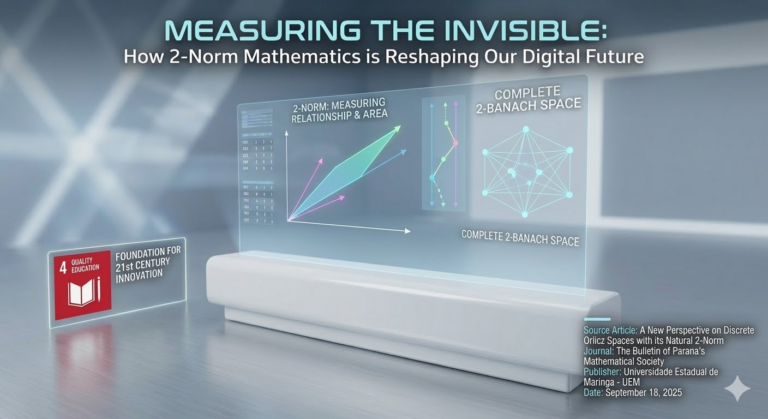
To understand this work, imagine a standard flat map. In this 2D world, we use “inner products” to calculate the shortest distance between two points or the angle of a turn. However, modern data—like the thousands of variables used to track global climate patterns or economic shifts—doesn’t fit on a flat map. It exists in n-normed spaces, where “distance” is measured not by lines, but by the volume of shapes created by multiple points.
The authors introduced a new way to define an “inner product” within these complex structures. By doing so, they have made it possible to calculate precise angles and determine the “completeness” of a mathematical space that was previously too abstract to measure accurately.
Why Does Abstract Math Matter for the World?
You might wonder how a formula for high-dimensional angles affects your daily life. The answer lies in Sustainable Development Goal 4 (SDG 4): Quality Education. The heart of SDG 4 is ensuring inclusive and equitable quality education and promoting lifelong learning opportunities for all.
By developing clearer mathematical frameworks, researchers provide the essential tools needed for the next generation of scientists and engineers. Advanced mathematics is the “engine under the hood” of the technology we use to solve global crises. Whether it is improving the algorithms that predict food security or optimizing the distribution of medical resources, high-level mathematical literacy—supported by cutting-edge research like that of Nur and Idris—is vital for a sustainable future.
A Foundation for Discovery
The study proves that these new mathematical subspaces are “complete,” meaning they are robust enough to support complex calculations without “gaps” in the logic. This provides a stable foundation for other scientists to build upon. As we strive toward the 2030 global goals, the precision offered by this new notion of inner products ensures that our digital and scientific models are as accurate as possible. It is a reminder that even the most abstract equations can have a very real impact on how we educate our society and solve the world’s most pressing problems.
Reference
DOI:
https://doi.org/10.22342/jims.29.3.1412.372-381
Contact:
Dr. Muh. Nur, S.Si., M.Si
+6282187050898
muhammadnur@unhas.ac.id