
MAKASSAR, Indonesia Mar 11 2026/f-analysis/ – Have you ever tried to visualize a geometric space containing more than three dimensions? In our everyday, physical lives, we are entirely accustomed to measuring the distance or the angle between two intersecting lines on a flat piece of paper, or perhaps within the corners of a standard three-dimensional room. However, what happens to our math when the digital information we are working with requires thousands or even millions of distinct dimensions to be properly understood?
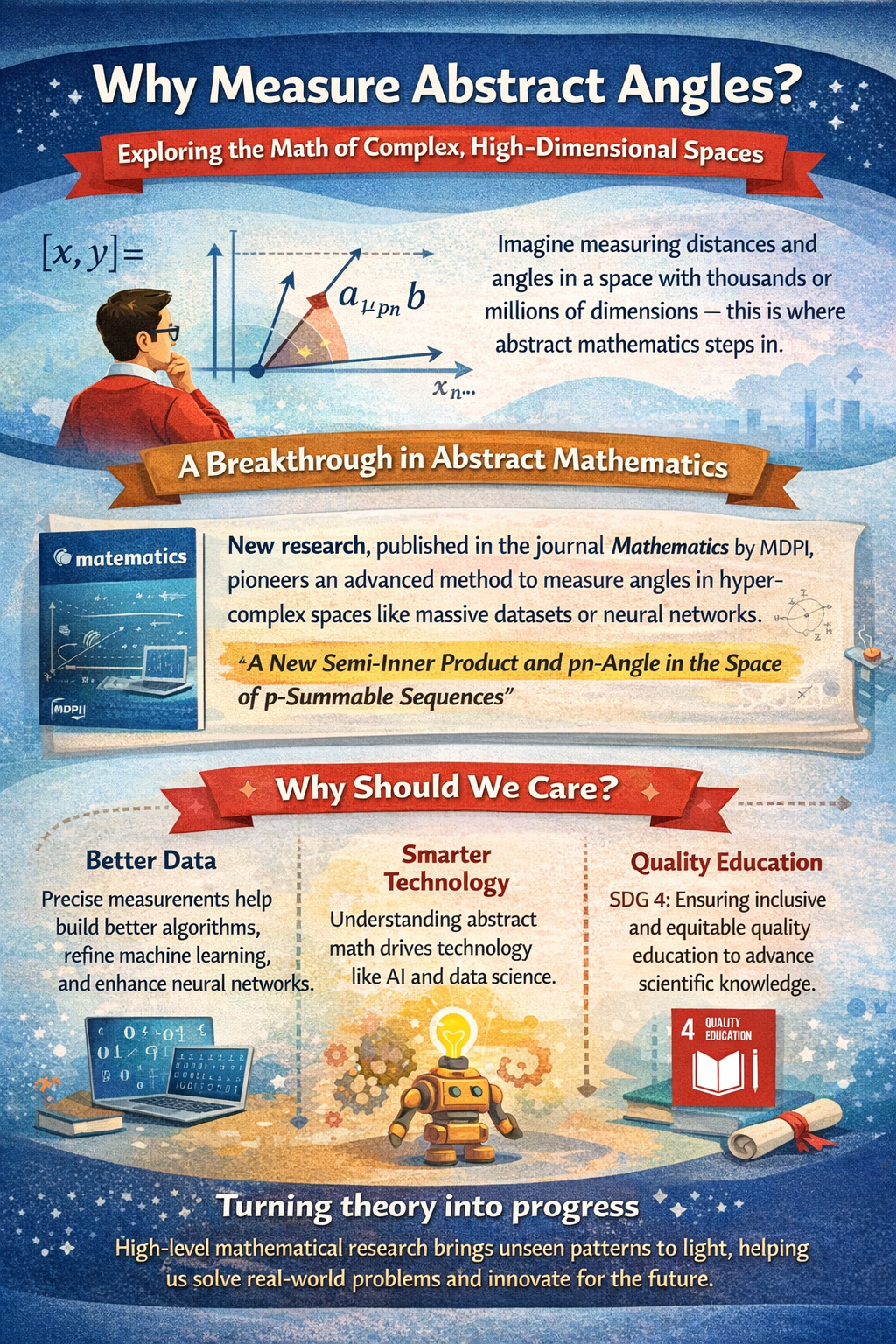
This is precisely the kind of mind-bending, abstract problem that modern mathematicians must tackle. A fascinating theoretical breakthrough in this specific area is detailed in the article titled “A New Semi-Inner Product and pn-Angle in the Space of p-Summable Sequences”. This collaborative research was published in the academic journal “Mathematics” by the publisher MDPI on 16 July 2023.
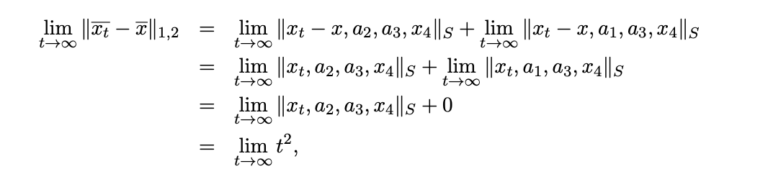
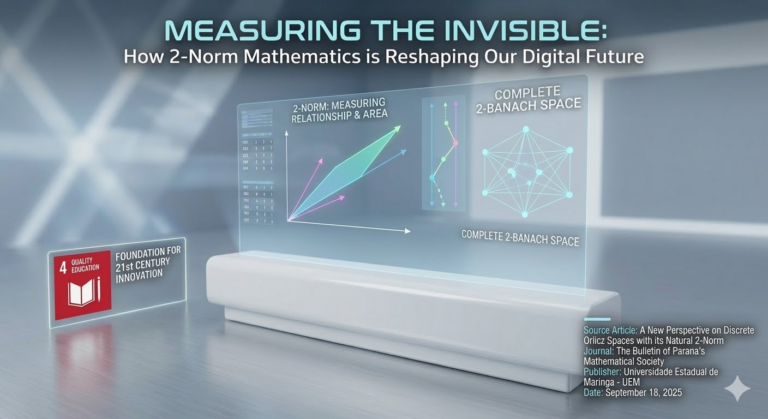
In this highly technical publication, the authors propose a completely new definition for a semi-inner product operating specifically within the space of p-summable sequences that is equipped with an n-norm. While that terminology might sound like an alien language to most, the core conceptual breakthrough is quite elegant. Essentially, the researchers have managed to develop a highly advanced mathematical ruler and protractor designed for entirely abstract spaces. By carefully utilizing this new mathematical definition, they successfully introduced the complex concepts of pn-orthogonality and the pn-angle to accurately measure the geometric relationship between two vectors residing in these spaces. Furthermore, they introduced the novel notion of measuring the specific angle between a simple one-dimensional subspace and much more complex arbitrary-dimensional subspaces. Within the specialized field of functional analysis, these obtained results are considered to be very significant.
But why should the general public care about measuring abstract angles? The answer lies in the modern technology we rely upon daily. These advanced concepts of functional analysis and complex calculus serve as the invisible engine powering our digital world. Whether a developer is building complex machine learning models, designing algorithms for data mining, or engineering neural networks, they are fundamentally relying on the ability of computers to calculate distances and angles between massive datasets.
This highlights the critical importance of SDG 4: Quality Education. Achieving this specific Sustainable Development Goal is not merely about ensuring basic global literacy; it is fundamentally about ensuring inclusive and equitable access to highly advanced scientific concepts. When we foster strong research groups and translate foundational mathematics into accessible curriculum, we equip future innovators with the necessary theoretical tools to solve pressing real-world problems.
Ultimately, while the equations might seem permanently confined to the university chalkboard, they represent the structural building blocks of tomorrow’s technological innovations. Exploring these abstract spaces allows us to continuously map the unseen territories that will ultimately define our shared future.
Reference
DOI:
https://doi.org/10.3390/math11143139
Contact:
Dr. Muh. Nur, S.Si., M.Si
+6282187050898
muhammadnur@unhas.ac.id