
MAKASSAR, Indonesia Mar 11 2026/f-analysis/ – When we think of angles, we usually picture the corner of a room, a slice of pizza, or the intersecting hands of a clock. These everyday examples exist in standard, predictable spaces where Euclidean geometry rules supreme. But what happens when we venture into the abstract realms of advanced mathematics, where the rules of distance and geometry behave completely differently? This is the domain of “normed spaces,” a concept that might sound intimidating but is simply a mathematical universe where we define the “length” of an object in highly specialized, non-traditional ways.
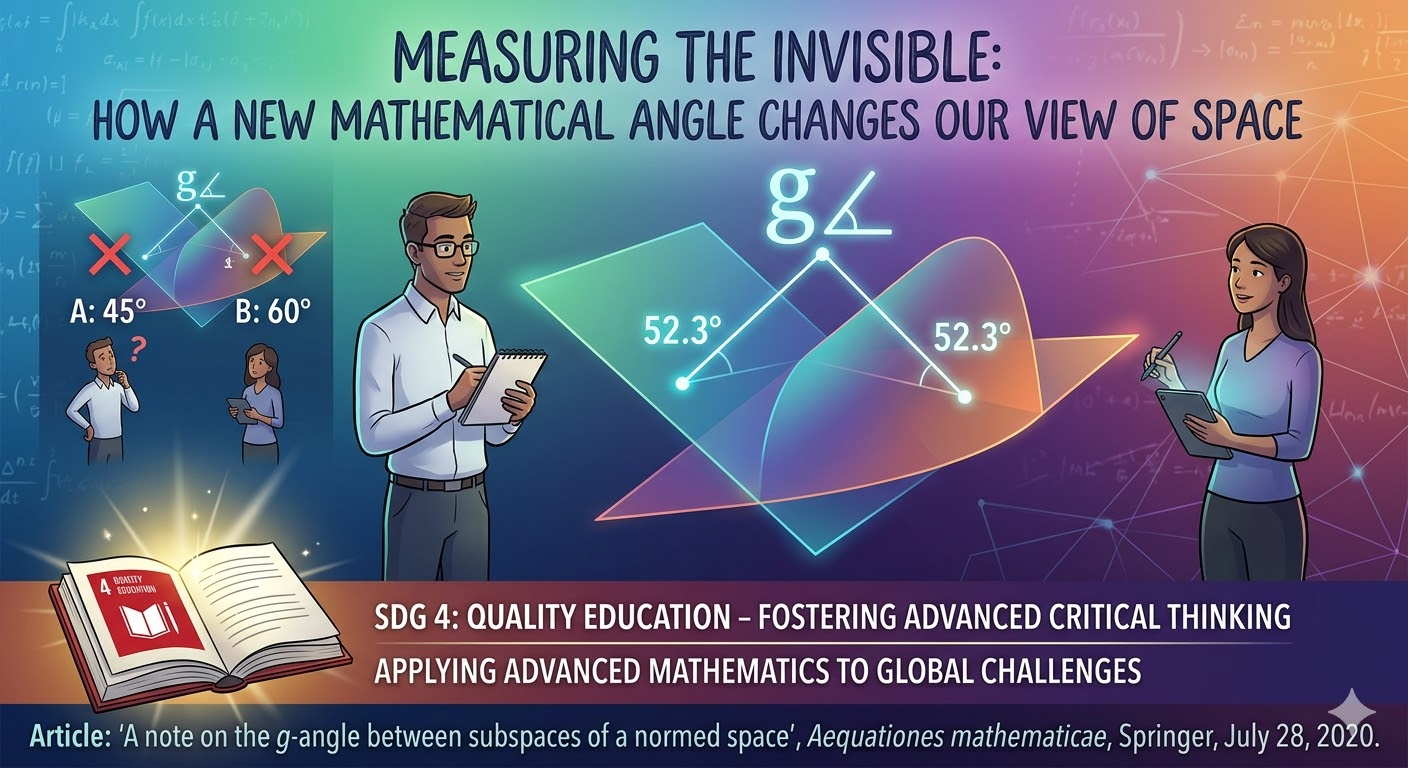
In these complex mathematical spaces, measuring the angle between two lines—or even two flat planes—is a massive challenge that has puzzled scholars for decades. For years, mathematicians struggled with formulas that were fundamentally imperfect. Imagine trying to measure the angle between two tilted tables, but your result changes depending on which legs of the table you use as your reference point. That was the exact problem with earlier calculations: they were heavily dependent on the specific “basis” or anchor points chosen to define the planes. This inconsistency meant that the “angle” wasn’t an intrinsic property of the planes themselves, but rather a byproduct of how they were measured.
This mathematical puzzle was brilliantly solved in an article titled “A note on the g-angle between subspaces of a normed space.” The research was authored by Muhammad Nur and Hendra Gunawan and was officially published online on July 28, 2020. It was featured in the esteemed academic journal Aequationes Mathematicae, a prestigious publication by Springer that focuses on functional equations and iteration theory.
In this remarkable paper, the authors introduced a brand-new way to calculate these abstract angles. By developing a fresh mathematical tool called a “2-norm,” they successfully created a solid, rigorous formula to find the precise “g-angle” between two-dimensional planes within a normed space. The true beauty of their new formula is its absolute consistency; it mathematically guarantees that the calculated angle remains exactly the same, no matter which anchor points are used to look at the planes. It serves as a perfect revision of previous, flawed attempts, providing the mathematical community with a reliable standard for geometric projection.
While this might sound like it only matters on a university chalkboard, this level of abstract reasoning is the very lifeblood of SDG 4: Quality Education. Achieving Quality Education is not just about basic literacy; it is about fostering a global culture of high-level critical thinking, advanced problem-solving, and continuous scientific discovery. When researchers deeply explore fields like functional analysis, they expand the ultimate limits of human comprehension. These theoretical breakthroughs often lay the hidden groundwork for future technologies, from sophisticated computer vision algorithms to complex machine learning models. By supporting and sharing this kind of pure academic research, we empower the next generation of educators to think beyond the visible world and solve the unimaginable problems of tomorrow. Ultimately, investing in mathematical literacy is investing in our shared future.
Reference
DOI:
https://doi.org/10.1007/s00010-020-00742-1
Contact:
Dr. Muh. Nur, S.Si., M.Si
+6282187050898
muhammadnur@unhas.ac.id