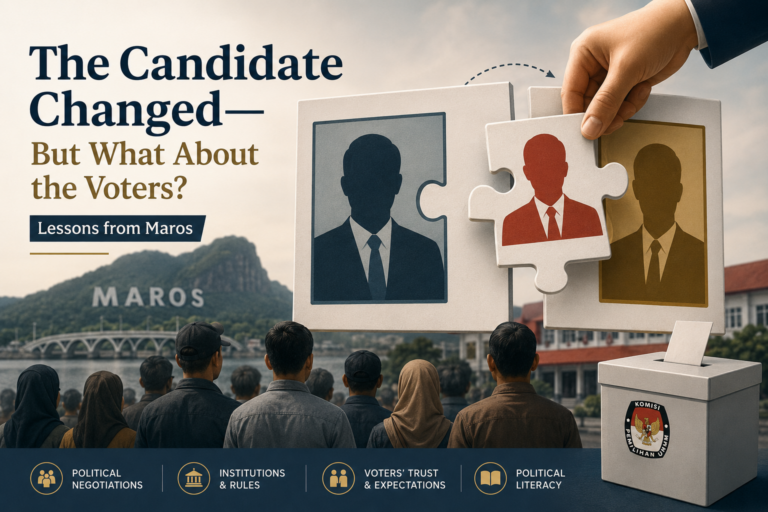

Makassar, August 14 2026 /DEPADIS – What happens when voters go to the polls and find only one candidate on their ballot? At first, the election may still look democratic: citizens can vote, election officials follow procedures, and the results can be legally determined. However, democracy is about more than just voting. It is also about making meaningful choices.
This question is explored in the article “Single Candidate and The Dynamics of The 2024 Maros Regional Election,” written by Muhammad Salman, Sukri Tamma and Ariana Yunus. The article was published in TPM – Testing, Psychometrics, Methodology in Applied Psychology Journal, Volume 33, Number 1, in 2026 by CISES srl (CISES), Italy. This study examines the emergence of a single candidate in the 2024 Maros Regional Election and its implications for the quality of local democracy.
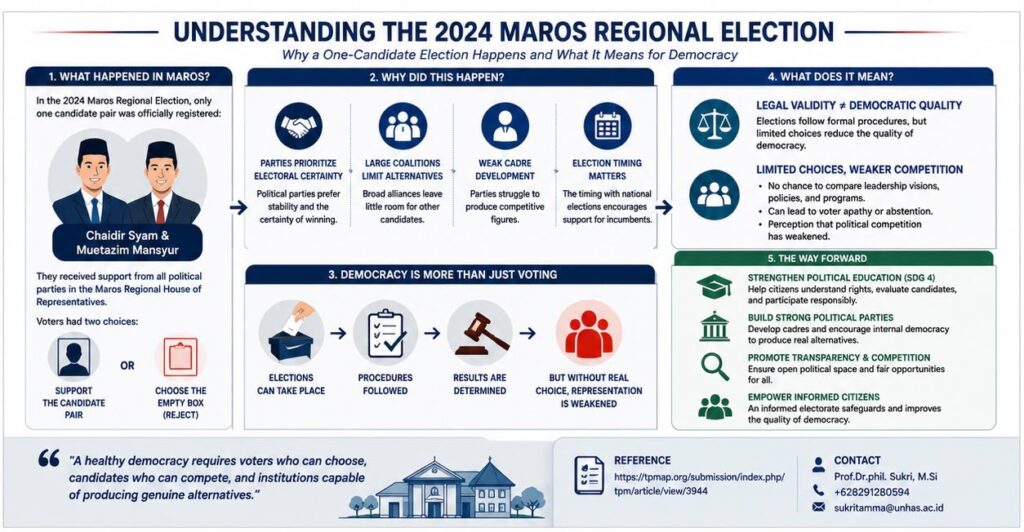
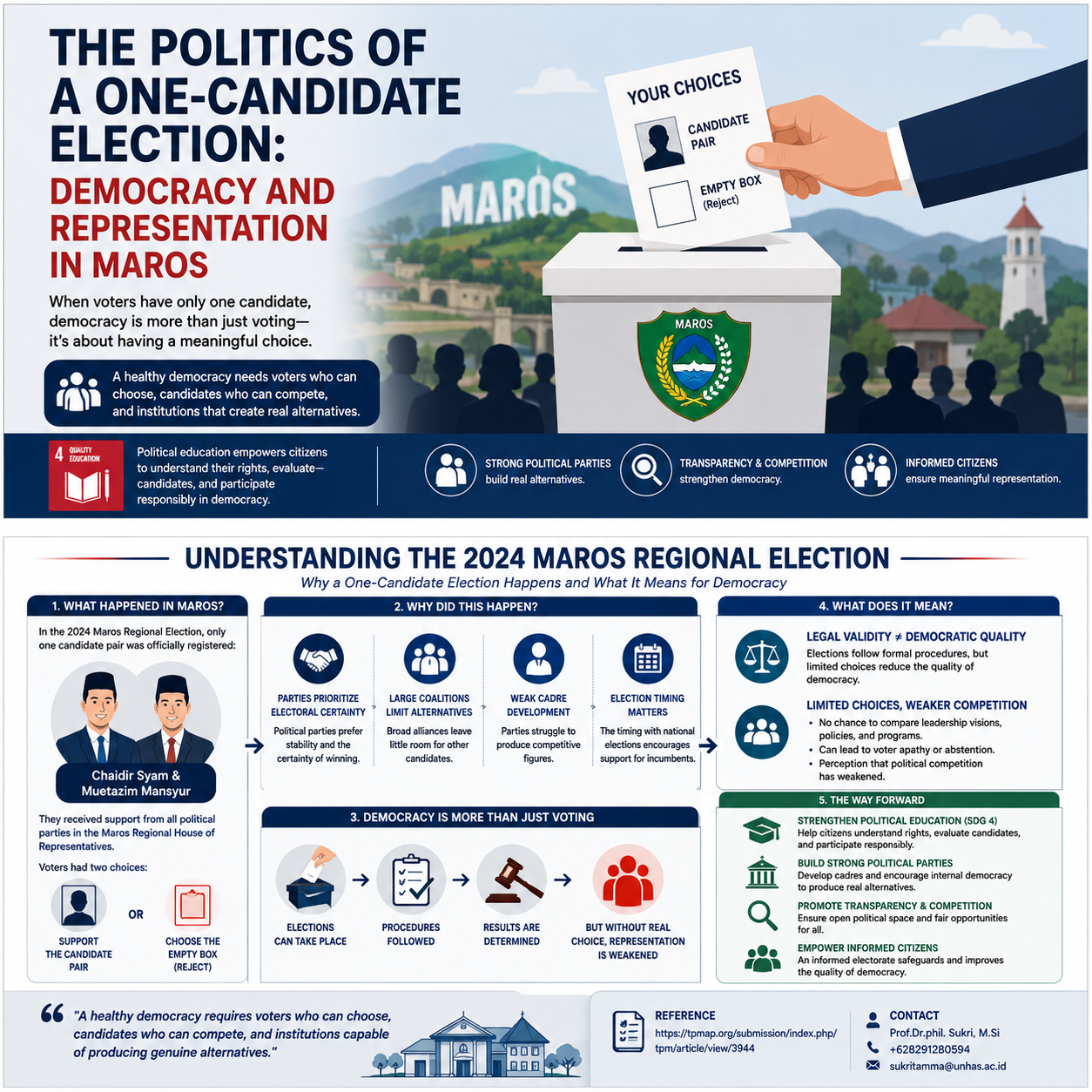
In Maros, Chaidir Syam and Muetazim Mansyur became the only officially registered candidate pair after receiving support from all political parties represented in the Maros Regional House of Representatives. Voters were therefore faced with two choices: support the candidate pair or select an empty box to express disagreement.
Why did this happen? This study identified several factors. Political parties tend to prioritize electoral certainty and political stability. Large coalitions reduced the space for alternative candidates, while weaknesses in political party cadre development made it difficult to produce competing figures in the party. The timing between national legislative and regional elections also encouraged parties to secure incumbent candidates.
This situation creates an important dilemma. A single candidate does not automatically mean that an election is invalid or that citizens have no choice in the matter. The empty box option still provides a mechanism for voters to reject the candidate. Election organizers in Maros also conducted voting simulations and maintained the formal electoral procedures.
However, legal validity is not necessarily the same as democratic quality or legitimacy. When voters have only one candidate, they lose the opportunity to compare competing leadership visions, policies and political programs. Limited choices may also encourage voter apathy or abstention and create the perception that political competition has weakened.
This issue is closely connected to SDG 4: Quality Education. Political education is essential for helping citizens understand how democratic institutions work, critically evaluate candidates, recognize their political rights, and participate responsibly. A well-informed electorate is better prepared to question political arrangements and to demand meaningful representation.
The Maros case offers a broader lesson: democracy cannot be measured only by whether elections take place. The quality of democracy also depends on political competition, alternative leadership, strong political parties, transparency, and an informed citizenry.
Ultimately, the single-candidate election in Maros reminds us that the ballot box is only one part of democracy itself. A healthy democracy requires voters who can choose, candidates who can compete, and political institutions capable of producing genuine alternatives. Therefore, strengthening political education and party cadre development is essential to ensure that local elections remain not merely procedural events but meaningful expressions of citizens’ sovereignty.
Reference: https://tpmap.org/submission/index.php/tpm/article/view/3944
Contact:
Prof.Dr.phil. Sukri, M.Si
+628291280594
sukritamma@unhas.ac.id