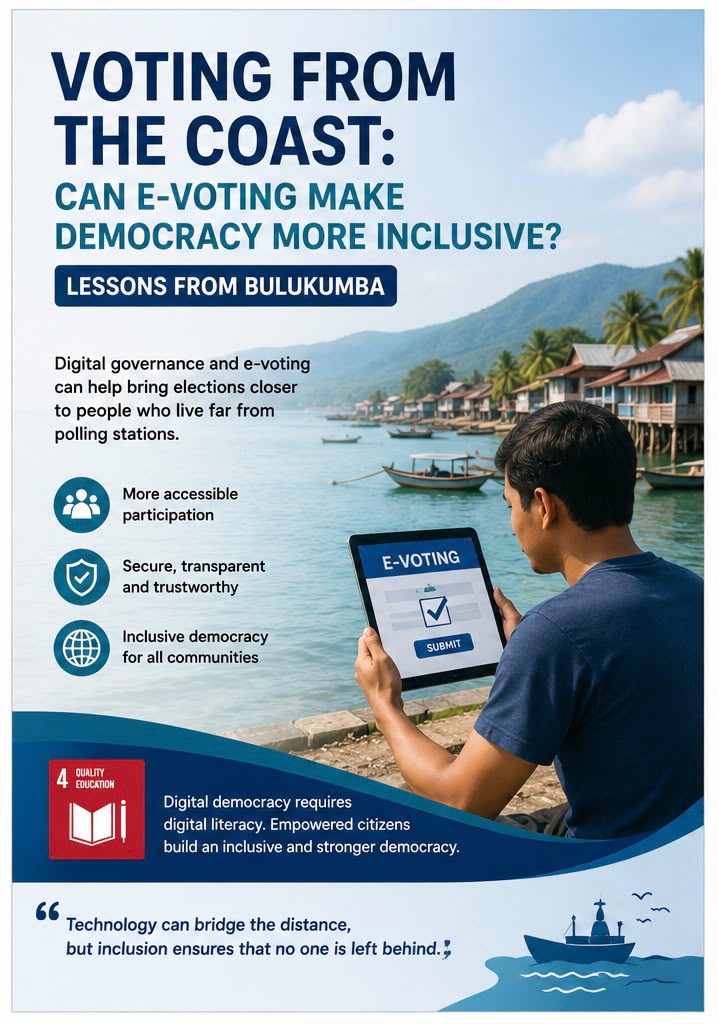

MAKASSAR, August 17 2026 /DEPADIS – Imagine living in a coastal or island community where participating in an election requires overcoming distance, transportation challenges and limited access to public services. For citizens in maritime areas, these geographical realities make political participation more difficult. Digital technology offers a possible solution in the form of e-voting. But can moving elections online really make democracy more inclusive?
This question is explored in the article “Digital Governance and Inclusive Democracy in Maritime Area: A Case Study of E-Voting Implementation in Bulukumba District, Indonesia.” This article was presented at the World Conference on Governance and Social Sciences 2025 (WCGSS 2025) and published by Atlantis Press on March 13, 2026. This study examines how digital governance and e-voting can potentially expand political participation in maritime regions such as Bulukumba.
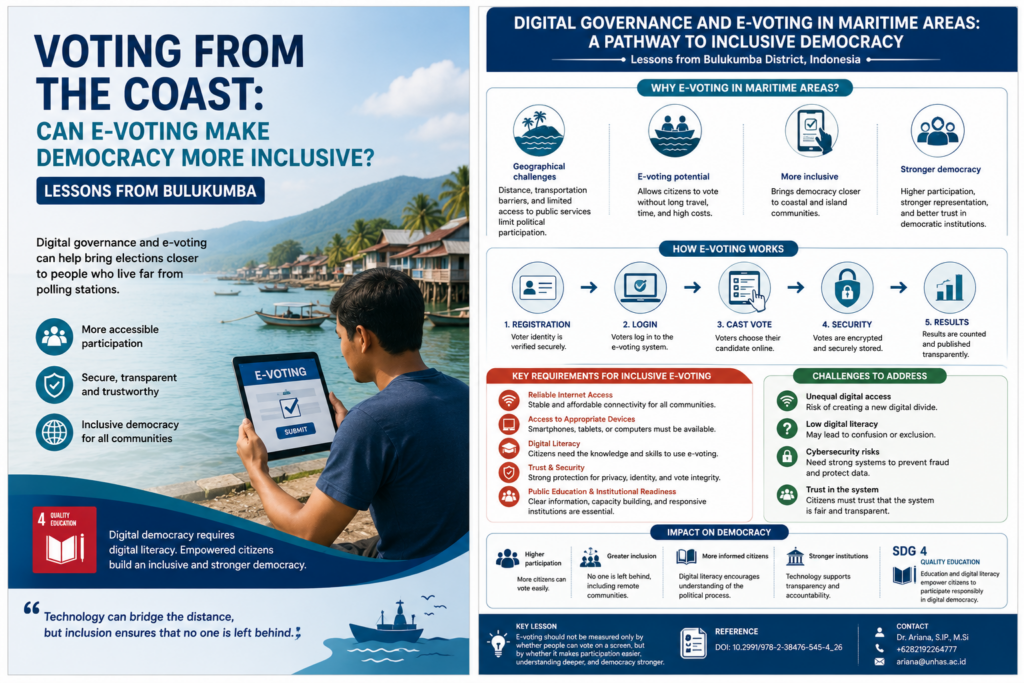
Bulukumba is an interesting setting for understanding these issues. Its communities are closely connected to the sea, and geographical conditions can create differences in access to government services and political processes. In such circumstances, digital governance can offer a new way to connect citizens with public institutions without requiring every interaction to depend on physical proximity.
E-voting is attractive because it can make voting more convenient. Citizens may be able to participate without traveling long distances or spending significant time and money reaching a polling station. For communities living in geographically dispersed areas, this could potentially reduce some practical barriers to political participation.
However, technology is not automatically inclusive of all people. A digital election is only democratic when people can access and trust the system. Citizens need reliable Internet connections, appropriate digital devices, sufficient digital literacy, and confidence that their votes are secure and confidential. Without these conditions, e-voting could unintentionally create a new form of inequality between citizens who are digitally connected and those who are not.
Therefore, digital governance must be accompanied by public education and institutional preparation. Communities need clear information about how e-voting works, how voter identity is protected, and how election results are secured. Election administrators also need the capacity to manage technological risks and respond to citizens’ concerns.
This study is closely connected to SDG 4: Quality Education. Digital democracy requires more than technological infrastructure; it requires citizens with the knowledge and skills to use digital systems responsibly. Therefore, strengthening digital literacy can be an important foundation for expanding inclusive political participation.
The Bulukumba case offers a broader lesson: technology should serve democracy and not replace its human and institutional foundations. E-voting can potentially make elections more accessible, but only when digital innovation is designed around citizens’ real needs.
Ultimately, the success of e-voting should not be measured simply by whether people can vote on a screen. A more important question is whether technology helps citizens participate more, understand the political process, and trust democratic institutions. For maritime communities, digital governance could become an important bridge between geographical distance and political inclusion; however, that bridge must be accessible to everyone.
Reference DOI: 10.2991/978-2-38476-545-4_26
Contact:
Dr. Ariana, S.IP., M.Si
+6282192264777
ariana@unhas.ac.id