
MAKASASAR, August 15 2026 / DEPADIS – South Sulawesi is blessed with abundant marine resources, yet having plenty of fish does not automatically mean that fishermen will enjoy better lives. Many small-scale fishermen remain economically vulnerable because they have limited bargaining power, fluctuating catches, and inadequate facilities for storing fish after they are caught. Without proper storage, fishermen may be forced to sell their catch immediately, often when the market prices are low.
This issue is examined in the article “Implementasi Kebijakan Cold Storage dan Implikasinya terhadap Kesejahteraan Nelayan di Sulawesi Selatan” (Implementation of Cold Storage Policy and Its Implications for Fishermen’s Welfare in South Sulawesi). The article was written by Rakhmat Ramdana, Sukri, Ariana Yunus, and Erwing Yanto and published in Mediasosian: Jurnal Ilmu Sosial dan Ilmu Administrasi Negara, published by the Faculty of Social and Political Sciences, Universitas Kadiri, on 28 May 2026. This article appears in Volume 10, Issue 1, 2026.
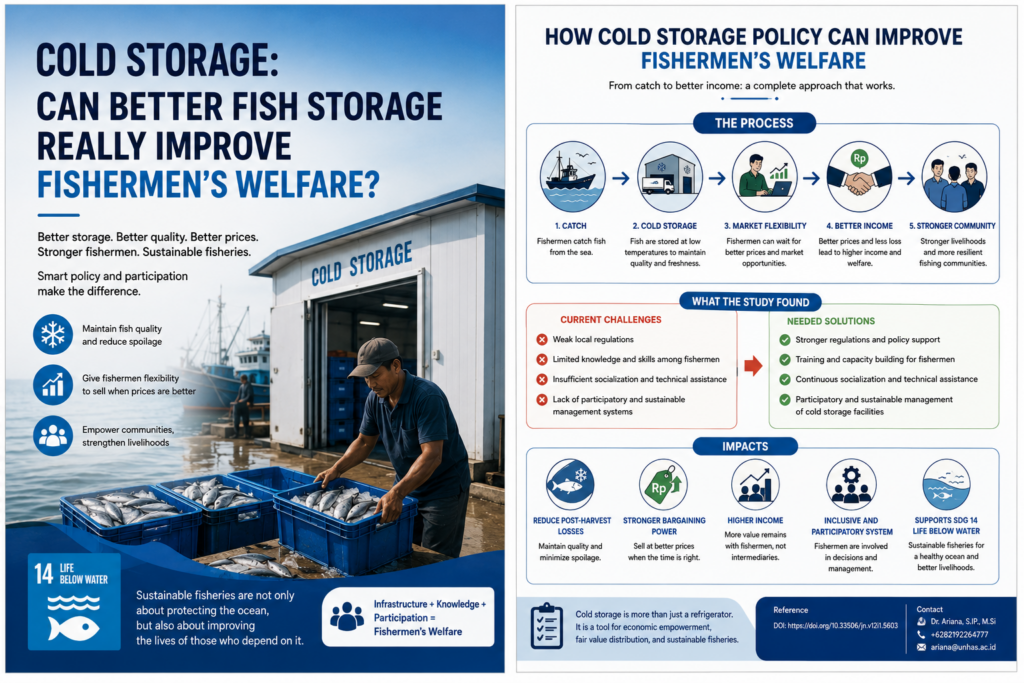
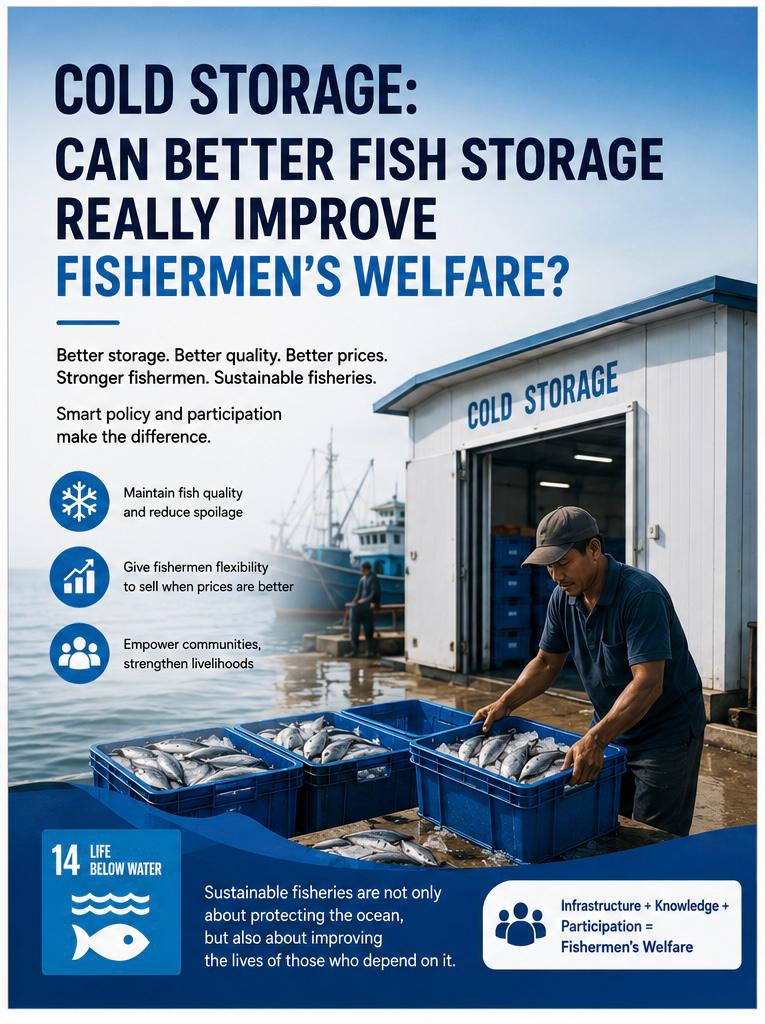
At first glance, cold storage may seem like a simple technological solution: catch the fish, keep it cold, and sell it later. However, its potential impact is much greater. Proper storage can maintain the quality of fish, reduce spoilage, and provide fishermen with greater flexibility in deciding when to sell their catch. This flexibility can be particularly important when fish prices fall during periods of abundant supply.
However, providing infrastructure alone is insufficient. The study found that the implementation of the cold storage policy in South Sulawesi, particularly in Takalar Regency, has not yet reached its full potential. Several obstacles remain, including weak local regulations, limited fishermen’s knowledge and skills, insufficient socialization and technical assistance, and the absence of participatory and sustainable management systems in the fishery.
This leads to an important lesson about public policy: infrastructure is useful only when people can effectively use and manage it. A modern cold-storage facility may have little impact if fishermen do not understand how to operate it, cannot access it easily, or are not involved in decisions regarding its management. Therefore, this study emphasizes institutional strengthening, capacity building, and greater participation by fishermen.
This issue is also closely connected to SDG 14: Life Below Water. Sustainable fisheries are not only about protecting marine ecosystems; they are also about ensuring that communities dependent on marine resources can obtain fair and sustainable livelihoods. Better post-harvest management can reduce losses and improve the economic value of fish without requiring fishermen to increase their catch.
This study highlights a broader challenge. South Sulawesi’s capture fisheries production is substantial, reaching an estimated 511,291 tons in 2024; however, fishermen’s welfare does not necessarily reflect this economic potential. Weak bargaining positions and limited storage facilities can cause a larger share of the value generated by fisheries to remain with intermediaries, rather than producers.
Ultimately, cold storage should not be viewed as a mere refrigerator for fish. It can be used as a tool for economic empowerment. When infrastructure is combined with effective regulation, training, technical assistance, and meaningful participation of fishermen, cold storage has the potential to strengthen bargaining power, reduce post-harvest losses, and create a more equitable fisheries value chain.
Reference DOI: https://doi.org/10.33506/jn.v12i1.5603
Contact:
Dr. Ariana, S.IP., M.Si
+6282192264777
ariana@unhas.ac.id