
MAKASSAR, August 15 2026/ DEPADIS – Why do some candidates succeed in highly competitive elections while others with substantial financial resources and campaign machinery struggle to win elections? The answer may lie in something less visible than money: political capital itself. In local elections, candidates do not compete only through campaign expenditures. They also rely on relationships, social networks, reputation, community support, and the ability to connect with influential people.
These dynamics are explored in the article “Strategi Modal Politik Bourdieu dalam Kemenangan Andi Sumangerukka pada Pilkada Sulawesi Tenggara 2024” (Bourdieu’s Political Capital Strategy in the Victory of Andi Sumangerukka in the 2024 Southeast Sulawesi Local Election). The article was published in Jurnal Noken: Ilmu-Ilmu Sosial, published by the Institute for Research, Publication, and Community Service, Universitas Muhammadiyah Sorong on May 28, 2026. This study uses Pierre Bourdieu’s concept of capital to understand how political resources can be transformed into electoral support.
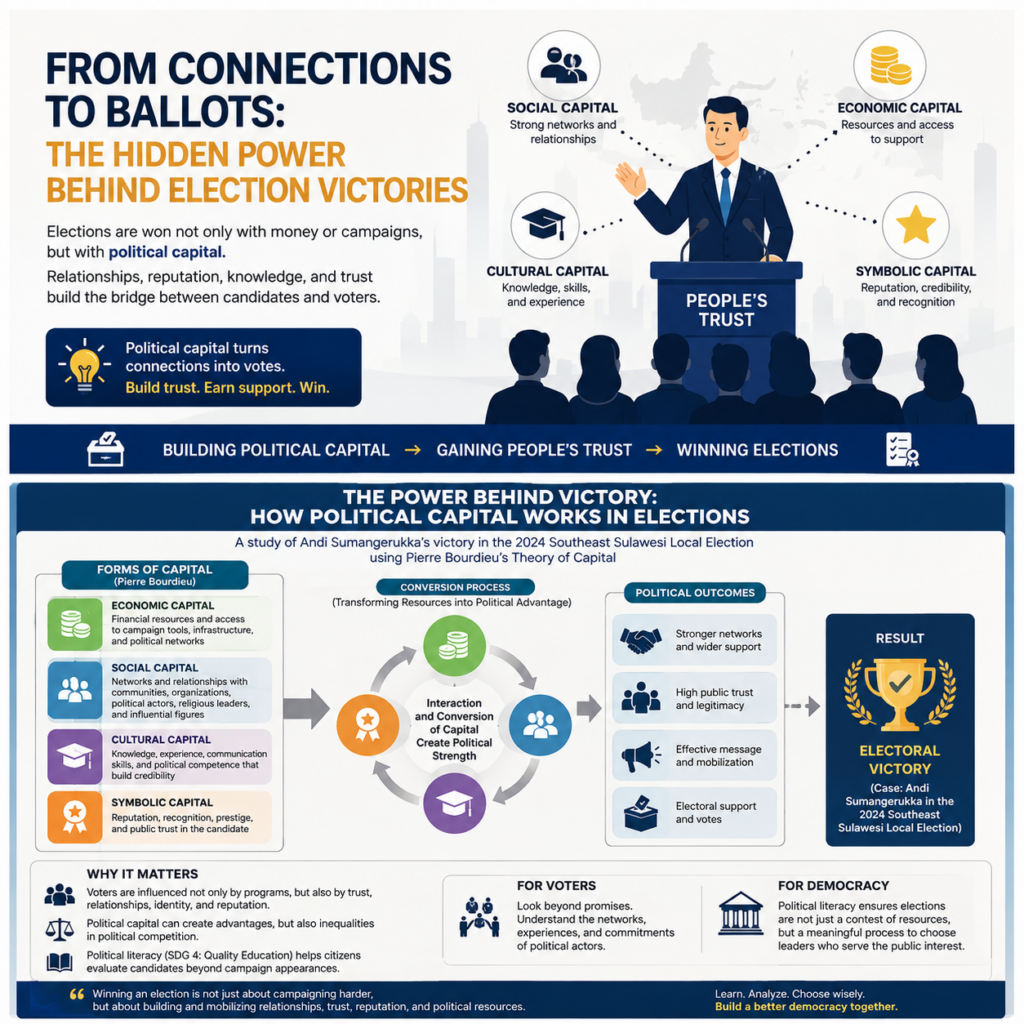
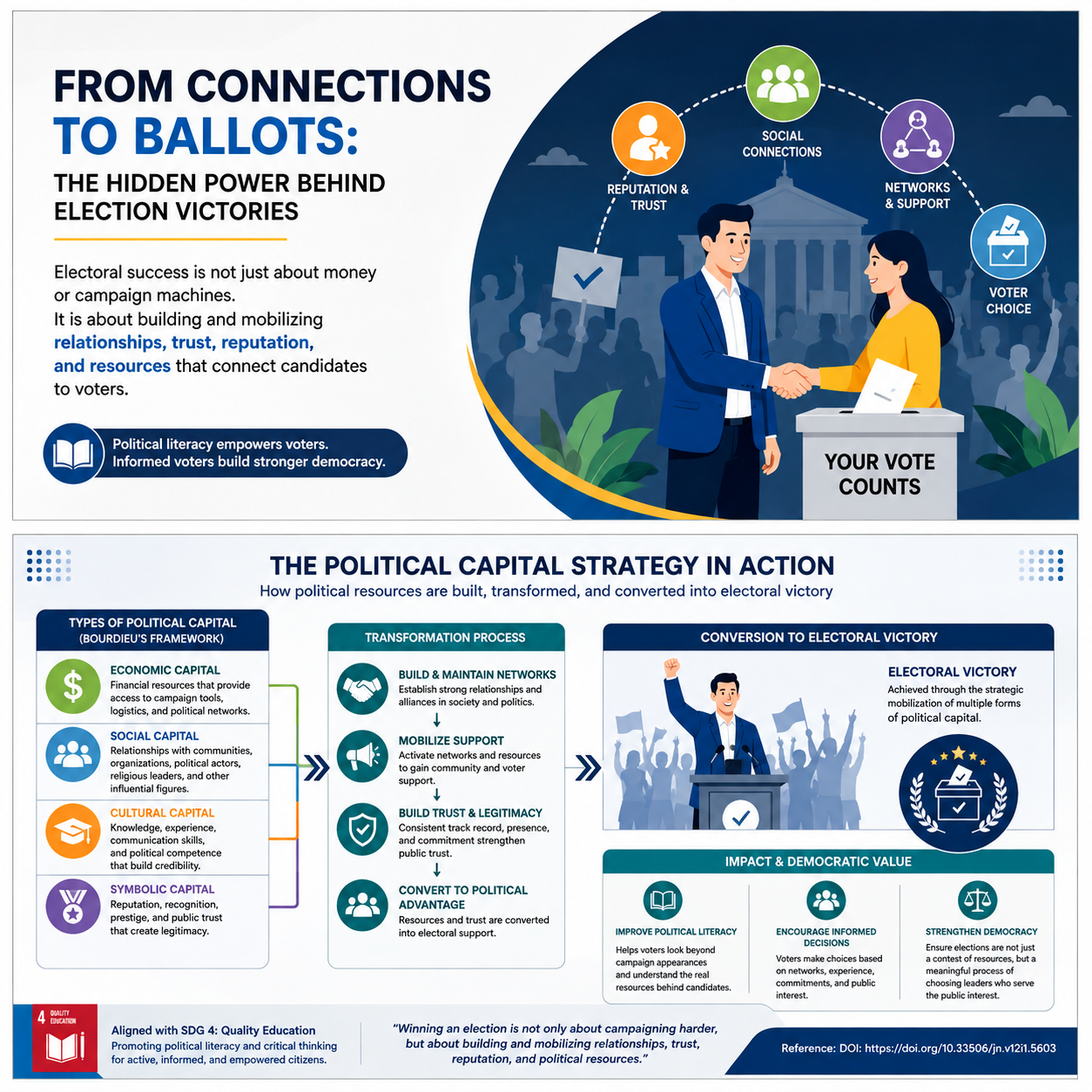
Bourdieu’s framework helps us view politics differently. Political competition is not simply about who has the most money or the most attractive campaign promise. Individuals and candidates possess different forms of capital, including economic, social, cultural, and symbolic. These resources can interact and be converted into political advantage.
Economic capital may provide access to campaign resources and to political networks. Social capital is derived from relationships with communities, organizations, political actors, religious leaders, and other influential figures. Cultural capital involves knowledge, experience, communication skills, and political competence. Meanwhile, symbolic capital is connected to reputation, recognition, prestige, and public trust.
The case of Andi Sumangerukka in the 2024 Southeast Sulawesi local election illustrates how these different resources can become politically valuable to candidates. Rather than viewing electoral victory as the result of a single campaign strategy, this study encourages us to examine the networks and forms of capital that candidates build and mobilize before and during elections.
This perspective is particularly important because voters do not make decisions based solely on formal political programs. Their choices can also be influenced by trust, personal relationships, social identities, perceptions of leadership, and candidates’ reputation. Therefore, political capital can function as a bridge between candidates and voters.
However, political capital also raises an important democratic question: Who has access to political networks and resources? Candidates with strong social connections may have greater opportunities to communicate their messages and mobilize their support. This makes political capital an important factor not only in understanding electoral victories but also in understanding the inequalities in political competition.
This study can be connected to SDG 4: Quality Education, particularly through the importance of political literacy and citizens’ ability to critically evaluate political candidates. Understanding how political capital operates can help voters look beyond campaign appearances and assess the networks, experiences, interests, and public commitments of political actors.
Ultimately, the case of Andi Sumangerukka reminds us that winning an election is not simply about campaigning harder; it is also about building and mobilizing relationships, trust, reputation, and political resources. For voters, understanding these dynamics can encourage more informed political decisions. For democracy, greater political literacy can help ensure that electoral competition is not merely a contest of resources but a meaningful process of choosing leaders who can genuinely represent the public interest.
Reference DOI: https://doi.org/10.33506/jn.v12i1.5603
contact:
Dr. Ariana, S.IP., M.Si
+6282192264777
ariana@unhas.ac.id