
Makassar, August 1 2026/DEPADIS – Waste management is usually discussed as an environmental and public service issue. However, for families living in extreme poverty, even a small waste collection fee can become a burden. This raises a bigger question: Should everyone pay the same fee for public services, regardless of their economic situation? In Makassar, this question has become part of a broader discussion on social justice, poverty, and inclusive public policy.
These issues are examined in the article “The Policy-Making Dialectic of Waste Fee Exemptions for Extremely Poor Communities in Makassar City”. The article was published in the Jurnal Ilmu Sosial dan Ilmu Politik Universitas Jambi by the Department of Social and Political Sciences, Faculty of Law, Universitas Jambi, on April 26, 2026. This study provides an important perspective on how governments can balance public service responsibilities with the needs of economically vulnerable citizens.
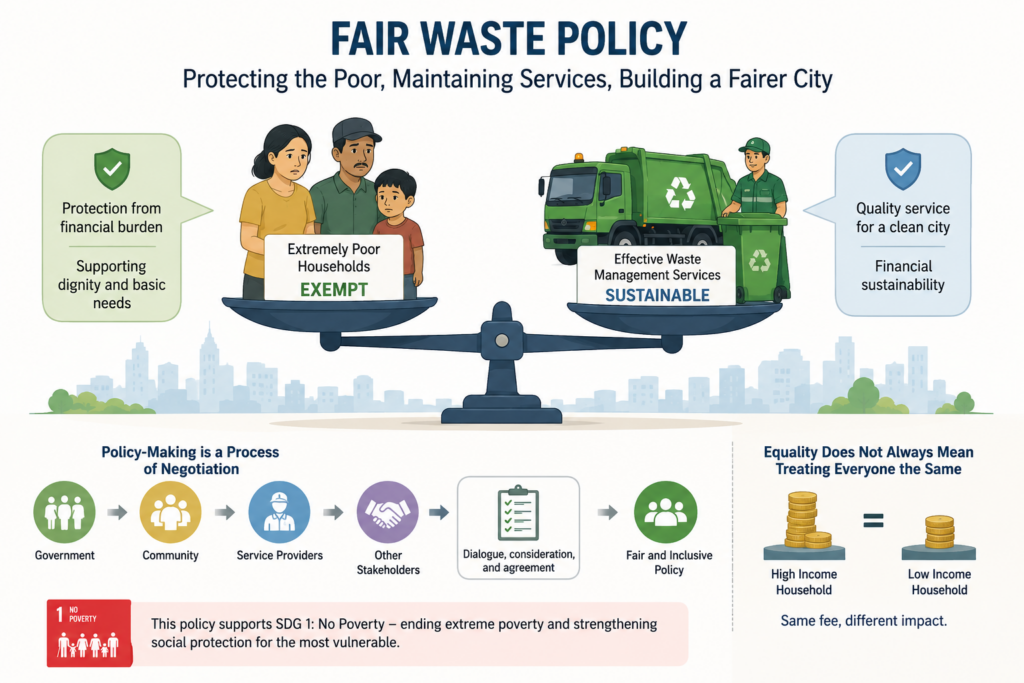
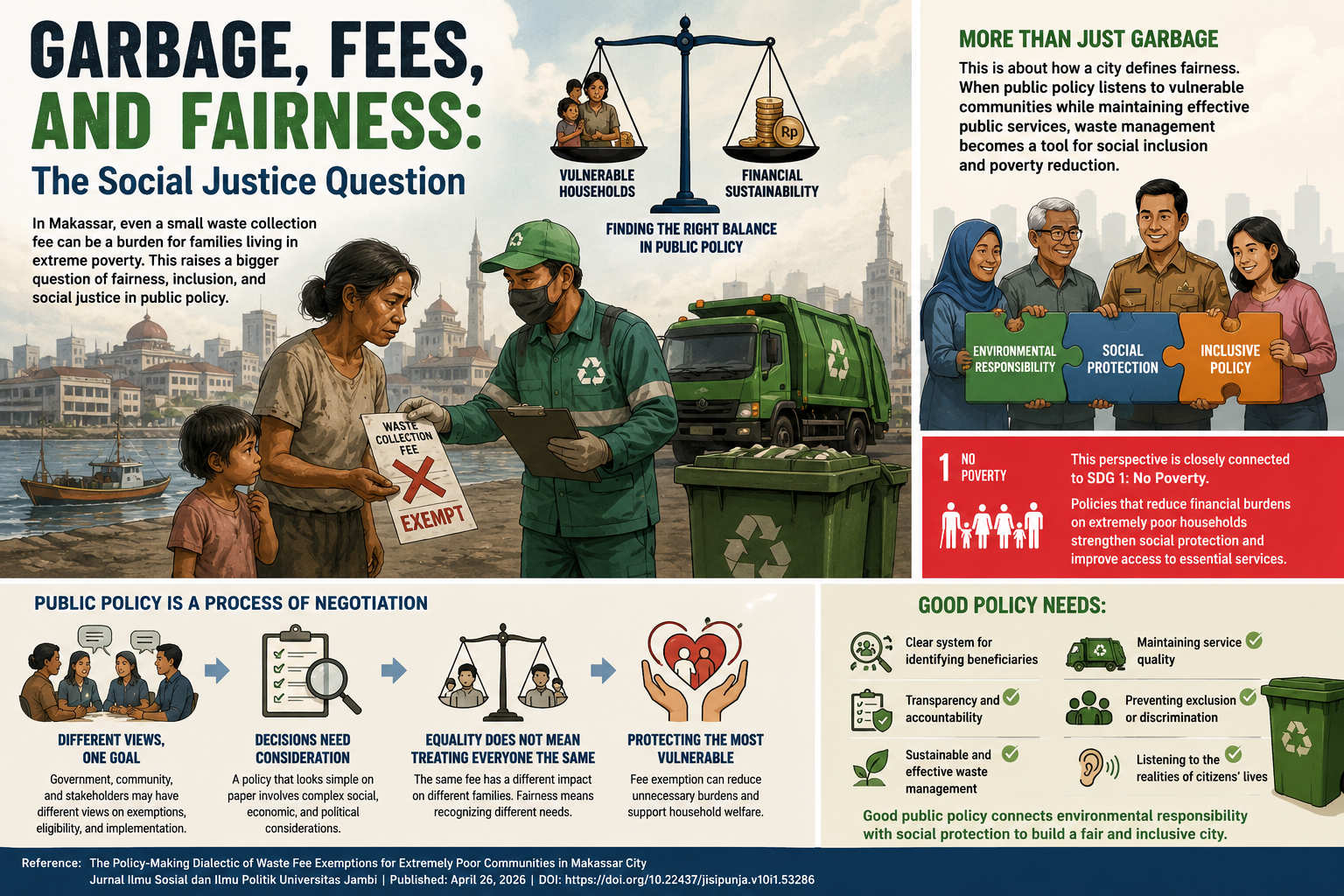
At first glance, exempting extremely poor households from waste collection fees may appear to be a simple administrative decision. In reality, it involves different interests and considerations. The government must maintain waste management services and ensure that the system is financially sustainable. Simultaneously, extremely poor households require protection from additional financial burdens.
Public policy is a process of negotiation. Government officials, communities, and other stakeholders may have different views on who should receive exemptions, how eligibility should be determined, and how the policy should be implemented. A policy that appears simple on paper can involve complex social and political considerations.
This issue also reminds us that equality does not always mean treating everyone identically. If a low-income household and a financially secure household are required to pay the same fee, the impact of that payment may be very different. For vulnerable families, even relatively small expenses can compete with essential needs such as food, education, health care, and housing.
This perspective is closely connected to SDG 1: No Poverty, which aims to eradicate extreme poverty. SDG 1 seeks to end poverty in all its forms and strengthen social protection for vulnerable populations. Policies that reduce unnecessary financial burdens on extremely poor households can become part of a broader strategy to protect household welfare and improve access to essential public services are needed.
However, a fee exemption policy should not be understood simply as giving something away. It should be accompanied by a clear system for identifying beneficiaries, maintaining service quality, ensuring transparency, and preventing exclusion or discrimination from the program. Policies must also consider how waste management can remain effective and sustainable.
The Makassar case offers a broader lesson: good public policy begins with an understanding of the realities of citizens’ lives. Environmental services, poverty reduction, and social protection need not be separate policy agendas. They can be connected through policies that recognize environmental responsibilities and social vulnerabilities.
Ultimately, the debate over waste collection fees is about more than just garbage. This is about how a city defines fairness. When public policy listens to vulnerable communities while maintaining effective public services, waste management can become not only an environmental responsibility but also an instrument of social inclusion and poverty reduction.
Reference DOI: https://doi.org/10.22437/jisipunja.v10i1.53286
Contact:
Prof. Dr.phil. Sukri, M.Si
+628291280594
sukritamma@unhas.ac.id