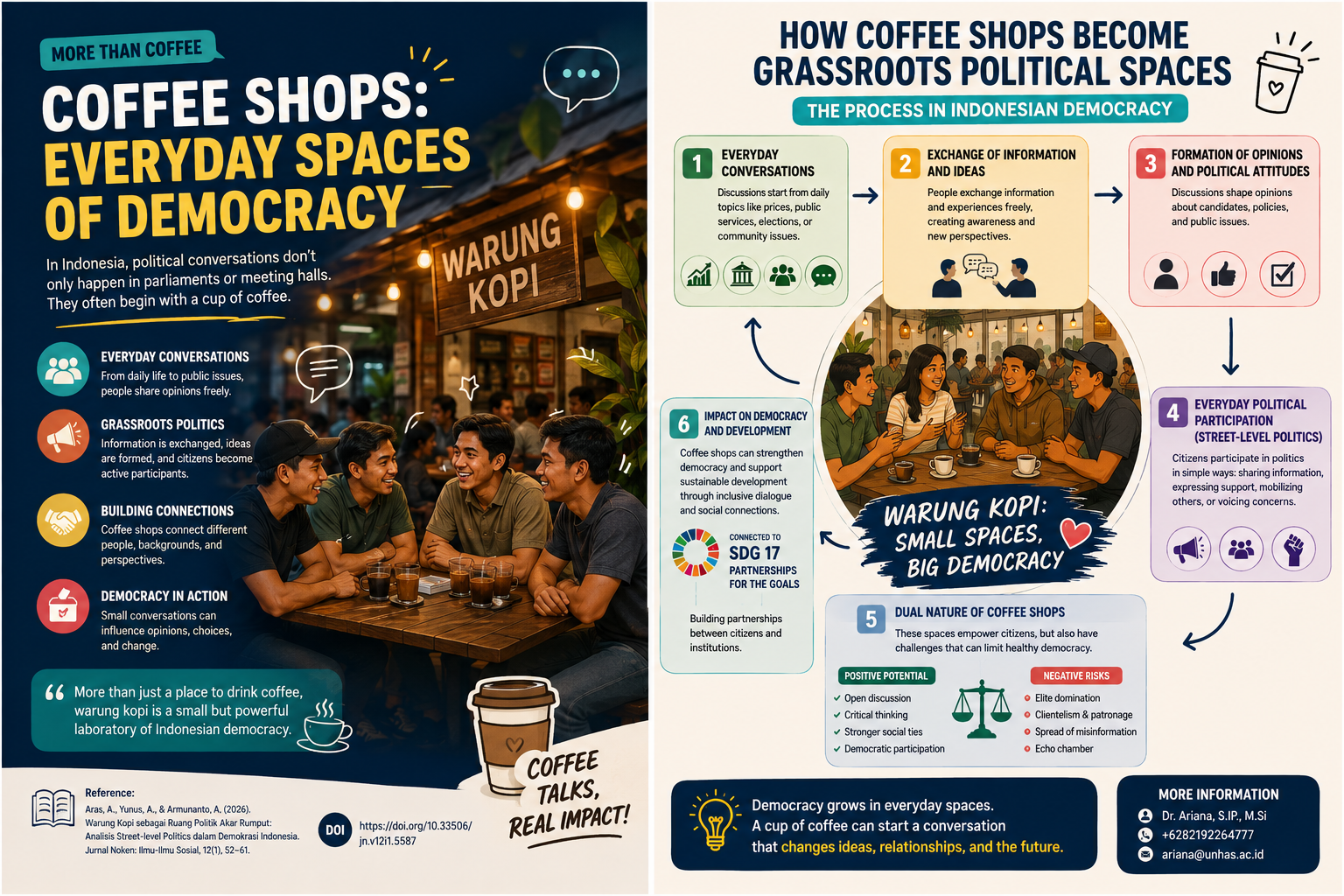

MAKASSAR, August 10 2026 /DEPADIS – In Indonesia, political conversations do not always occur in parliament buildings, campaign offices, or formal public meetings. Sometimes, they begin with a cup of coffee. At a warung kopi (Warkop), people may talk about rising prices, local leaders, elections, public services, or community problems while enjoying an ordinary conversation. These seemingly casual discussions can become an important part of grassroots democracy.
This phenomenon is examined in the article “Warung Kopi sebagai Ruang Politik Akar Rumput: Analisis Street-level Politics dalam Demokrasi Indonesia” (Coffee Shops as Grassroots Political Spaces: An Analysis of Street-level Politics in Indonesian Democracy). The article is written by Arwan Aras, Ariana Yunus, and Ali Armunanto and published in the Jurnal Noken: Ilmu-Ilmu Sosial, by the Institute for Research, Publication, and Community Service (LPPM), Universitas Muhammadiyah Sorong, on 28 May 2026. This article appears in Volume 12, Issue 1, pages 52–61.
This study presents Warkop as an informal political space where people from different backgrounds can meet and exchange ideas. Conversations that begin with everyday matters can gradually develop into discussions about political candidates, public policy, elections, and community concerns. In this sense, Warkop becomes a kind of “everyday public space” where political opinions are formed outside formal political institutions.
This study uses the concept of street-level politics to explain how political participation can emerge from ordinary social activities. People do not necessarily need to attend political meetings or join political parties to become involved in politics. By exchanging information, discussing public issues, and expressing opinions in everyday spaces, citizens can become active political participants.
However, there is another side to this story. Warkop is not always a perfectly equal, democratic space. The study finds that these spaces can also become arenas where local elites build relationships, mobilize support, and maintain patronage and clientelistic networks in the following ways. In other words, the same coffee shop can encourage political discussion while simultaneously reproducing unequal power dynamics.
This contradiction makes Warkop particularly interesting to study. It can function as a space where citizens freely exchange ideas, but it can also become an echo chamber where people mainly hear information that confirms their existing beliefs. Informal political conversations may also allow misinformation to spread because the information is not always verified through reliable sources.
This study is closely connected to SDG 17: Partnerships for the Goals. Democracy and sustainable development depend on communication, collaboration, and relationships between citizens and institutions. Informal spaces such as Warkop provide opportunities for people to build social networks, exchange information, and connect their everyday concerns with broader public issues.
The lesson is simple but powerful: democracy does not only live inside formal institutions. It also grows through everyday conversations between ordinary citizens. A cup of coffee may seem insignificant, but the conversations surrounding it can influence opinions, relationships, political choices, and even local power.
Therefore, Warkop is more than just a place to drink coffee. It can be a small but important laboratory of Indonesian democracy, where political ideas are discussed, support is mobilized, power is negotiated, and citizenship is practiced from the ground up.
Reference DOI: https://doi.org/10.33506/jn.v12i1.5587
Contact:
Dr. Ariana, S.IP., M.Si
+6282192264777
ariana@unhas.ac.i