

MAKASSAR, Indonesia – Apr 1 2026/DSAI/ — In today’s financial world, making the right lending decision is critical. Banks and financial institutions must carefully assess whether a borrower is likely to repay a loan—or default. A recent study introduces a powerful artificial intelligence (AI) approach that significantly improves the accuracy of credit scoring, helping institutions make smarter and safer decisions.
The research explores how ensemble learning, combined with traditional statistical methods, can enhance credit risk prediction. Specifically, it proposes an advanced model called Ensemble Logistic Regression with Gradient Boosting, designed to outperform conventional techniques in identifying good and bad borrowers .

Credit scoring itself is a classification problem. It analyzes historical borrower data—such as financial status, demographics, and behavior—to determine whether a loan applicant is trustworthy. Traditionally, logistic regression has been widely used due to its simplicity and interpretability. However, it struggles when dealing with complex, nonlinear relationships in real-world data.
To overcome this limitation, the study introduces an ensemble approach. Instead of relying on a single model, ensemble learning combines multiple models to improve prediction performance. Among these techniques, boosting stands out because it focuses on correcting previous mistakes—giving more attention to data points that were misclassified.
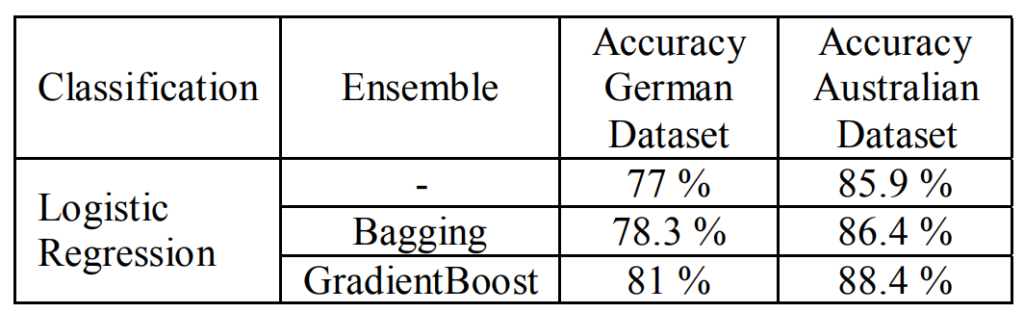
The researchers tested their model using two well-known datasets: the German Credit Dataset and the Australian Credit Dataset. The results are impressive. According to the results table on page 3, the proposed Gradient Boosting ensemble achieved 81% accuracy on the German dataset and 88.4% accuracy on the Australian dataset—outperforming both single logistic regression and bagging methods .
This improvement may seem small at first glance, but in financial systems, even a few percentage points can translate into millions in reduced risk and better loan decisions.
Why does this method work so well? The answer lies in how boosting learns. Instead of treating all data equally, it continuously adjusts the model by focusing on errors. Over time, the system becomes better at identifying risky borrowers, leading to more reliable predictions.
This research contributes to several Sustainable Development Goals (SDGs). It supports SDG 8: Decent Work and Economic Growth by strengthening financial systems and enabling responsible lending. It also aligns with SDG 9: Industry, Innovation, and Infrastructure, as it promotes the adoption of AI in financial technology. Additionally, it contributes to SDG 1: No Poverty, since better credit assessment can expand fair access to financial services while reducing harmful debt risks.
Ultimately, this study highlights an important shift in financial analytics: moving from simple models to intelligent, adaptive systems. By combining statistical methods with modern AI techniques, financial institutions can make more accurate, fair, and data-driven decisions.
Article Metadata (Source of This Popular Scientific Writing):
Title: Ensemble GradientBoost for Increasing Classification Accuracy of Credit Scoring
Conference: 2017 International Conference on Advanced Informatics: Concepts, Theory and Applications (ICAICTA)
Publisher: IEEE
Publication Year: 2017
Publication Date: 10 August 2017
DOI: https://doi.org/10.1109/ICAICTA.2017.8320700
Authors & Contact:
Armin Lawi*, Firman Aziz, Syafruddin Syarif
Universitas Hasanuddin, Makassar, Indonesia
E-mail: armin@unhas.ac.id
In a world where financial decisions shape lives, smarter algorithms don’t just improve accuracy—they build trust.