


Description
What if a cave could tell the story of human life for hundreds of thousands of years?
Deep inside the limestone landscape of Maros-Pangkep, South Sulawesi, Leang Bulu Bettue offers something remarkably close to that. Beneath its surface lies a layered archaeological record that preserves evidence of human activity from the Pleistocene to the much more recent past.
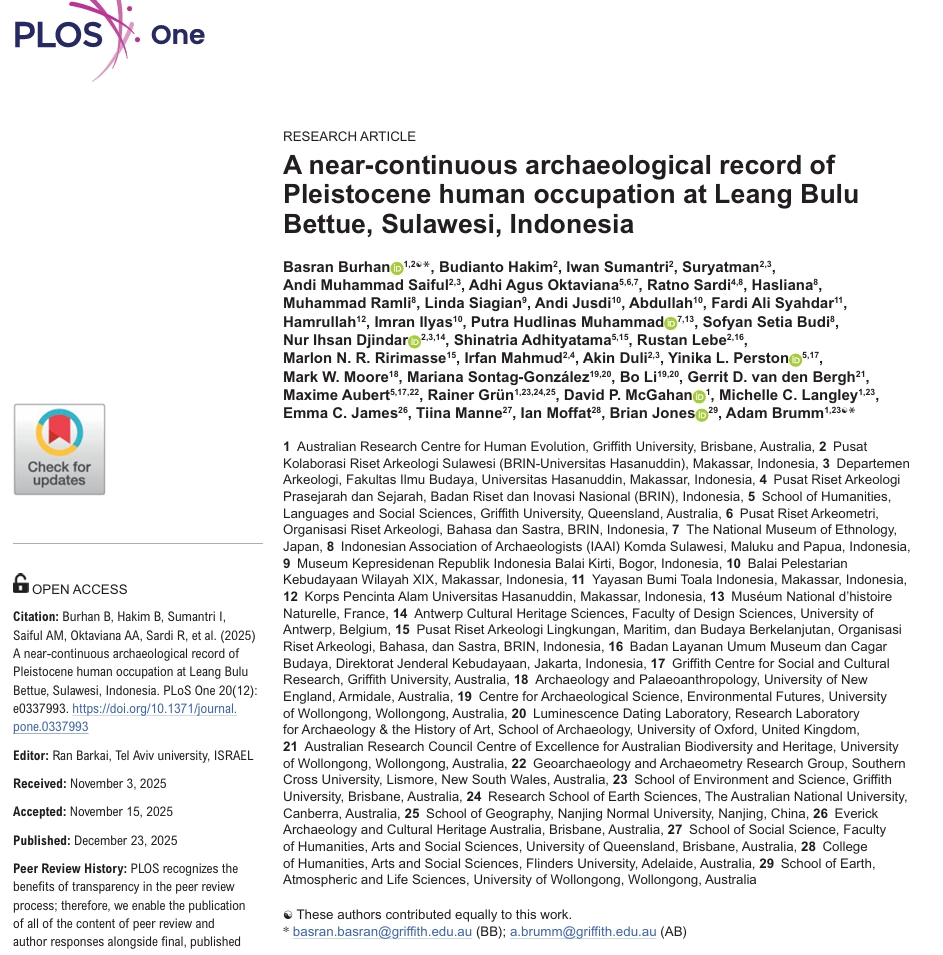
A major international research team has now documented this extraordinary record in the study “A near-continuous archaeological record of Pleistocene human occupation at Leang Bulu Bettue, Sulawesi, Indonesia.” Led by Basran Burhan and Adam Brumm, with researchers including Budianto Hakim, Iwan Sumantri, Suryatman, and many other Indonesian and international scholars, the study brings together years of excavation and scientific analysis.
The researchers conducted multiple seasons of deep-trench excavation at the limestone cave and rock-shelter complex. Since investigations began in 2013, they have uncovered stratified deposits reaching approximately 8 metres below the present surface. The site is currently the only known location on Sulawesi with an archaeological sequence extending from the Middle and Late Pleistocene through to the Late Holocene.
The deepest layers offer a glimpse into a very different Sulawesi.
Evidence of animal butchery and stone-tool production, including a distinctive stone “pick,” dates to approximately 132,300–208,400 years ago. These findings indicate that humans—or earlier human relatives—were already using this landscape long before the emergence of the cultural world associated with later Homo sapiens.
Then, around 40,000 years ago, the archaeological record changes dramatically.
An earlier occupation phase, characterised by relatively simple cobble-based stone technology and animal remains dominated by dwarf bovids such as anoas, was replaced by a very different archaeological signature. The researchers identify this later phase as the first evidence at the site for artistic expression and symbolic culture.
This transition raises a much bigger question: who were the people responsible for these changes?
The researchers suggest that the sharp behavioural difference may reflect the replacement of archaic hominins by modern humans. However, they present this as a possibility rather than a definitive conclusion. The archaeological record provides an important new framework for investigating when different human populations arrived, lived, changed, and perhaps disappeared from Sulawesi.
What makes Leang Bulu Bettue especially significant is therefore not a single artefact. It is the continuity of the archaeological record itself.
Layer by layer, the cave preserves traces of changing technologies, environments, animals, and human behaviour. Together, these traces transform a limestone shelter into a long-term archive of human occupation in Wallacea.
The discovery also highlights why protecting archaeological landscapes matters. The Maros-Pangkep karst is not simply a spectacular natural environment. Its caves contain irreplaceable evidence about the deep history of human life in Southeast Asia.
This makes the research relevant to Sustainable Development Goal 15 (SDG 15): Life on Land, particularly the protection of terrestrial ecosystems and natural heritage. Conserving karst landscapes can simultaneously protect biodiversity, geological formations, and archaeological evidence that cannot be recreated once lost.
Leang Bulu Bettue reminds us that Sulawesi's human story did not begin with written history. It reaches deep into the Pleistocene—preserved quietly in layers of sediment, stone, bone, and the traces of human activity.
Sometimes, the oldest stories are not written in books. They are written in the ground.
Article Information
Article Title: A near-continuous archaeological record of Pleistocene human occupation at Leang Bulu Bettue, Sulawesi, Indonesia
Authors: Basran Burhan, Budianto Hakim, Iwan Sumantri, Suryatman, Andi Muhammad Saiful, Adhi Agus Oktaviana, Ratno Sardi, Hasliana, Muhammad Ramli, Linda Siagian, Andi Jusdi, Abdullah, Fardi Ali Syahdar, Hamrullah, Imran Ilyas, Putra Hudlinas Muhammad, Sofyan Setia Budi, Nur Ihsan Djindar, Shinatria Adhityatama, Rustan Lebe, Marlon N. R. Ririmasse, Irfan Mahmud, Akin Duli, Yinika L. Perston, Mark W. Moore, Mariana Sontag-González, Bo Li, Gerrit D. van den Bergh, Maxime Aubert, Rainer Grün, David P. McGahan, Michelle C. Langley, Emma C. James, Tiina Manne, Ian Moffat, Brian Jones, and Adam Brumm
Journal: PLOS ONE
Publisher: Public Library of Science (PLOS)
Publication Date: 23 December 2025
Volume: 20
Issue: 12
Article Number: e0337993
DOI: 10.1371/journal.pone.0337993
Access: Open Access, CC BY 4.0
Description
Archaeology is often imagined as a discipline of ancient objects, excavation sites, and discoveries buried beneath the ground. But behind every excavation is another essential tool: language.
When archaeologists from different countries work together, even simple field instructions can become surprisingly complicated. A technical term that is familiar to an Indonesian archaeologist may not immediately carry the same meaning for an international researcher. The problem becomes even more important when research findings must later be communicated through international publications.
A new article highlights a simple but practical way to address this challenge: creating a shared vocabulary between English and Indonesian for archaeological research.
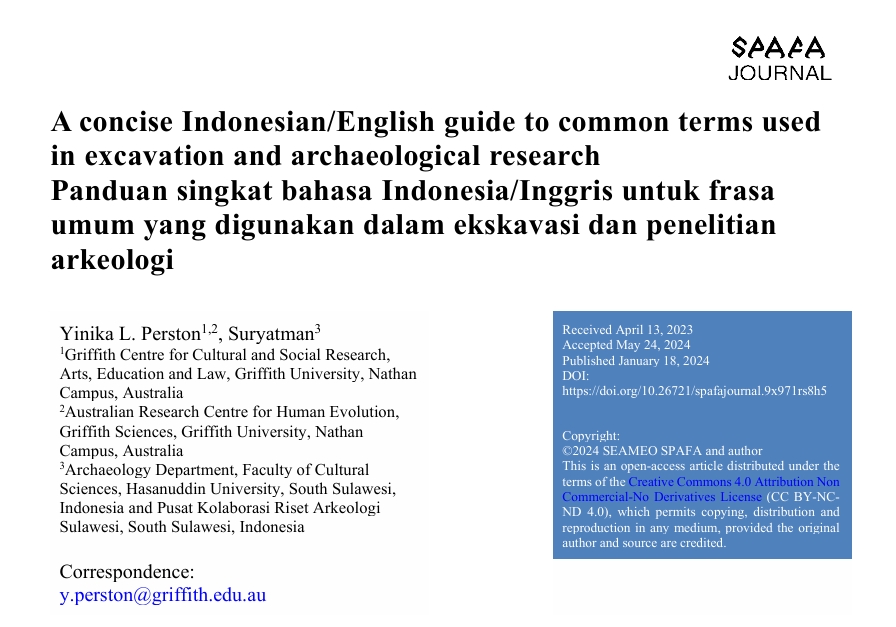
The article, titled “A Concise Indonesian/English Guide to Common Terms Used in Excavation and Archaeological Research,” was written by Yinika L. Perston and Suryatman. The authors recognize that international collaboration has played an important role in Indonesian archaeology for more than a century. As archaeological research becomes increasingly collaborative, clear communication between researchers becomes essential.
Rather than presenting a complicated theoretical discussion, the article provides a basic list of translations for commonly used archaeological terms in English and Indonesian. These languages are currently among the most frequently used for archaeological research, fieldwork, and academic publications involving Indonesian archaeology.
Why does such a list matter?
Imagine a team preparing an excavation. Researchers need to describe soil layers, record archaeological contexts, identify finds, document features, and communicate observations. If members of the team use different terms for the same archaeological concept—or interpret the same term differently—small misunderstandings can affect field documentation and communication.
A shared vocabulary can therefore function as more than a translation tool. It can become a bridge between researchers, students, field teams, and institutions.
The need is particularly relevant for the next generation of archaeologists. Students entering archaeological fieldwork may encounter English terminology in international literature while using Indonesian terminology in classrooms, reports, and local research settings. Understanding the relationship between the two can make it easier to move between national and international research environments.
The article also reminds us that language is part of the infrastructure of science. Archaeological discoveries may attract public attention, but reliable research depends on something much less visible: researchers being able to communicate accurately with one another.
This perspective can be connected to Sustainable Development Goal 4 (SDG 4): Quality Education. Building accessible bilingual resources can support students and researchers in developing the knowledge and communication skills needed to participate in archaeological research across linguistic and national boundaries.
Ultimately, preserving archaeological knowledge is not only about protecting artifacts and excavation sites. It is also about ensuring that researchers can share, understand, document, and transmit that knowledge.
Sometimes, strengthening archaeology does not require a new excavation or a sophisticated piece of technology. Sometimes, it begins with something much simpler: making sure everyone on the research team understands the same words.
Article Information
Article Title: A Concise Indonesian/English Guide to Common Terms Used in Excavation and Archaeological Research
Authors: Yinika L. Perston and Suryatman
Journal: SPAFA Journal
Publisher: SEAMEO SPAFA
Publication Date: 18 January 2024
DOI: 10.26721/spafajournal.9x971rs8h5
Copyright: ©2024 SEAMEO SPAFA and the authors
Access: Open Access under the CC BY-NC-ND 4.0 license
Description
A forest is more than trees. For Indigenous communities, it can also be a living archive—holding knowledge about soil, plants, seasons, farming, and the gradual return of vegetation after a field has been cultivated. Sometimes, that knowledge is preserved not in written records, but in the words people use to describe the landscape around them.
A study of the Dayak Tunjung community in East Kalimantan, Indonesia, shows why those words matter.
The research, “Signifying the End of Swidden? An Analysis of Vocabulary of the Fallow Stage Among a Kalimantan Indigenous Group, Indonesia,” examines the vocabulary used to describe different stages of fallow land in traditional swidden agriculture. Conducted by Syamsul Rijal, Muhammad Hasyim, Lukman Lukman, and Ery Iswary, the study explores how language reflects changes in both ecological knowledge and the relationship between communities and their environment.
The researchers conducted 16 semi-structured interviews and participant observation in Linggang Melapeh Village. Participants were selected across generations and occupations, allowing the researchers to compare how ecological vocabulary is remembered and used by different groups.
The findings reveal an important generational difference.
Older members of the Dayak Tunjung community still retain a detailed vocabulary associated with ecological succession and customary land management. These terms distinguish stages of fallow land and reflect observations accumulated through generations of interaction with the forest.
Among younger generations, however, familiarity with some of these traditional terms is declining. At the same time, traditional agricultural cycles are changing, with increasingly shorter fallow periods.
This is more than a change in vocabulary.
The researchers describe the pattern as biocultural erosion—a process in which the loss of linguistic knowledge occurs alongside changes in ecological relationships and cultural practices. Land commodification and shifting livelihood strategies are among the pressures contributing to these transformations.
The study offers an important reminder: when a word disappears, the knowledge behind that word may disappear with it.
For this reason, protecting Indigenous languages is not only a matter of preserving cultural identity. It can also help safeguard ecological knowledge that has developed through long-term relationships with particular landscapes.
The researchers call for efforts to revitalize Indigenous ecological narratives while strengthening Indigenous governance in conservation. They recommend approaches including education, participatory mapping, and culturally grounded policies that recognize local knowledge rather than treating conservation as something designed entirely from outside the community.
This makes the research especially relevant to Sustainable Development Goal (SDG) 15: Life on Land, which promotes the protection and sustainable use of terrestrial ecosystems. Indigenous ecological knowledge can contribute to this goal by offering locally grounded ways of understanding forests, land regeneration, and sustainable resource use.
Ultimately, the Dayak Tunjung case shows that environmental change can sometimes be heard before it is seen. It may appear in the disappearance of a word, the shortening of a farming cycle, or the fading memory of how a forest regenerates.
Protecting the forest, therefore, may also mean protecting the language that teaches people how to understand it.
Article Information
Article Title: Signifying the End of Swidden? An Analysis of Vocabulary of the Fallow Stage Among a Kalimantan Indigenous Group, Indonesia
Authors: Syamsul Rijal, Muhammad Hasyim, Lukman Lukman, and Ery Iswary
Journal: Forest and Society
Publisher: Hasanuddin University
Publication Date: 17 September 2025
Volume: 9
Issue: 2
Pages: 604–622
DOI: 10.24259/fs.v9i2.43632
Scopus EID: 2-s2.0-105027964454