


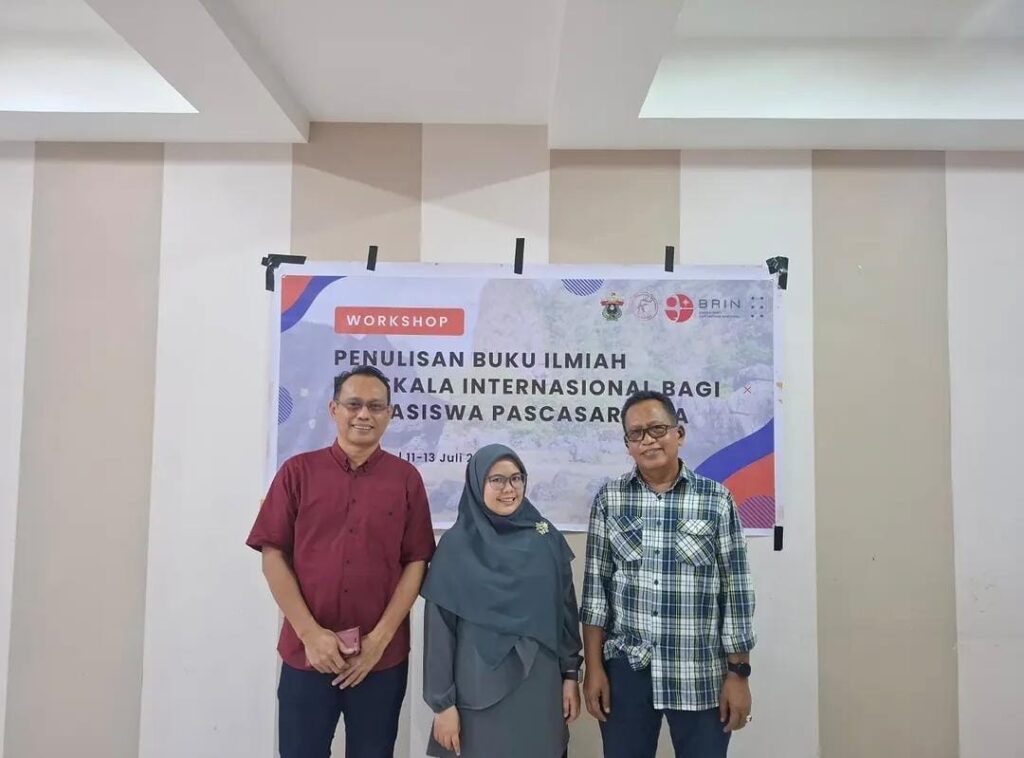
Strengthening academic writing capacity is essential for postgraduate students who seek to communicate research findings effectively and contribute to international scholarly discussions. In this context, an International Scientific Writing Workshop was held on July 11–12, 2025, at the Research and Community Service Institute (LPPM), Universitas Hasanuddin, Makassar, Indonesia. The workshop provided a collaborative academic environment for postgraduate students to develop their scientific writing skills and gain a deeper understanding of the standards and practices required for producing high-quality scholarly publications.
The main objective of the workshop was to strengthen participants’ capacity to transform research ideas into well-structured academic manuscripts. The participants, consisting of postgraduate students, were introduced to the scientific writing process from the early stages of developing a research idea to preparing a manuscript for publication. The sessions emphasized how to formulate clear research questions and objectives, organize a manuscript systematically, and develop a logical flow of arguments that allows readers to understand the significance of a study.
A key focus of the workshop was the development of evidence-based academic arguments. Participants learned how to identify and use relevant scholarly literature to support their arguments and position their research within existing academic debates. The workshop also highlighted the importance of integrating references critically rather than simply adding citations, enabling researchers to demonstrate how their work relates to previous studies and where their research offers new perspectives or contributions.
The two-day workshop also addressed strategies for preparing manuscripts for international journals and academic forums. Participants gained insights into academic publication standards, manuscript preparation, and approaches for presenting research contributions clearly to an international audience. Discussions on scholarly publishing helped participants better understand the expectations of academic journals and the importance of maintaining clarity, coherence, originality, and academic integrity throughout the writing and publication process.
Beyond technical writing skills, the workshop provided an opportunity for academic exchange and professional networking. Participants interacted with academics, researchers, and fellow postgraduate students from diverse backgrounds, allowing them to exchange experiences and perspectives on research and publication. Such interactions encouraged participants to view scientific writing not only as an individual academic requirement but also as a means of participating in broader knowledge networks and developing future research collaborations.
The activity contributes directly to Sustainable Development Goal (SDG) 4: Quality Education by strengthening advanced learning opportunities and research competencies among postgraduate students. Improving scientific writing capacity can support the development of highly skilled researchers who are better prepared to contribute to academic, professional, and societal knowledge.
The workshop also supports SDG 17: Partnerships for the Goals by fostering academic interaction, knowledge exchange, and professional networks among researchers and postgraduate students. These connections can provide a foundation for future collaborative research, joint publications, and international academic partnerships.
Overall, the International Scientific Writing Workshop at LPPM Universitas Hasanuddin served as a valuable platform for strengthening postgraduate research capacity. By combining practical scientific writing training with academic exchange and publication-oriented learning, the activity contributed to the development of researchers who are better equipped to communicate their knowledge and participate in the international scholarly community.