


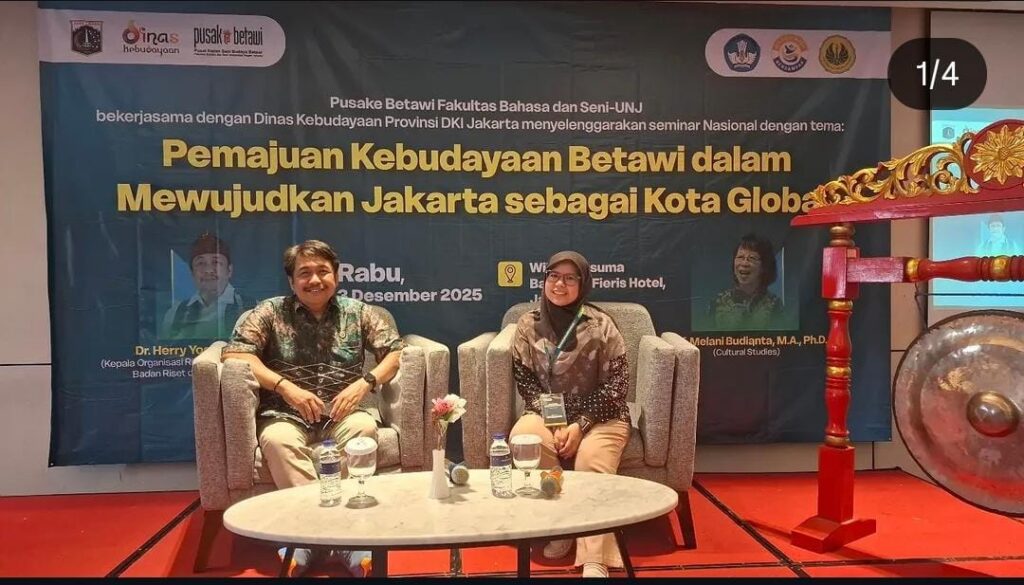
On Wednesday, December 10, 2025, the National Seminar entitled “Advancing Betawi Culture in Realizing Jakarta as a Global City” was held at Hotel Fioris, East Jakarta. Organized by Pusake Betawi, Faculty of Languages and Arts, Universitas Negeri Jakarta (UNJ), in collaboration with the Jakarta Provincial Department of Culture, the seminar brought together more than 100 participants from academic, governmental, cultural, and community backgrounds. The event served as a forum for exchanging ideas on the role of Betawi culture in strengthening Jakarta’s identity as the city continues to develop within an increasingly global and interconnected environment.
The seminar highlighted the importance of maintaining Betawi culture amid rapid urbanization, modernization, technological development, changing lifestyles, and global cultural influences. As the indigenous culture of Jakarta, Betawi culture represents an important part of the city’s historical and social identity. Therefore, cultural advancement needs to go beyond simply preserving traditional practices. It should also create opportunities for Betawi culture to adapt, innovate, and remain meaningful to contemporary society while maintaining its distinctive values and identity.
During the discussions, participants explored various aspects of Betawi cultural heritage, including language, traditional arts, performing arts, culinary traditions, clothing, architecture, and community practices. These cultural elements have considerable potential to strengthen Jakarta’s character and distinguish the city from other global urban centers. Cultural identity can therefore become an important asset in developing a global city that remains connected to its local roots.
The seminar also emphasized the role of education in sustaining cultural heritage. This perspective supports Sustainable Development Goal (SDG) 4: Quality Education, particularly by strengthening knowledge, awareness, and appreciation of local cultural heritage through academic and public engagement. Universities and educational institutions can contribute through research, cultural documentation, learning activities, and knowledge exchange that connect younger generations with their cultural heritage.
At the same time, the advancement of Betawi culture can contribute to SDG 1: No Poverty by creating opportunities for cultural practitioners, creative communities, artists, and local entrepreneurs to participate in cultural and creative activities. Cultural development can support livelihoods when heritage is responsibly connected with creative industries, community-based initiatives, and sustainable economic opportunities.
The seminar further demonstrated the importance of cooperation among government institutions, universities, cultural organizations, artists, communities, and younger generations. Such collaboration reflects SDG 17: Partnerships for the Goals, emphasizing that sustainable cultural development requires collective action and partnerships across sectors.
Ultimately, the seminar reinforced the idea that becoming a global city does not require Jakarta to abandon its local identity. Instead, a strong and living cultural heritage can serve as a foundation for building a distinctive, inclusive, and culturally rooted global city. Through education, collaboration, innovation, and active community participation, Betawi culture can continue to thrive and contribute meaningfully to Jakarta’s present and future.