
MAKASSAR, Indonesia /CORN-RG/– Farmers know that a maize variety that performs well in one location may not always perform equally well somewhere else. Differences in soil, rainfall, temperature, altitude, and other environmental conditions can significantly affect crop productivity. This creates an important challenge for plant breeders: how can we identify maize hybrids that combine high yields with stable performance across different growing environments?
A 2025 study by Muhammad Azrai and colleagues provides important insights into this challenge. Published in Open Agriculture, the study entitled “Stability and Adaptability Analyses to Identify Suitable High-Yielding Maize Hybrids Using PBSTAT-GE” evaluated promising maize hybrids across diverse environments in Indonesia.
The researchers evaluated eight candidate maize hybrids together with two commercial check varieties across eight locations in Indonesia during 2023. The testing environments represented remarkably different growing conditions, ranging from lowlands at only 31 meters above sea level to highlands reaching 997 meters above sea level.
Why test the same hybrids in so many different places?
Because yield alone does not tell the whole story. A hybrid may produce exceptionally high yields in one environment but perform poorly when conditions change. For farmers, breeders, and the seed industry, a valuable hybrid needs either stable performance across a broad range of environments or strong adaptation to a specific target environment.
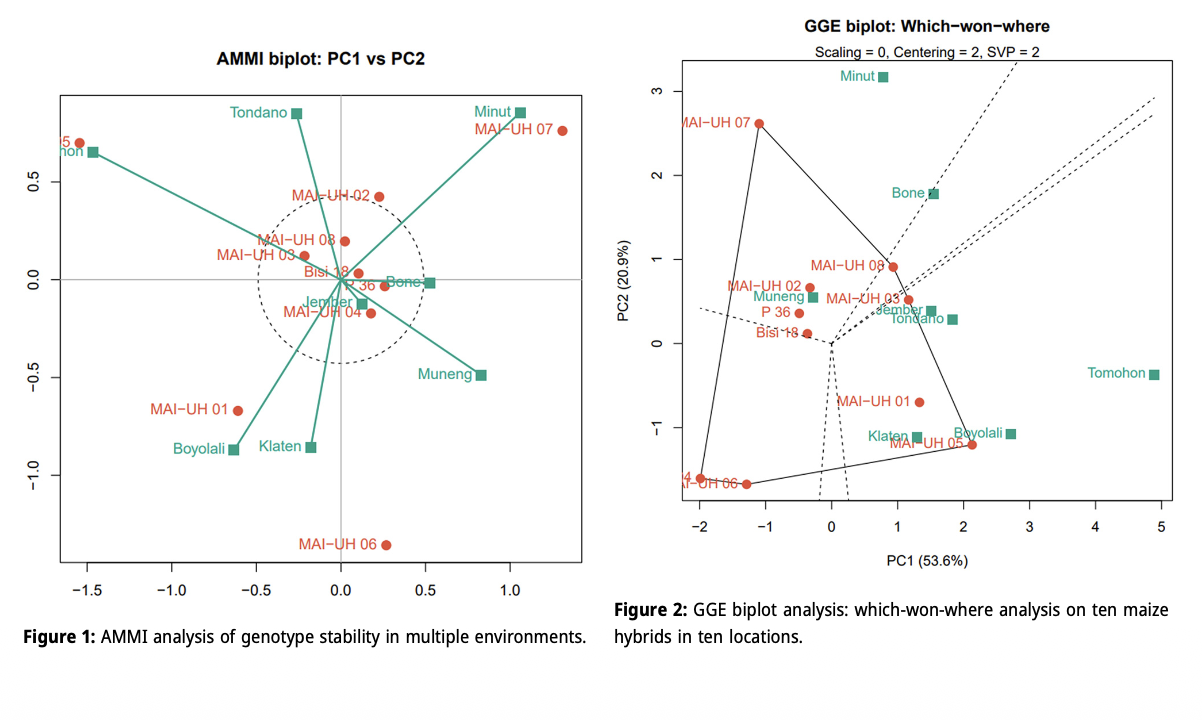
To investigate this, the researchers used PBSTAT-GE, a web-based statistical platform for analyzing genotype-by-environment interactions. Rather than simply asking which hybrid produced the highest yield, the analysis addressed two critical questions: Which hybrids remain stable across environments, and which hybrids are particularly well adapted to specific locations?
The results demonstrated substantial variation among testing environments. The overall average maize productivity reached 10.55 tonnes per hectare. Among the test locations, Klaten recorded the highest average productivity at 12.75 tonnes per hectare, while Bone recorded the lowest at 9.01 tonnes per hectare.
These differences demonstrate precisely why multi-environment testing is essential. The performance of a maize genotype is shaped not only by its genetic potential but also by how that genetic potential interacts with the environment in which it is grown.
Most importantly, MAI-UH 08 and MAI-UH 03 emerged as promising hybrids, combining high productivity with favorable stability and adaptability across the evaluated environments. Based on these characteristics, the researchers recommended both hybrids for further variety-release procedures.
Other hybrids demonstrated more specific adaptation. MAI-UH 01, MAI-UH 02, and MAI-UH 05 showed potential for particular environments, including locations such as Tomohon and Boyolali. These findings highlight another important principle of modern plant breeding: not every successful variety needs to perform identically everywhere. Some genotypes may be particularly valuable when matched with the environments where they perform best.
The research contributes to the broader goals of sustainable agriculture and responsible land use. It is particularly relevant to Sustainable Development Goal 2 (SDG 2): Zero Hunger, through efforts to develop productive and resilient crop varieties, and SDG 15: Life on Land, by supporting more efficient and environmentally appropriate use of agricultural land.
Identifying maize hybrids that are well matched to their growing environments can help farmers make better use of existing agricultural land while reducing the uncertainty associated with deploying varieties under unsuitable conditions. For Indonesia, where maize is cultivated across highly diverse agroecological environments, this information is particularly valuable.
The study carries a simple but powerful message:
The best maize seed is not merely the one that produces the highest yield—it is the one that delivers the right performance in the right environment.
Through multi-environment testing and analytical tools such as PBSTAT-GE, maize breeding can move beyond selecting for yield alone toward identifying hybrids that combine productivity, stability, and environmental adaptability.
For the Corn Research Group at Hasanuddin University, this research represents an important step toward developing maize varieties that are scientifically selected not only for their yield potential, but also for their ability to perform under the diverse growing environments encountered by Indonesian farmers.
Reference
Azrai, M. et al. (2025). Stability and Adaptability Analyses to Identify Suitable High-Yielding Maize Hybrids Using PBSTAT-GE. Open Agriculture, 10(1), 20250447. De Gruyter.
Contact:
Prof. Dr. Muhammad Azrai
Faculty of Agriculture, Hasanuddin University
azrai@agri.unhas.ac.id