
MAKASSAR, Indonesia /CORN-RG/– Maize is more than an important crop. It supports food systems, livestock production, and agricultural industries, while providing livelihoods for millions of farming households. Yet maize production is highly dependent on water availability, making drought one of the major challenges to maintaining stable yields.
As climate variability increases the risk of water shortages during critical stages of crop growth, plant breeders face an increasingly important question:
Can we develop maize hybrids that maintain high and stable yields even when water becomes limited?
A 2026 study entitled “Yield Stability in Maize (Zea mays L.) Using GGE Biplot and Selection Indices Under Irrigated and Drought-Stress Conditions” provides important insights into this challenge. Published in the SABRAO Journal of Breeding and Genetics, the research evaluated the performance and stability of maize hybrids under contrasting water conditions.
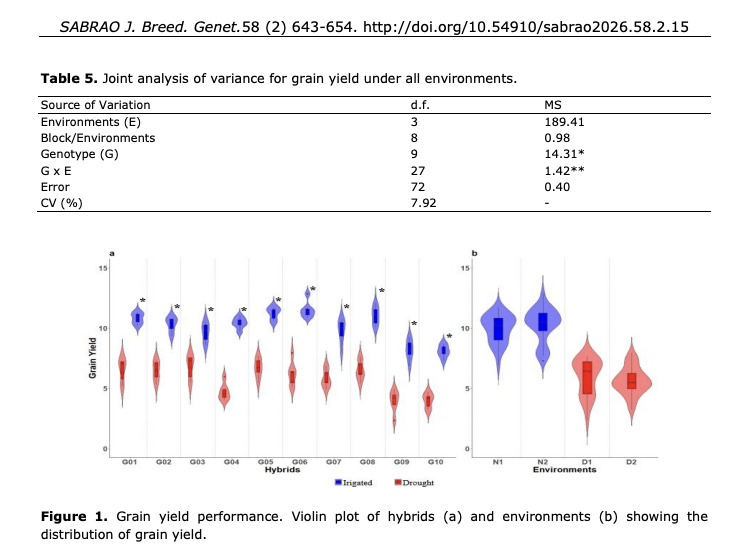
The researchers tested eight experimental maize hybrids and two commercial varieties across four environments in Indonesia. Two environments represented irrigated conditions, while the other two exposed the plants to drought stress.
This experimental design allowed the researchers to look beyond a simple question of which hybrid produced the highest yield. Instead, they could ask something more important for future maize production:
Which hybrids can remain productive and reliable when water availability changes?
The impact of drought was substantial. Across the evaluated environments, average grain yield under drought stress was 42.4% lower than under irrigated conditions. This sharp decline illustrates how strongly water limitation can affect maize productivity.
However, the hybrids did not respond equally.
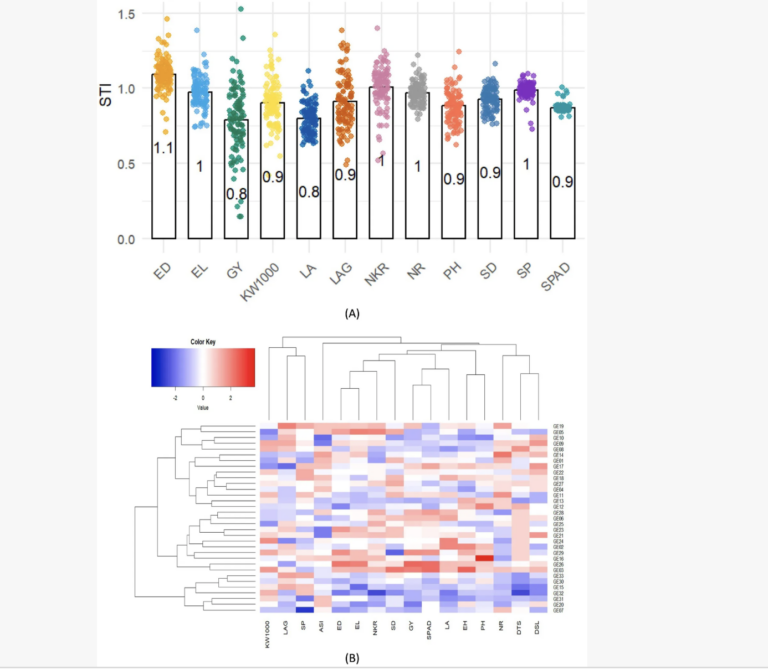
Using several drought-tolerance and selection indices, the researchers identified G05 (R0641), G03 (R0211), and G08 (R0020) as promising drought-tolerant hybrids. Among them, G05 performed particularly well across several selection indices, while G03 demonstrated strong yield stability under drought conditions.
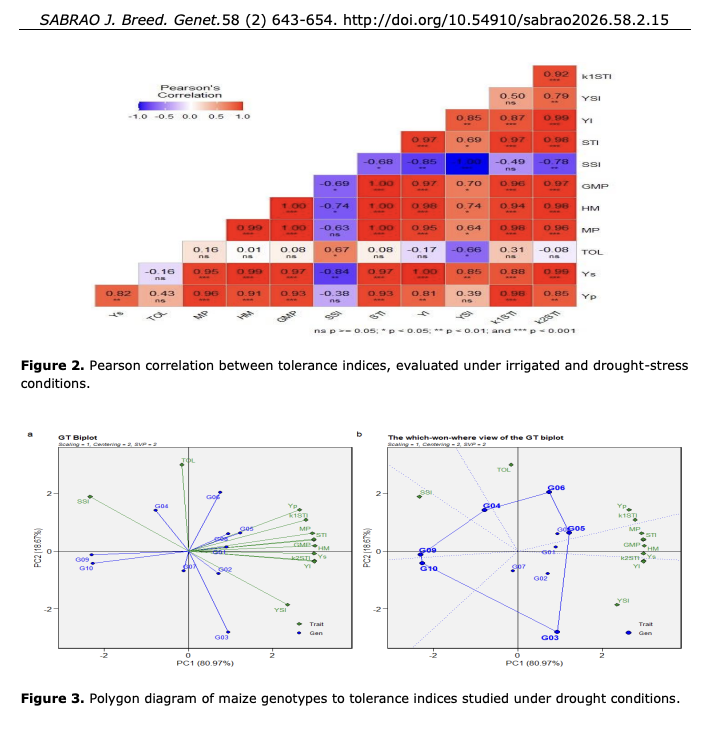
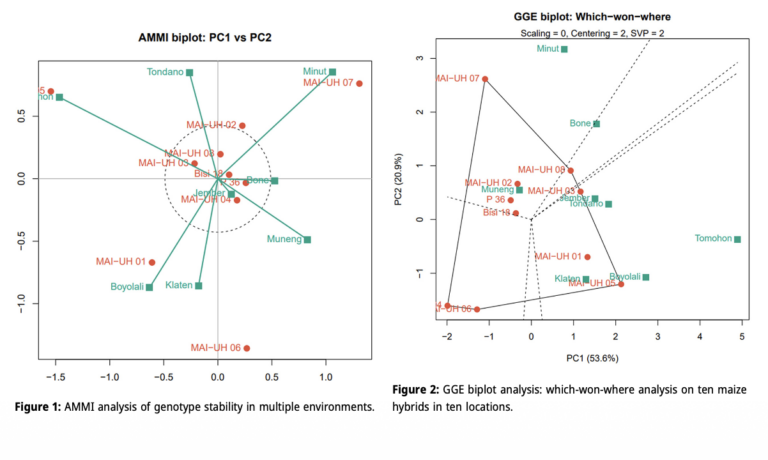
The researchers also applied GGE biplot analysis, a statistical approach commonly used by plant breeders to visualize genotype performance and genotype-by-environment interactions.
The analysis revealed an important pattern: G06 performed particularly well under irrigated conditions, G03 showed strong potential under drought stress, while G05 demonstrated good stability across contrasting water conditions.
In practical terms, maize hybrids can behave differently depending on their environment. Some may perform exceptionally well when water is readily available, while others are better able to maintain productivity under drought. A particularly valuable hybrid may combine both attributes—competitive yield potential and greater stability when environmental conditions change.
This distinction matters for farmers. Selecting maize solely on the basis of maximum yield under favorable conditions may overlook genotypes that offer greater reliability when rainfall becomes uncertain.
The study therefore demonstrates the importance of combining yield evaluation, drought-tolerance indices, and genotype-by-environment analysis in modern maize breeding. Together, these approaches can help breeders distinguish between hybrids adapted to specific conditions and those capable of maintaining more stable performance across contrasting environments.
The findings are particularly relevant to Sustainable Development Goal 2 (SDG 2): Zero Hunger, as drought-tolerant and stable crop varieties can contribute to more resilient agricultural production under increasing environmental stress.
The research is also relevant to SDG 13: Climate Action. Developing crop varieties capable of maintaining productivity under water-limited conditions represents an important component of agricultural adaptation to increasing climate variability.
In addition, the study supports the broader objectives of SDG 15: Life on Land by promoting crop improvement strategies that can help sustain agricultural productivity on existing farmland under increasingly challenging environmental conditions.
For maize breeding, the message is clear:
The maize of the future should not only produce high yields when conditions are favorable—it must also remain productive when water becomes scarce.
By combining multi-environment testing, drought-tolerance indices, and analytical approaches such as GGE biplot, maize breeders can identify genetic materials that offer both productivity and resilience. Such information provides an important scientific foundation for developing maize varieties better prepared for increasingly variable growing environments.
Reference
Bimantara, Y.M., Suwarno, W.B., Sobir, S., & Maharijaya, A. (2026). Yield Stability in Maize (Zea mays L.) Using GGE Biplot and Selection Indices Under Irrigated and Drought-Stress Conditions. SABRAO Journal of Breeding and Genetics, 58(2), 643–654.
Contact:
Prof. Dr. Muhammad Azrai
Faculty of Agriculture, Hasanuddin University
azrai@agri.unhas.ac.id