
MAKASSAR, Indonesia, Oct 31 2025 /CORN-RG/– How can farmers produce more maize without continuously expanding farmland? One promising answer is surprisingly simple: grow more plants on the same area—but make sure the plants are designed to handle the crowd.
A 2025 study led by Muhammad Azrai and colleagues explored this idea by investigating how maize canopy architecture and physiological traits influence productivity when plants are grown at higher densities. The study, entitled “Canopy Architectural and Physiological Traits for Optimizing Maize Yield under High Planting Density,” was published in Frontiers in Sustainable Food Systems.
The researchers evaluated 13 maize hybrids at the Bajeng Experimental Station in Gowa Regency, South Sulawesi, Indonesia, using three planting densities of approximately 71,000, 81,000, and 95,000 plants per hectare.
Why does planting density matter?
When maize plants are grown closer together, competition for sunlight, water, nutrients, and space becomes more intense. Leaves can increasingly shade one another, limiting the amount of light reaching deeper layers of the crop canopy and potentially reducing photosynthetic efficiency.
However, not all maize plants are built the same way.
Maize hybrids with a more compact canopy and relatively upright leaves can distribute sunlight more effectively throughout the canopy. This architecture can help reduce excessive shading and potentially allow more plants to grow within the same area while maintaining efficient light interception and grain production.
The results revealed an important finding: more plants do not automatically mean higher yield.
The intermediate density of approximately 81,000 plants per hectare produced the highest average grain yield, reaching 12.85 tons per hectare. In comparison, the density of approximately 71,000 plants per hectare produced 11.54 tons per hectare, while increasing the population further to approximately 95,000 plants per hectare resulted in an average yield of 11.79 tons per hectare.
This means that the intermediate planting density increased average grain yield by approximately 11% compared with the lower density. Increasing the population beyond this level did not provide an additional yield advantage.
The finding highlights an important principle for maize production: the goal is not to maximize the number of plants, but to optimize the relationship between plant population, canopy structure, and available resources.
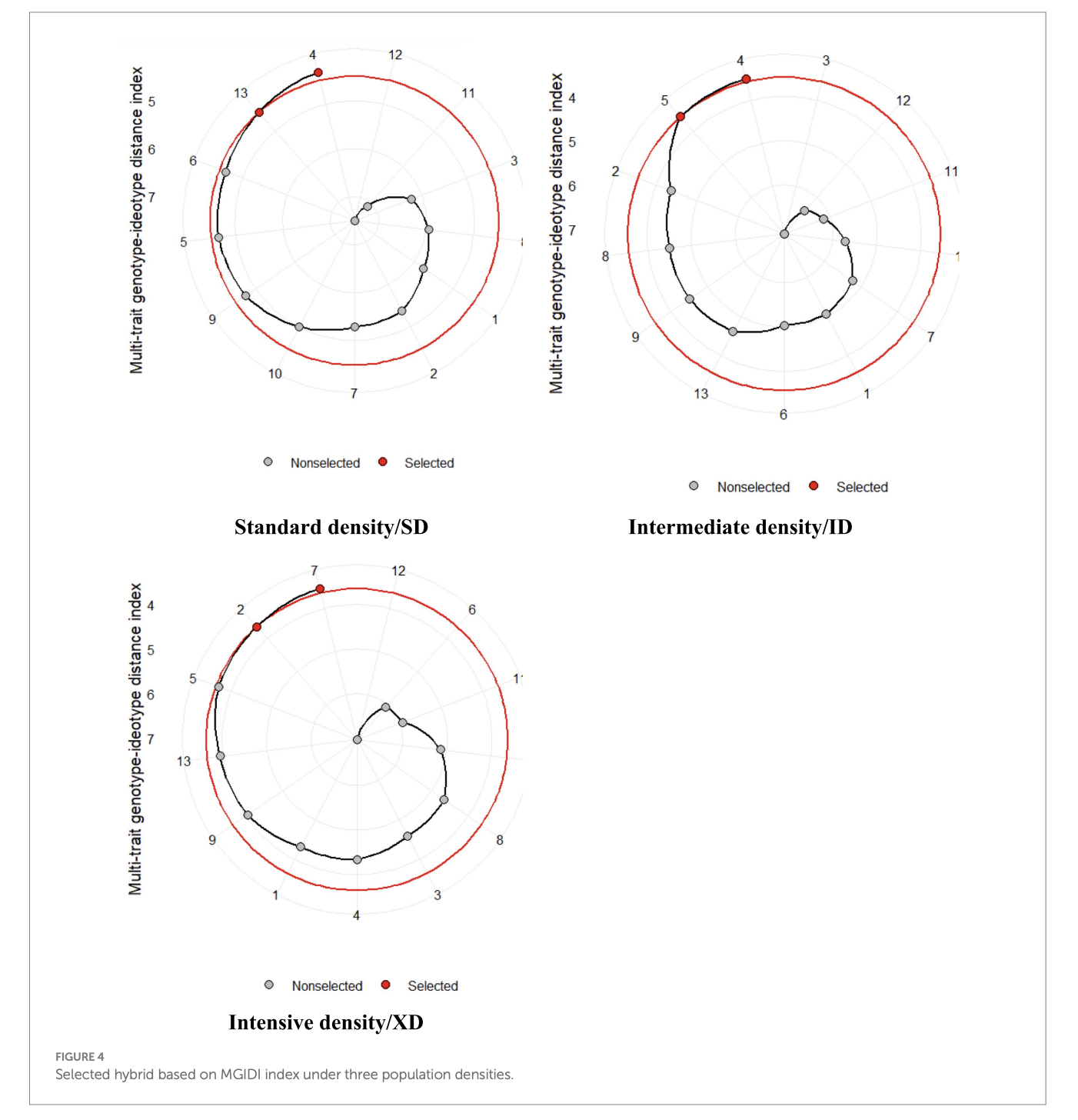
The researchers also applied the Multi-Trait Genotype-Ideotype Distance Index (MGIDI) to identify maize hybrids that combined several desirable characteristics.
MGIDI can be thought of as a way of searching for an “ideal maize plant.” Rather than selecting hybrids based on grain yield alone, the method considers multiple traits simultaneously. This allows breeders to identify plants that combine high productivity, desirable canopy architecture, physiological performance, and adaptation to increased planting density.
Through this approach, G4, G2, and G5 emerged as promising hybrids with broad adaptability across the evaluated planting densities. These genotypes provide valuable breeding materials for developing maize hybrids better suited to more intensive production systems.
The study demonstrates that increasing maize productivity does not necessarily require expanding agricultural land. Instead, productivity can be improved by combining better-adapted hybrids with optimized planting density and more efficient canopy architecture.
This concept is known as sustainable intensification—producing more from existing agricultural land while using resources more efficiently.
The research contributes to Sustainable Development Goal 2 (SDG 2): Zero Hunger by providing scientific approaches for increasing crop productivity and supporting more efficient food and feed production.
It is also relevant to SDG 12: Responsible Consumption and Production, as optimizing plant density and crop architecture can contribute to more efficient use of agricultural resources.
In addition, the study supports SDG 15: Life on Land. Increasing productivity on existing farmland can contribute to sustainable land use and potentially reduce pressure to expand agricultural production into natural ecosystems.
The message is clear:
Future maize productivity is not simply about planting more—it is about designing smarter plants and finding the right space for them to thrive.
By combining optimized planting density with maize hybrids that possess favorable canopy and physiological traits, breeders and farmers can move toward production systems capable of generating higher yields from existing farmland while using available resources more efficiently.
Reference:
Azrai, M., Aqil, M., Efendi, R., Zainuddin, B., Syam’un, E., Anshori, M. F., Riadi, M., Priyanto, S. B., Andayani, N. N., Yasin, M., Laurenze, R., & Syam, A. (2025). Canopy Architectural and Physiological Traits for Optimizing Maize Yield under High Planting Density. Frontiers in Sustainable Food Systems, 9, 1469305.
DOI: 10.3389/fsufs.2025.1469305
Contact:
Prof. Dr. Muhammad Azrai
Faculty of Agriculture, Hasanuddin University
azrai@agri.unhas.ac.id