
MAKASSAR, Indonesia, Jul 15 2026 /CORN-RG/– What if farmers and agricultural researchers could predict maize yield before harvest by allowing artificial intelligence to “read” the plants and their management conditions? This possibility is becoming increasingly realistic as artificial intelligence helps researchers uncover complex relationships among crop characteristics, cultivation practices, and productivity.
But can artificial intelligence really learn which combinations of plant traits and management practices are most closely associated with maize yield?
A 2026 study by Muhammad Aqil, Muhammad Azrai, Nining Nurini Andayani, and colleagues explored this question by applying advanced machine-learning approaches to maize production data. The study, entitled “Transformer-based modeling of maize yield and biomass using integrated agronomic and management traits,” was published in the Journal of Agriculture and Food Research.
The research brought artificial intelligence directly into the maize field. Conducted at the Maros Experimental Station in South Sulawesi, Indonesia, the experiment evaluated different planting arrangements and nano-fertilizer application times while collecting information on plant growth, leaf characteristics, chlorophyll status, canopy condition, grain yield, biomass, and crop management.
These data were then used to train artificial intelligence models to recognize complex patterns that may be difficult to identify through individual observations alone.
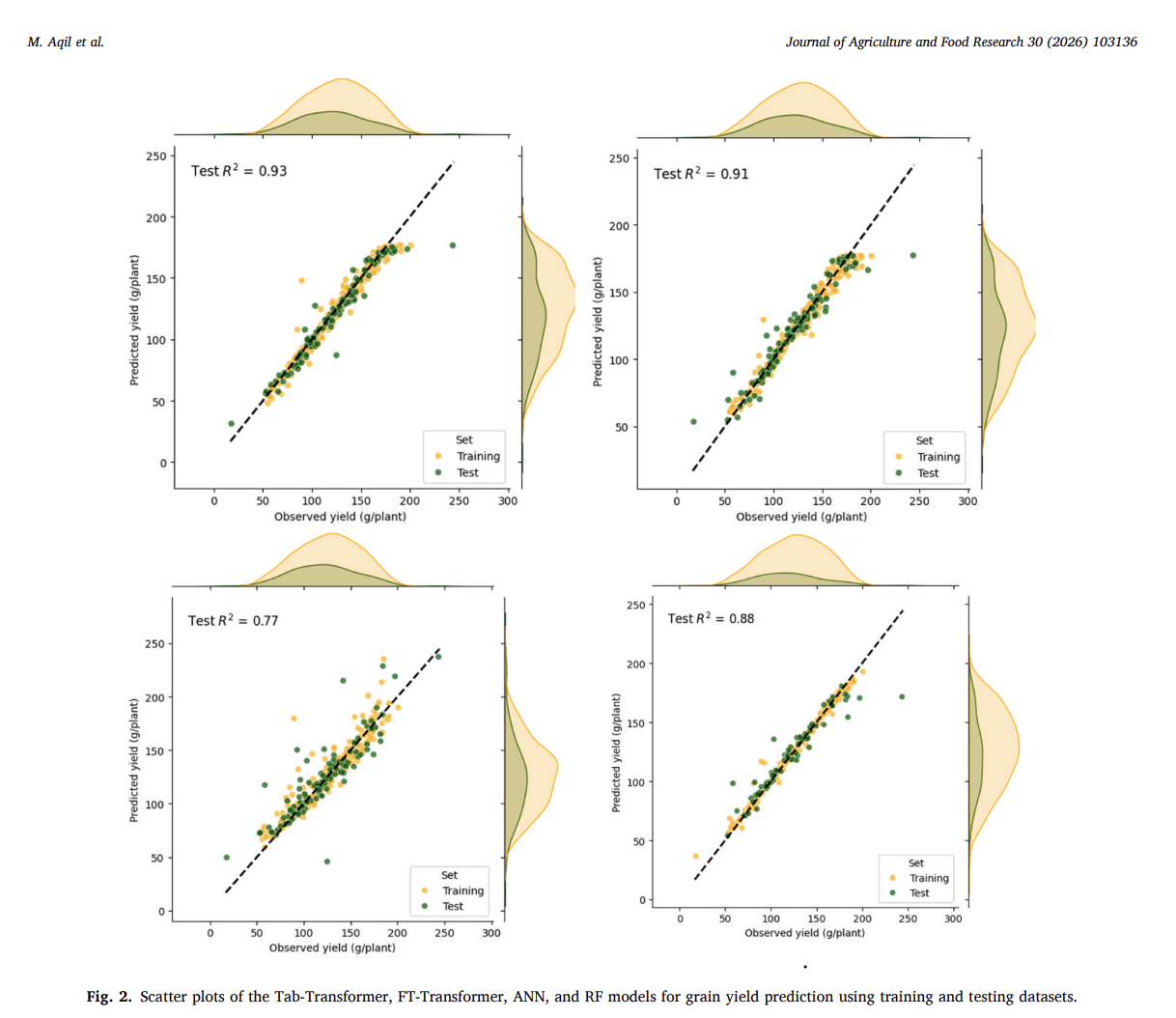
The researchers compared four prediction approaches: Tab-Transformer, FT-Transformer, Artificial Neural Network (ANN), and Random Forest.
The results were promising.
For grain-yield prediction, the Tab-Transformer achieved the best performance, with an R² value of 0.93. This was followed by the FT-Transformer (R² = 0.91), Random Forest (R² = 0.88), and ANN (R² = 0.77).
In practical terms, the high predictive performance of the Transformer-based models demonstrates their ability to capture relationships between maize characteristics, management practices, and final productivity within the conditions represented by the study data.
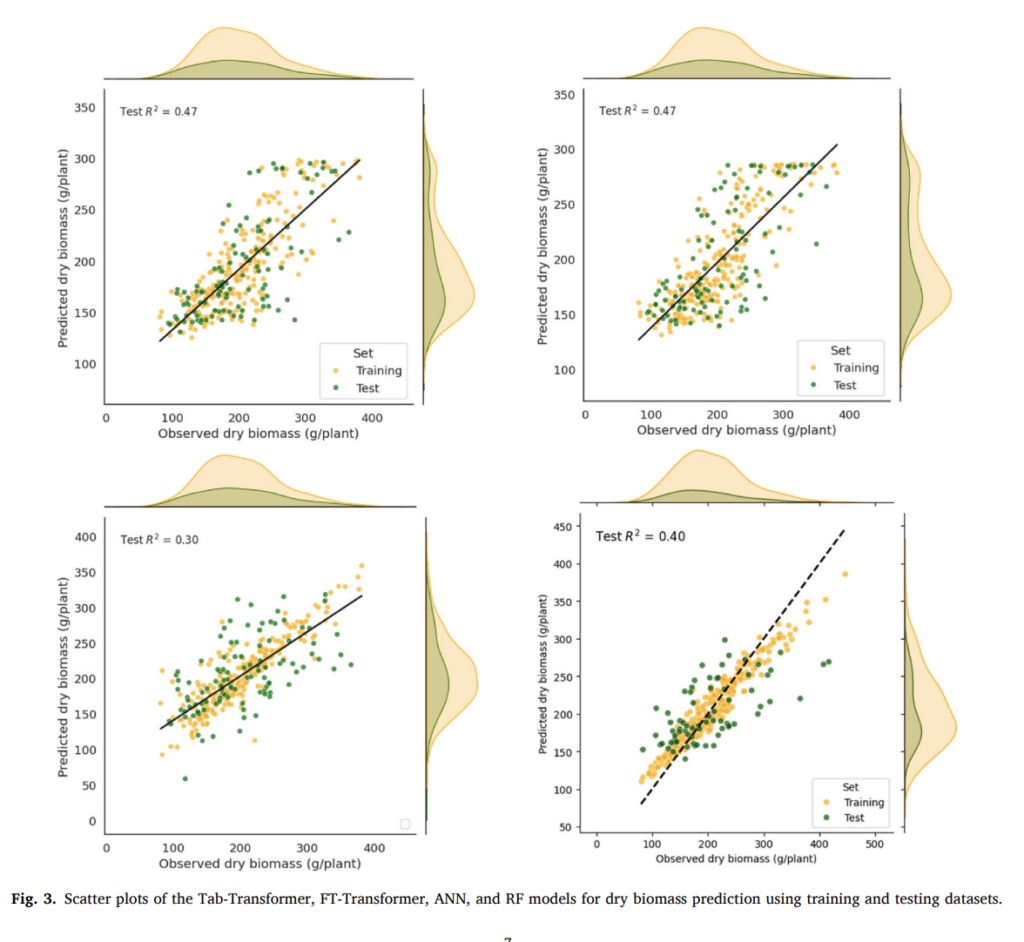
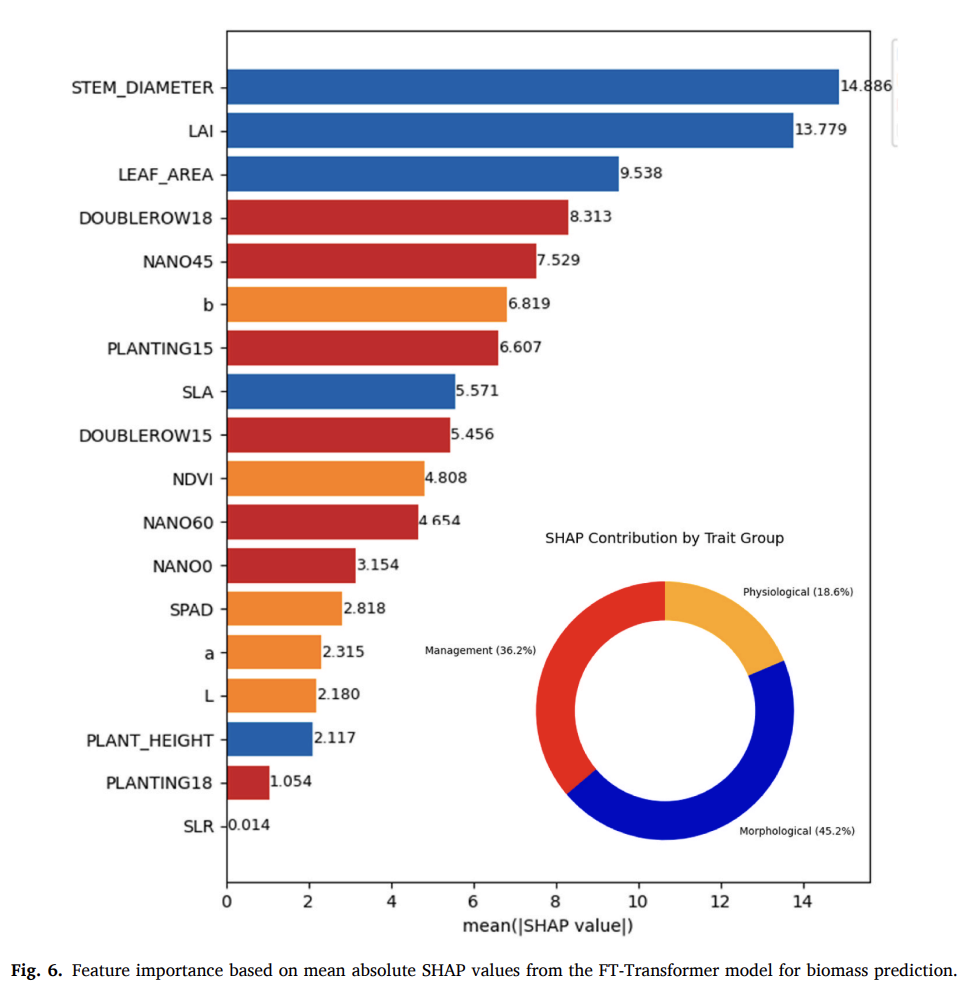
Predicting biomass proved more challenging. Nevertheless, the Transformer-based approaches still outperformed the conventional models evaluated in the study, demonstrating their potential for analyzing complex agricultural datasets.
But perhaps one of the most interesting contributions of the research was that the models did more than generate predictions.
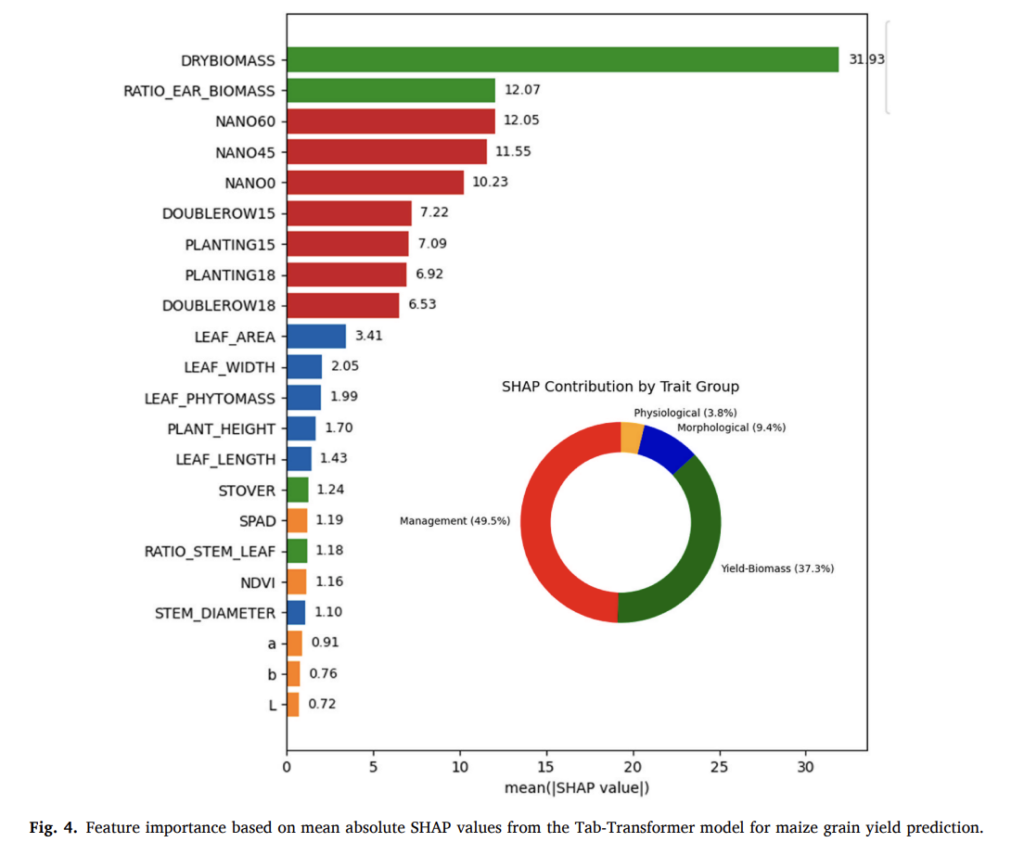
They also helped reveal which groups of variables contributed most strongly to grain-yield prediction.
Biomass-related traits accounted for 45.2% of the importance in predicting grain yield, while management factors contributed 39.8%. This highlights the substantial role of crop-management decisions alongside measurable plant characteristics.
The finding carries an important message: artificial intelligence does not make good agronomy less important—it can help researchers understand it better.
Planting arrangements, fertilizer timing, plant growth, canopy development, and other crop characteristics interact in complex ways. Machine-learning approaches can help analyze these relationships simultaneously, turning large amounts of agricultural data into information that may support better decision-making.
AI should therefore not be viewed as a replacement for farmers, plant scientists, or agronomists. Instead, it can serve as a decision-support tool, complementing field experience and scientific knowledge with the ability to detect patterns across many interacting variables.
This research contributes to Sustainable Development Goal 2 (SDG 2): Zero Hunger by advancing data-driven approaches that can support more productive and efficient crop-production systems.
It is also relevant to SDG 9: Industry, Innovation and Infrastructure, particularly through the integration of artificial intelligence and digital analytical methods into agricultural research and innovation.
In the longer term, such technologies may also contribute to SDG 1: No Poverty by supporting innovations that improve agricultural decision-making, resource-use efficiency, and productivity. However, realizing these benefits will depend on translating research models into practical and accessible tools for agricultural users.
The future of maize production may therefore combine two complementary forms of intelligence:
the experience of people who understand the field and artificial intelligence capable of finding patterns hidden within agricultural data.
By bringing together agronomic knowledge, crop-management information, and Transformer-based modeling, this research demonstrates how agricultural data can be transformed into more powerful insights for the future of maize production.
Reference:
Aqil, M., Azrai, M., Andayani, N. N., et al. (2026). Transformer-based modeling of maize yield and biomass using integrated agronomic and management traits. Journal of Agriculture and Food Research, 30, 103136.
Contact:
Prof. Dr. Muhammad Azrai
Faculty of Agriculture, Hasanuddin University
azrai@agri.unhas.ac.id