
Makassar, March 3, 2026 – A research team from Hasanuddin University and the University of Muhammadiyah Palopo has published a groundbreaking study investigating how reef-building corals adapt to different environmental conditions through phenotypic plasticity. The research, conducted across two distinct reef systems in South Sulawesi—the Spermonde Islands and Bone Gulf—provides compelling evidence that Porites lobata, one of the Indo-Pacific’s most ecologically significant coral species, exhibits remarkable morphological flexibility in response to local environmental conditions.
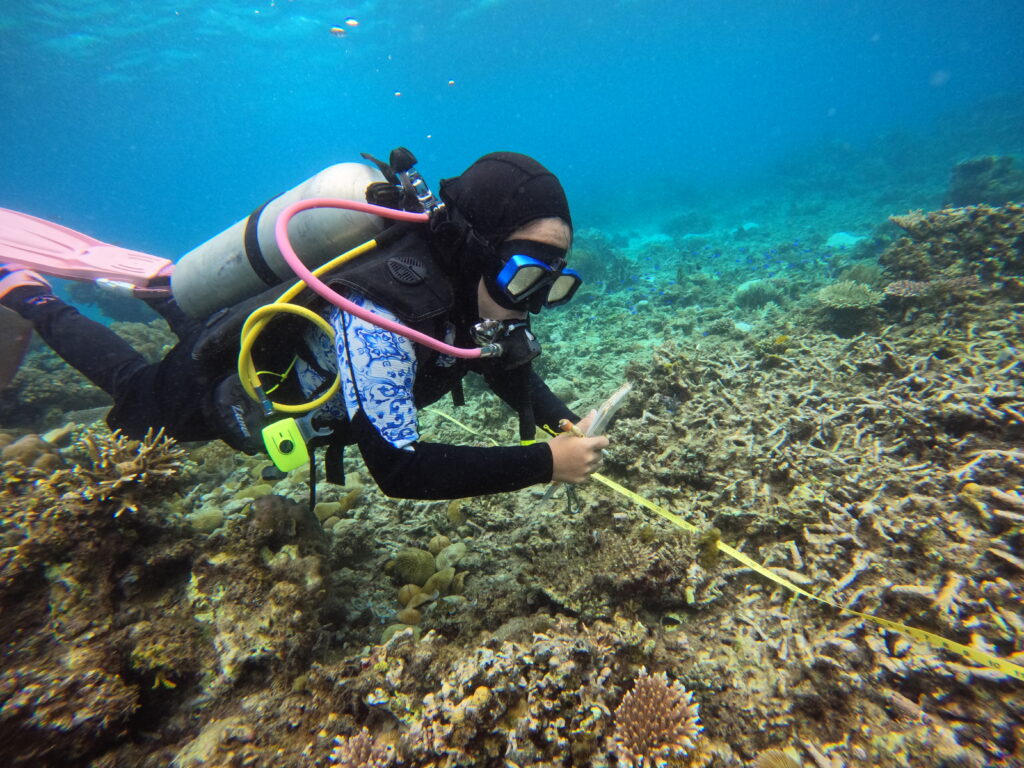
Led by Funty Septiyawati Polapa (Universitas Muhammadiyah Palopo/Doctoral Program, Universitas Hasanuddin) and supervised by Professor Jamaluddin Jompa, the research team conducted comprehensive morphometric analysis of 48 Porites lobata specimens, measuring 26 distinct skeletal characteristics to quantify intraspecific variation. The study represents one of the most detailed investigations of coral morphological plasticity in Indonesian waters.
Key Findings: Environmental Gradients Shape Coral Architecture
The research revealed striking morphological differences between the two populations:
- Corallite Size Divergence: Bone Gulf colonies exhibited significantly larger mean corallite diameters (1.040 ± 0.157 mm) compared to Spermonde specimens (0.948 ± 0.084 mm)
- Morphological Variability: Bone Gulf populations showed nearly double the variability in corallite size, suggesting greater phenotypic diversity
- Pali Count Differences: Bone Gulf specimens displayed higher and more variable pali counts (mean = 7.2, SD = 1.1) compared to Spermonde (mean = 6.5, SD = 0.8)
These morphological differences correlated strongly with environmental gradients, particularly a sustained temperature difference of approximately 2.2°C between the cooler Bone Gulf waters (27.46°C) and the warmer Spermonde waters (29.66°C). Additional environmental parameters, including pH, dissolved oxygen, and nitrate concentrations, showed distinct profiles between locations, creating a natural laboratory for investigating coral adaptive responses.
Methodology: Rigorous Morphometric Analysis
The study employed a stratified random sampling design across both locations during the dry season (June-August 2025). Colonies were selected from depths of 3-10 meters, with fragments collected from the apical region of each colony to ensure representative sampling of actively growing tissue.
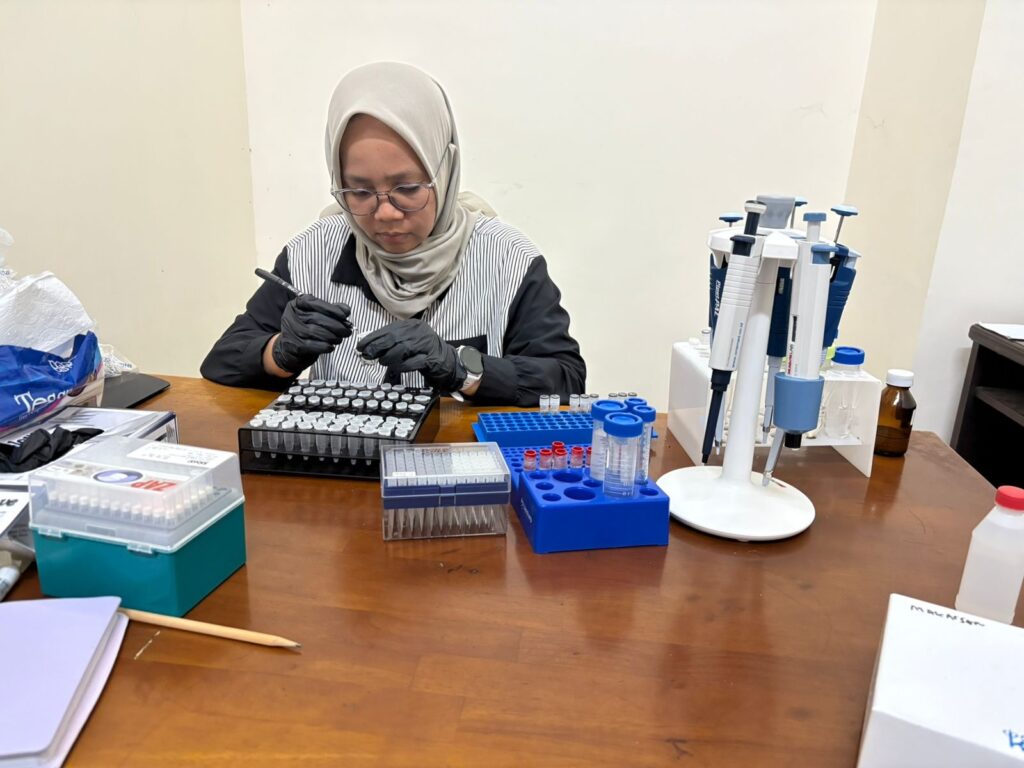
In the laboratory, samples underwent careful preparation including tissue removal using sodium hypochlorite, followed by microscopic analysis using an Infitek stereoscopic microscope (MSC-ST830) with calibrated ocular micrometer. All 26 morphological characters—including corallite dimensions, septal arrangements, columellar structures, and descriptive traits—were measured following the validated protocol established by Tisthammer & Richmond (2018). Three representative corallites per specimen were analyzed, with each character measured three times to ensure precision (measurement error <3%).
Statistical Analysis Reveals Robust Patterns
Normality tests confirmed normal distribution of corallite diameters within both locations (Spermonde: W = 0.98, p = 0.715; Bone Gulf: W = 0.96, p = 0.421). However, significant heteroscedasticity between locations (F = 3.48, p = 0.003) necessitated non-parametric testing. The Mann-Whitney U test revealed a strong trend toward difference approaching statistical significance (U = 189, p = 0.061), suggesting biological relevance despite not meeting the conventional α = 0.05 threshold.
Principal Component Analysis (PCA) and correlation analyses further elucidated the morphological patterns. Notably, the relationship between corallite diameter and pali count was substantially stronger in Bone Gulf (Pearson’s r = 0.65, p = 0.003; R² = 0.42) compared to Spermonde (r = 0.28, p = 0.12; R² = 0.08), suggesting more integrated morphological responses in the Bone Gulf population.
Implications for Coral Resilience and Conservation
The systematic morphological variation observed provides compelling evidence for phenotypic plasticity as a key mechanism enabling corals to acclimate to local environmental conditions. The greater morphological diversity in Bone Gulf populations carries significant ecological implications:
“Populations exhibiting higher morphological variability, such as those in Bone Gulf, may represent valuable reservoirs of resilience for reef management in a changing climate,” explains Professor Jamaluddin Jompa. “The ability of a single species to express different skeletal forms in response to local conditions suggests broader adaptive capacity than previously recognized.”
These findings have direct implications for conservation planning:
- Protection of Environmental Heterogeneity: Conservation strategies should prioritize maintaining diverse environmental conditions that support intraspecific morphological diversity
- Identification of Resilient Populations: The more morphologically variable Bone Gulf population may possess greater capacity to withstand environmental changes
- Integration of Trait-Based Approaches: Coral monitoring programs should incorporate morphometric analysis alongside traditional cover assessments
Future Research Directions
While the correlation with environmental parameters strongly supports the plasticity hypothesis, the study’s design cannot fully exclude potential contributions from local genetic adaptation. The research team recommends two complementary approaches for future investigation:
- Reciprocal transplant experiments to directly observe morphological changes in the same genotypes across different environments
- Population genetic analysis (e.g., using SNP markers) to measure genetic structure and link it to morphological variation
Such integrated approaches combining genetics, experimental ecology, and morphometrics would yield a more mechanistic understanding of coral adaptive capacity.
Acknowledgments
This research was supported by the Directorate of Research, Technology, and Community Service grant, Ministry of Higher Education, Science, and Technology, Indonesia under the BIMA Fundamental Basic Research scheme (main contract number: 069/C3/DT.05.00/PL/2025; derivative contract number: 02209/UN4.22/PT.01.03/2025). The research team extends gratitude to field assistants Randy and Arham for their invaluable support during data collection.Corresponding Author:
Professor Jamaluddin Jompa
Department of Marine Science, Faculty of Marine and Fisheries
Universitas Hasanuddin, Makassar, Indonesia
Email: j.jompa@unhas.ac.id