
Makassar, March 2, 2026 – A research team from Hasanuddin University (UNHAS) and the University of Muhammadiyah Palopo has recently completed a pivotal study examining coral reef monitoring methods in the Spermonde Archipelago. Conducted in August 2025, this research integrated ecological and social approaches to design effective, community-based disaster mitigation models.
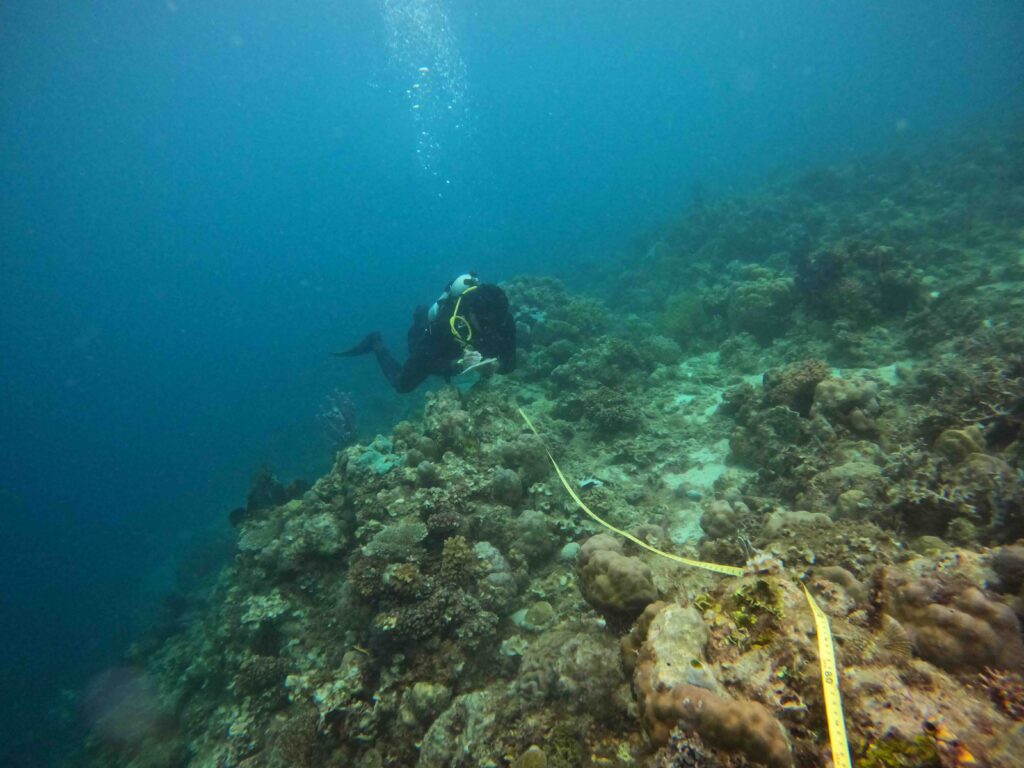
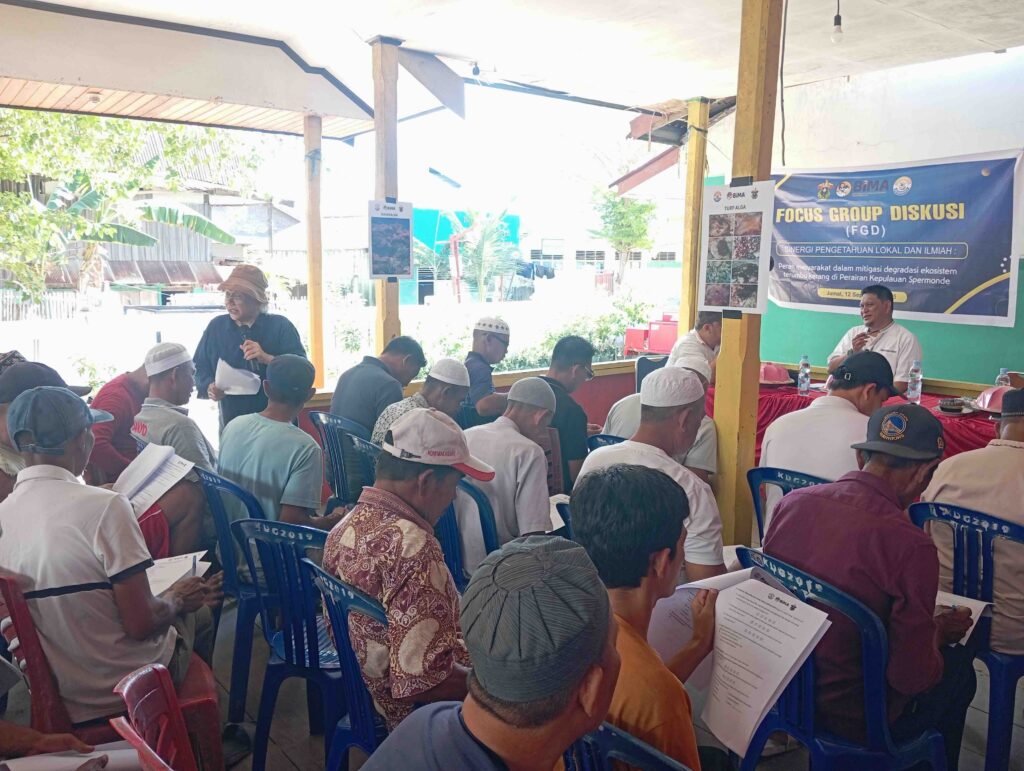
Led by Prof. Jamaluddin Jompa from the Department of Marine Science, Faculty of Marine and Fisheries, UNHAS, the team conducted ecological surveys on three islands representing a water quality gradient: Lae-Lae Island (turbid waters), Kodingareng Lompo Island (moderate), and Lanyukang Island (clear waters). Three monitoring methods were compared: Line Intercept Transect (LIT) , Underwater Photo Transect (UPT) , and drone-based mapping. Complementing this, a Focus Group Discussion (FGD) engaged 33 residents from the three islands to explore their perceptions, knowledge, and readiness for conservation efforts.
The findings revealed critical insights. Ecologically, a clear pattern emerged: water quality is a primary determinant of coral reef condition. Lae-Lae Island, with its turbid waters, was dominated by dead coral and rubble, starkly contrasting with Lanyukang Island, which still maintains significant live hard coral cover. Methodologically, the study concluded that the three monitoring techniques possess complementary strengths and weaknesses. LIT excels in in-situ accuracy, UPT offers greater objectivity and in-depth analysis, and drones are highly effective for rapid, large-scale mapping. The integration of all three is recommended for obtaining comprehensive data.
The social dimensions of the study provided equally profound insights. The FGD revealed a gap in visual literacy among community members. While the majority (58%) are aware that reef conditions are worsening, their understanding of health indicators and ecological mechanisms, such as the link between nutrient pollution and algal blooms, remains limited. This was quantified by the finding that only 26.5% of participants could correctly sequence images depicting stages of reef health.
Despite this, the community demonstrated strong local knowledge in proposing solutions tailored to their specific islands. Based on these inputs and the ecological data, the research team formulated site-specific mitigation models:
- Lae-Lae Island: Focus on waste management and substrate restoration.
- Kodingareng Lompo Island: A combination of participatory patrols and coral transplantation.
- Lanyukang Island: Strengthening customary regulations (a modern sasi system) and developing monitoring-based ecotourism.
“This research confirms that the effectiveness of ecological disaster mitigation depends not only on the accuracy of scientific data, but also on its synergy with local knowledge and multi-dimensional partnerships that empower communities as key conservation actors,” stated Prof. Jamaluddin Jompa. The team hopes these findings will provide an evidence-based foundation for conservation policies and enhance the adaptive capacity of local communities and stakeholders in the Spermonde Archipelago to respond to evolving ecological challenges.
This research was supported by a grant from the Ministry of Higher Education, Science, and Technology of the Republic of Indonesia through the Fundamental Basic Research scheme. Data and materials are available upon reasonable request.