
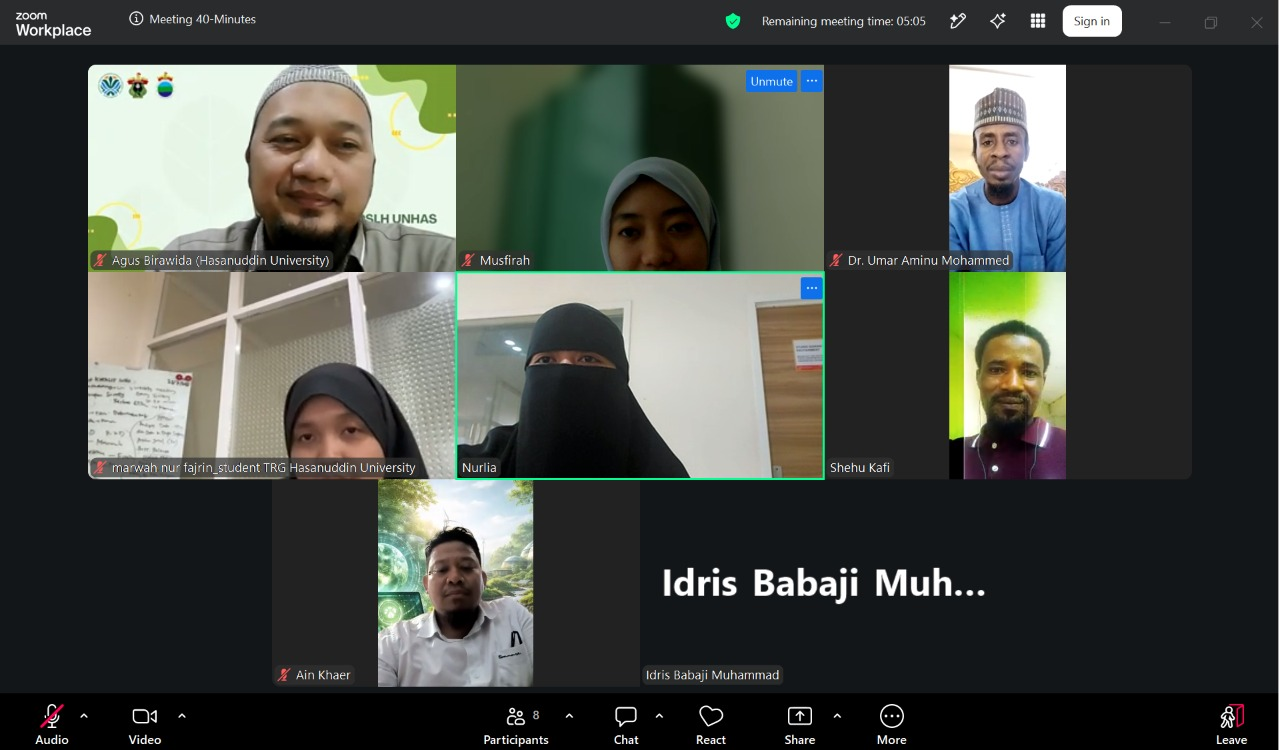

International collaboration has become an essential pillar in addressing increasingly complex environmental and public health challenges. Recognizing that environmental issues transcend national boundaries, the Coastal Domestic Water Research Group (TRG), Hasanuddin University (UNHAS) held an international research discussion with the Department of Biological Sciences, SA’ADU ZUNGUR University (SUZA), Bauchi, Nigeria, to explore opportunities for collaborative research, scientific publication, and academic exchange in the field of environmental sciences.
The online discussion was conducted via Zoom on 30 July 2026, bringing together 8 participants consisting of researchers, lecturers, and postgraduate students from both institutions. The meeting served as a strategic platform to strengthen academic networking while identifying shared research interests that could contribute to solving environmental and public health problems in coastal and inland communities.
The discussion was led by Dr. Agus Bintara Birawida, Head of the Coastal Domestic Water Research Group (TRG), Hasanuddin University. During his presentation, he introduced the research vision and achievements of TRG, highlighting the group’s long-standing commitment to environmental health research, particularly in coastal and small island ecosystems. He shared various ongoing and completed studies related to drinking water quality assessment, community-based water treatment technologies, environmental contamination by heavy metals, health risk assessment, waste management, climate-related environmental health issues, and sustainable environmental remediation. These research experiences provided valuable insights into how interdisciplinary environmental science can support evidence-based policies and improve community resilience.

Representing the international partner were Shehu Abubakar Kafi and Dr. Umar Aminu Mohammed from the Department of Biological Sciences, SA’ADU ZUNGUR University, Bauchi, Nigeria. Both institutions exchanged perspectives on their current research priorities and discussed potential collaboration in environmental pollution, water quality monitoring, environmental microbiology, ecosystem health, climate resilience, and public health. The participants also explored opportunities for joint scientific publications in reputable international journals, collaborative grant proposals, student exchanges, and future multidisciplinary research projects involving researchers from both universities.
The meeting was also attended by postgraduate students from Hasanuddin University, including Master’s student Marwah Nur Fajrin and Doctoral students Nurlia Sila and Ain Khaer, who introduced their respective research topics and expressed their enthusiasm for participating in future international collaborative studies. Their involvement reflects the importance of integrating young researchers into global scientific networks, fostering academic capacity building, and encouraging knowledge exchange across countries.
This collaboration directly supports Sustainable Development Goal (SDG) 17 – Partnerships for the Goals, which emphasizes the importance of international partnerships in advancing science, technology, and innovation. Furthermore, the research themes discussed contribute significantly to SDG 6 – Clean Water and Sanitation through collaborative efforts to improve water quality and environmental management, as well as SDG 3 – Good Health and Well-being by promoting research aimed at reducing environmental health risks and protecting vulnerable communities.
Through this international discussion, both Hasanuddin University and SA’ADU ZUNGUR University reaffirmed their commitment to building long-term academic partnerships that generate impactful research, strengthen scientific capacity, and provide sustainable solutions to global environmental and public health challenges. The meeting marked an important first step toward establishing a productive collaboration that is expected to produce internationally recognized research outputs while contributing to the achievement of the Sustainable Development Goals.


