


Barrang Caddi, Indonesia, 6 May 2026 / TRG / For many people living on small islands, clean water is not always easy to obtain. On Barrang Caddi Island, Makassar City, the challenge is even more serious because the island is small, surrounded by seawater, and has limited freshwater sources. Many residents still depend on dug wells, but the water quality often does not meet clean water standards, especially because of turbidity.
Turbid water may look only cloudy, but it can indicate the presence of suspended particles, organic matter, sediment, or possible contamination from household waste and poor sanitation. In small island areas, where houses, wells, septic tanks, and drainage channels are often located close to one another, the risk of water quality decline becomes higher.
A published study tested a practical water treatment method using local island-based materials: moringa seeds, pumice stone, and activated charcoal made from mangrove wood. The study was conducted on dug well water from Barrang Caddi Island using a quasi-experimental design. Researchers selected one active dug well with the highest total dissolved solids value and tested four treatment methods: moringa seed coagulation, pumice filtration, activated charcoal filtration, and a combination of coagulation and filtration.
The results were encouraging. Moringa seed coagulation reduced turbidity by 26.85%. Pumice filtration performed better, reducing turbidity by 68.72%. Activated charcoal filtration showed the highest effectiveness, reducing turbidity by 79.96%. Meanwhile, the combined coagulation-filtration method reduced turbidity by 74.80%. Statistical analysis also showed a significant difference between the treatment methods, meaning that the choice of treatment technology matters.
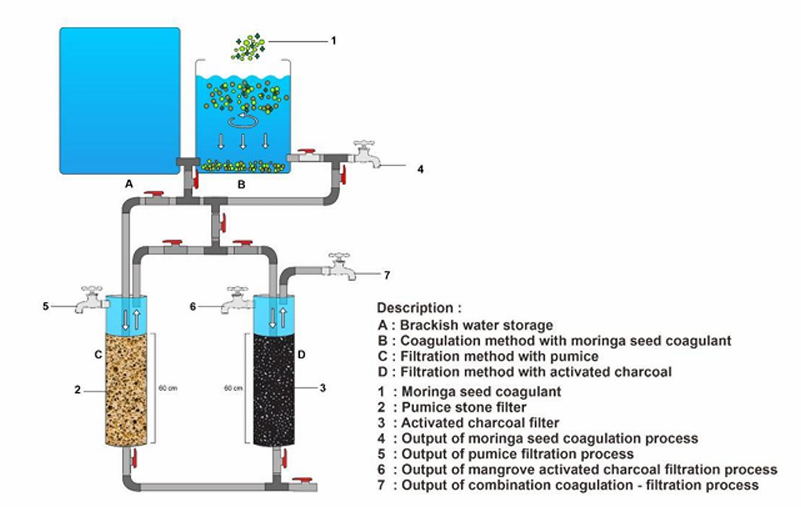
The study highlights an important lesson: simple technologies can be powerful when they use materials that are locally available and easy to apply. Moringa seeds can help bind small particles in water. Pumice stone, with its porous structure, can filter suspended materials. Activated charcoal can adsorb organic substances, odor, color, and fine particles. Together, these materials offer a practical and low-cost approach for improving water quality in coastal and island communities.
This topic is directly related to SDG 3: Good Health and Well-being, because safer water helps prevent water-related diseases. It also supports SDG 1: No Poverty, since affordable water treatment can reduce household costs and health burdens. SDG 4: Quality Education is reflected in the need to educate communities about simple water treatment. SDG 14: Life Below Water and SDG 15: Life on Land are linked to protecting coastal ecosystems and using natural resources responsibly. Finally, SDG 17: Partnerships for the Goals is essential because universities, local governments, communities, and health institutions must work together to expand clean water solutions.
The message from Barrang Caddi is clear: clean water innovation does not always need expensive technology. Sometimes, the best solution begins with local knowledge, local materials, and scientific testing. For small islands, this kind of approach can help turn limited resources into healthier futures.
Reference
DOI:
10.32382/medkes.v20i1
Contact:
Dr.Agus Bintara Birawida
+62 85241800050
agusbirawida@unhas.ac.id


