


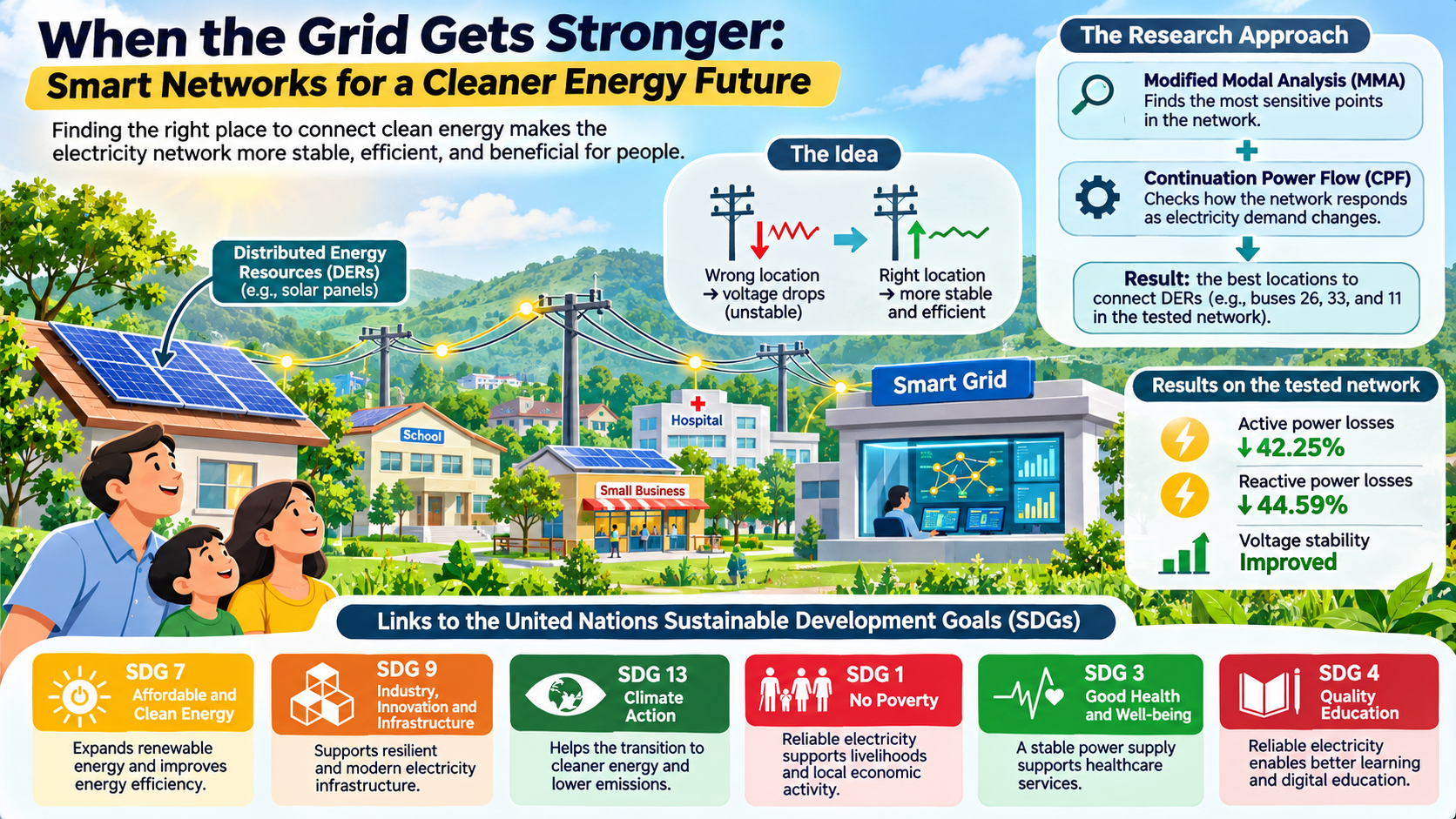
Solar panels and other small-scale energy sources are changing how electricity is produced. Instead of relying only on large power stations far from consumers, communities and businesses can generate electricity closer to where it is needed. This approach, known as distributed energy resources (DERs), can support the transition to cleaner energy. However, connecting more renewable sources to the grid does not automatically guarantee better performance. Their location matters.
Think of an electricity network as a system of roads. If too much traffic is concentrated on a weak road, congestion can occur. In an electricity network, certain points are more sensitive to changes in demand and power flow. These weaknesses can lead to voltage drops. Voltage is often compared to water pressure: it helps electricity reach equipment at the level needed for proper operation. Keeping voltage within an acceptable range is essential for a reliable power supply.
A study published in the journal Energies, titled “Novel Hybrid Modified Modal Analysis and Continuation Power Flow Method for Unity Power Factor DER Placement,” examines how to identify suitable locations for DER units, including solar photovoltaic generation. Published by MDPI on 8 February 2023, the article introduces a combined approach using Modified Modal Analysis (MMA) and Continuation Power Flow (CPF). In simple terms, one technique identifies parts of the network that strongly influence voltage stability, while the other assesses how the network responds as electricity demand changes. When the methods identify different sensitive locations, an additional calculation helps select a site that balances lower power losses with improved stability.
The method was tested on a 34-bus distribution network. It selected buses 26, 33, and 11 as preferred locations for three DER units. After connection, the network voltage profile and stability improved. The study reported reductions of 42.25% in active power losses and 44.59% in reactive power losses. These figures describe the tested network model; actual results depend on each electricity system’s characteristics and operating conditions.
The findings are most directly connected to United Nations Sustainable Development Goal (SDG) 7: Affordable and Clean Energy, particularly expanding renewable energy and improving energy efficiency. They also relate to SDG 9: Industry, Innovation and Infrastructure, by supporting more resilient electricity infrastructure, and SDG 13: Climate Action, because better renewable-energy integration can support efforts to reduce dependence on fossil-fuel-based generation.
There are wider, indirect links. More reliable electricity can support livelihoods and economic activity (SDG 1: No Poverty), healthcare facilities (SDG 3: Good Health and Well-being), and schools and digital learning (SDG 4: Quality Education). These are potential benefits of improved electricity services, not impacts measured by this study.
The key message is that a clean-energy transition is not simply about installing more solar panels. It also requires smarter decisions about where and how renewable sources connect to the grid. A stronger, more efficient network can help communities make better use of clean electricity.