


Makassar, Indonesia, April 19, 2026/BIONE/–Corn plays a vital role in Indonesia’s agricultural system as both a staple food and a major component of animal feed. However, increasing productivity remains a challenge due to pest attacks, particularly the Asian corn stem borer (Ostrinia furnacalis). This pest can damage plants at all growth stages, reducing yield and crop quality significantly. Conventional control methods rely heavily on chemical pesticides, which can harm the environment and non-target organisms. Therefore, sustainable alternatives are needed. One promising solution is biological control using beneficial fungi such as Beauveria bassiana.
This study is based on the article “Population of Asian Corn Stem Borer (Ostrinia furnacalis) on F1 of Beauveria bassiana-Inoculated Corn”, published in May 18, 2020 on the Advances in Biological Sciences Research by Atlantis Press. The research explores the use of B. bassiana as an endophytic fungus that lives inside plant tissues without causing harm. Two corn varieties, Lamuru and Batara, were grown from seeds inoculated with the fungus. Researchers conducted field observations and laboratory analyses to evaluate pest populations, infestation levels, and fungal infection rates. The presence of the fungus was also confirmed through isolation and microscopic identification.
Different Varieties, Different Outcomes
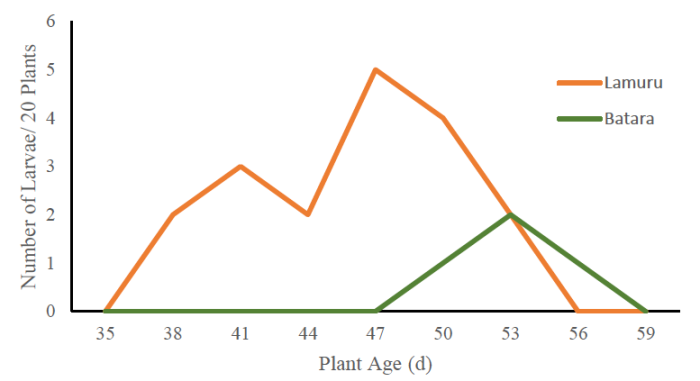
The findings reveal that not all corn varieties respond in the same way to pest attacks. The Lamuru variety showed earlier and higher levels of infestation, with larval populations appearing sooner and increasing more rapidly. In contrast, the Batara variety experienced delayed pest attacks and maintained lower population levels throughout the observation period.
This pattern can be clearly observed in the graphical data, where the increase in larval population occurs earlier in Lamuru compared to Batara. Such differences suggest that plant characteristics, including morphology and physiology, influence how pests interact with their hosts. In addition, the percentage of infested plants was consistently higher in Lamuru, reaching its peak before gradually declining.

Natural Infection as a Control Mechanism
A key highlight of this study is the ability of B. bassiana to infect and kill stem borer larvae effectively. Despite higher infestation levels in Lamuru, the fungus was still able to infect a large proportion of larvae, reaching 83%. In Batara, all observed larvae were successfully infected, demonstrating even stronger effectiveness. The visual evidence of infected larvae shows a clear transformation: Initially darkened bodies gradually become covered with white fungal growth, indicating successful colonization by the fungus. This process reflects the natural infection cycle of B. bassiana, where the fungus penetrates the insect body, multiplies internally, and eventually leads to death. Such observations confirm that the fungus remains active within plant tissues and continues to function as a biological control agent.
Implications for Sustainable Agriculture
The presence of B. bassiana inside plant tissues offers continuous protection without repeated pesticide use. For farmers, especially smallholders, this method provides a practical and scalable solution. Integrating endophytic fungi with crop management strategies can enhance sustainability and long-term productivity. This study contributes directly to Sustainable Development Goal (SDG) 15: Life on Land, as it promotes environmentally friendly pest management. It also supports SDG 1 (No Poverty) by improving crop productivity and farmer income, SDG 3 (Good Health and Well-being) by reducing exposure to hazardous chemicals, SDG 4 (Quality Education) through research and knowledge development, SDG 14 (Life Below Water) by limiting agricultural pollution, and SDG 17 (Partnerships for the Goals) through collaborative scientific efforts.
Toward Smarter Pest Management
This research demonstrates that B. bassiana can act as an internal defense mechanism within corn plants. By providing long-term protection against pests, it offers a sustainable alternative to chemical control. As agriculture faces increasing environmental challenges, integrating biological solutions into farming systems is essential for building resilient and sustainable food production.
Reference:
DOI: https://doi.org/10.2991/absr.k.200513.010
Contact Info:
Prof. Dr. Ir. Itji Diana Daud, M.S.
+62811445853
itjidianadaud@unhas.ac.id


