Makassar, Indonesia. May 18, 2026 | BiMin – Imagine charging your smartphone in just a few seconds or storing renewable energy more efficiently using a material produced by harmless bacteria. While it may sound futuristic, scientists are already exploring this possibility through an extraordinary natural material called bacterial cellulose. Unlike conventional cellulose obtained from plants, bacterial cellulose is naturally pure, highly porous, and forms an interconnected network of ultrafine fibers, making it an ideal starting point for developing advanced energy storage materials.
As the world moves toward clean energy, one of the biggest challenges is finding energy storage systems that are not only powerful but also sustainable. Batteries have become part of our daily lives, yet they often require long charging times and have limited lifespans. Supercapacitors, on the other hand, offer rapid charging, excellent durability, and high power output. Their performance, however, depends heavily on the quality of the electrode materials.
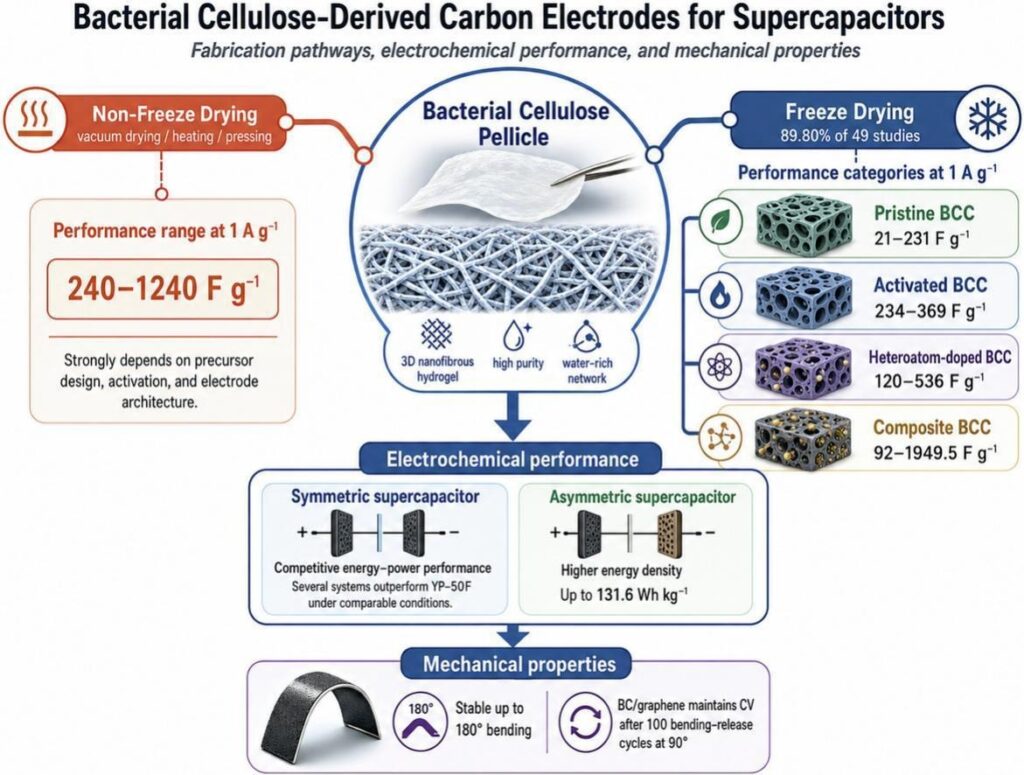
This is where bacterial cellulose becomes remarkably valuable. Researchers have discovered that this natural biomaterial can be transformed into porous carbon through carefully controlled heating processes. The resulting carbon maintains a three-dimensional nanofiber structure that allows electrons and ions to move efficiently, enabling supercapacitors to store and release energy much faster.
Even more exciting, scientists continue to improve this material using innovative engineering strategies. By creating microscopic pores, introducing beneficial chemical elements such as nitrogen or sulfur, or combining bacterial cellulose-derived carbon with metal oxides and other functional materials, researchers have significantly enhanced the energy storage capability of these electrodes. These approaches not only increase electrical conductivity but also create additional active sites where electrical charges can be stored more effectively.
One of the most remarkable messages from this research is that nature itself provides a sustainable blueprint for future technologies. Instead of relying solely on expensive synthetic materials, bacterial cellulose offers a renewable, environmentally friendly alternative that can be produced through microbial fermentation. This approach supports the growing concept of a circular economy, where biological resources are transformed into high-value products with minimal environmental impact.
The findings summarized in this review also demonstrate how material design plays a crucial role in determining performance. From freeze-drying techniques that preserve the delicate nanofiber network to chemical activation and composite engineering, every processing step contributes to creating electrodes with larger surface areas, improved conductivity, and superior electrochemical performance. These scientific advances bring us closer to practical supercapacitors capable of supporting electric vehicles, portable electronics, smart devices, and renewable energy systems.
Beyond the laboratory, this innovation contributes directly to several global development goals. SDG 7 (Affordable and Clean Energy) is supported by the development of efficient and sustainable energy storage technologies that accelerate the adoption of renewable energy. The research also strongly contributes to SDG 9 (Industry, Innovation and Infrastructure) by advancing high-performance materials for future energy systems. Furthermore, the utilization of renewable biomass as a carbon source supports SDG 12 (Responsible Consumption and Production) by promoting sustainable resource utilization. Equally important, the collaborative nature of this research community reflects the spirit of SDG 17 (Partnerships for the Goals), highlighting the importance of international scientific cooperation in solving global energy challenges.
Reference : https://doi.org/10.1016/j.est.2026.123044
Contact:
Prof. Dahlang Tahir
+62 853-9418-8647
dtahir@fmipa.unhas.ac.id