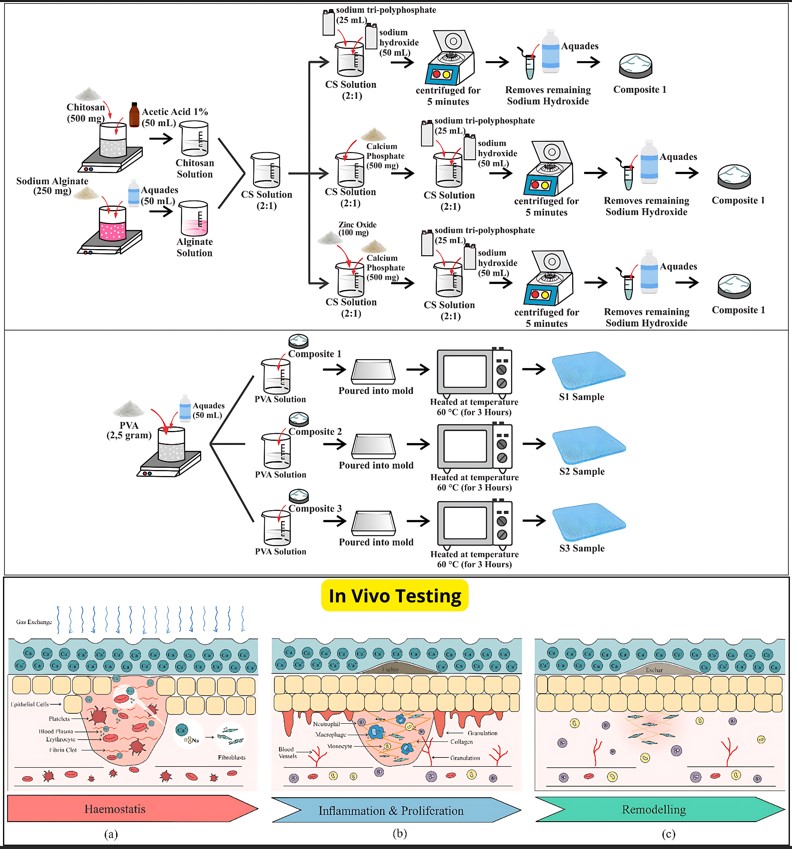
Makassar, Indonesia. May 11, 2026 | BiMin – A simple wound may look harmless, but in many cases, improper treatment can lead to infection, prolonged pain, and even life-threatening complications. This is why scientists around the world continue searching for better wound-care materials that are safer, smarter, and more environmentally friendly. One exciting breakthrough comes from our research, we developed a biodegradable antibacterial wound dressing made from alginate, calcium phosphate, and zinc oxide.
The study was published in the journal International Journal of Biological Macromolecules under the title “Structural and Optical Properties of Alginate-Based Antibacterial Dressing with Calcium Phosphate and Zinc Oxide for Biodegradable Wound Painting Applications.” The article was published by Elsevier on July 18, 2024. The research was conducted by Nurul Fajri R. Tang, Bidayatul Armynah, and Dahlang Tahir.
What makes this innovation interesting is the use of alginate, a natural material extracted from seaweed. Alginate is already widely known for being biocompatible, affordable, and biodegradable. However, alginate alone is not mechanically strong enough for advanced medical applications. To solve this problem, the researchers combined it with calcium phosphate (CaP) and zinc oxide (ZnO), creating a stronger and more functional wound dressing.
The results were impressive. The new material showed better elasticity, stronger mechanical properties, and stronger antibacterial performance compared to ordinary alginate dressings. In laboratory tests, the sample containing ZnO demonstrated the highest ability to inhibit the growth of Staphylococcus aureus, one of the most common bacteria responsible for skin infections. This antibacterial effect is extremely important because infected wounds often heal more slowly and can become dangerous if untreated.
Another fascinating aspect of this research is its optical property. Zinc oxide helped increase light absorption and the production of reactive oxygen species (ROS), which can assist antibacterial activity. In simple terms, the dressing not only protects wounds physically but may also actively help destroy harmful bacteria.
Beyond medical performance, the environmental aspect of the study deserves attention. Traditional wound dressings are often difficult to decompose and contribute to medical waste pollution. In contrast, this new dressing was designed to be biodegradable in soil and seawater. Although the ZnO-containing sample degraded more slowly due to its stronger antibacterial structure, the material still showed environmentally friendly characteristics compared to many synthetic medical products currently used worldwide.
This innovation strongly relates to SDG 3: Good Health and Well-Being because it supports safer and more effective healthcare technology. Better wound dressings can reduce infection risks, accelerate healing, and improve patient quality of life. At the same time, the biodegradable nature of the material also supports SDG 14: Life Below Water and SDG 15: Life on Land, since reducing persistent medical waste helps protect marine ecosystems and soil environments from long-term pollution.
Research like this reminds us that future healthcare is not only about curing people, but also about protecting the planet. A small bandage may seem simple, yet behind it lies a powerful combination of nanotechnology, biomaterials, and environmental awareness that could shape the future of sustainable medicine.
Reference : https://doi.org/10.1016/j.ijbiomac.2024.133996
Contact:
Prof. Dahlang Tahir
+62 853-9418-8647
dtahir@fmipa.unhas.ac.id