


MAKASSAR, Indonesia, Nov 2025 – Growing a healthy banana plant may seem simple: plant a sucker, provide water, give it sunlight, and wait. But producing large numbers of healthy planting materials can be much more challenging—especially when scientists try to multiply plants through tissue culture. Inside a laboratory, even tiny problems can stop a plant from growing. Contamination by microorganisms and browning of plant tissues are two common challenges that can reduce the success of in vitro culture. Now, researchers have found an interesting solution: biochar. A recent study titled “Biochar-Supplemented In Vitro Culture of Musa acuminata var. barangan to Control Contamination and Enhance Regeneration,” published in the Iraqi Journal of Agricultural Sciences by the University of Baghdad, College of Agriculture on October 27, 2025, investigated how biochar could improve the in vitro culture of banana cv. Barangan.
Why Is Contamination a Problem?
Plant tissue culture is a powerful technique for producing large numbers of plants from small pieces of plant material. However, microorganisms can easily compete with the plant for nutrients and space inside culture containers. Another problem is browning. When plant tissues are injured during preparation, they may release phenolic compounds that cause the tissue and culture medium to turn brown. Severe browning can interfere with plant growth and regeneration. The researchers explored whether coconut shell-derived biochar could help overcome these challenges.
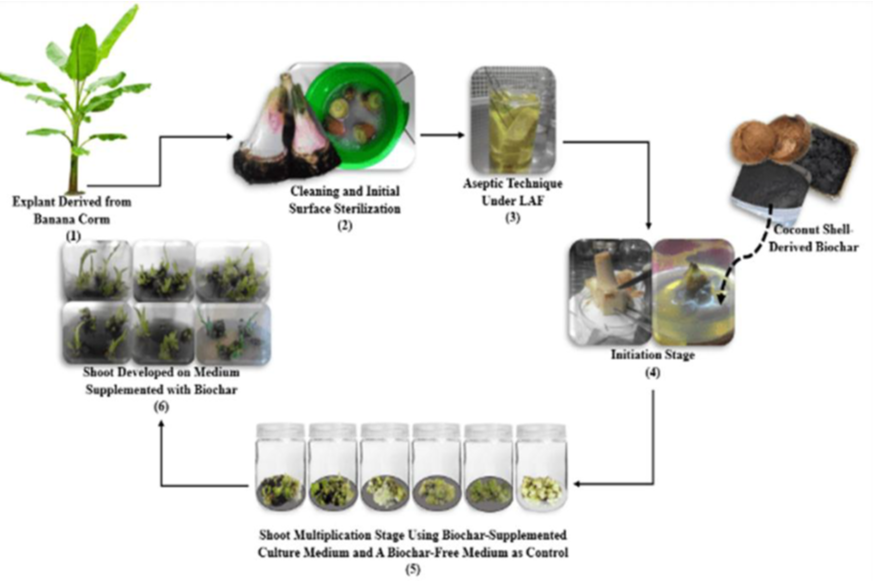
What Did the Researchers Do?
The study tested 11 biochar concentrations, ranging from 0 to 5 g/L, in Murashige and Skoog (MS) culture medium. The researchers monitored contamination, browning, propagule formation, fresh weight, shoot number, and shoot height. The results were particularly interesting. Without biochar, contamination appeared as early as 3.33 days after culture. In contrast, adding 2 g/L biochar delayed contamination to 13.8 days. The same concentration also produced the best results for shoot multiplication and shoot height. Biochar also helped reduce browning. The lowest browning intensity was recorded at 5 g/L, although higher concentrations were not necessarily better for overall plant performance. In fact, concentrations of 4 g/L or more reduced culture performance, possibly because excessive biochar altered the balance of the culture medium and created stress for the developing plant.
Why Does Biochar Make a Difference?
Biochar may provide several benefits inside the culture medium. Its porous structure can help adsorb phenolic compounds, while its properties may contribute to nutrient availability, pH stability, and regulation of compounds affecting plant development. The study suggests that the key is not simply adding more biochar, but finding the right amount.
Supporting SDG 12: Responsible Consumption and Production
This research contributes to Sustainable Development Goal (SDG) 12 – Responsible Consumption and Production by demonstrating how a biomass-derived material such as coconut shell biochar can be incorporated into an innovative plant production system. Turning agricultural or biomass residues into useful materials can create added value while supporting more sustainable approaches to biotechnology.
A Small Addition with a Bigger Possibility
The research shows that something as simple as biochar can have an important role in plant tissue culture. For banana propagation, the right biochar concentration may help delay contamination, reduce browning, and support plant regeneration. More broadly, the study highlights an important principle for sustainable biotechnology: better technology does not always mean more resources—it can mean using existing resources more intelligently.
Reference
DOI:
https://doi.org/10.36103/rss1c992
Dr. Mustika Tuwo
+62 852-9985-2835
mustikatuwo@unhas.ac.id