Makassar, Indonesia September 30 2025/APHREG. For a dairy farmer, getting a cow pregnant is about much more than producing the next calf. Successful reproduction determines how regularly a cow can produce milk and how efficiently a farm can maintain its herd. When a cow repeatedly fails to become pregnant, the problem can quietly become a serious economic burden.
This condition is known as repeat breeding—when a cow has normal reproductive cycles but fails to conceive after repeated breeding attempts. It can mean more artificial insemination, longer intervals between calves, and fewer opportunities for milk production.
A recent study titled “Prevalence and risk factors of repeat breeding in dairy cows in Cendana District, Enrekang Regency, South Sulawesi, Indonesia” investigated this problem among smallholder dairy farms. The article was published in the Open Veterinary Journal, by Eldaghayes Publisher, on 30-Sep-25. The research involved 163 dairy cows and data from 48 farmers in Cendana District, Enrekang Regency.
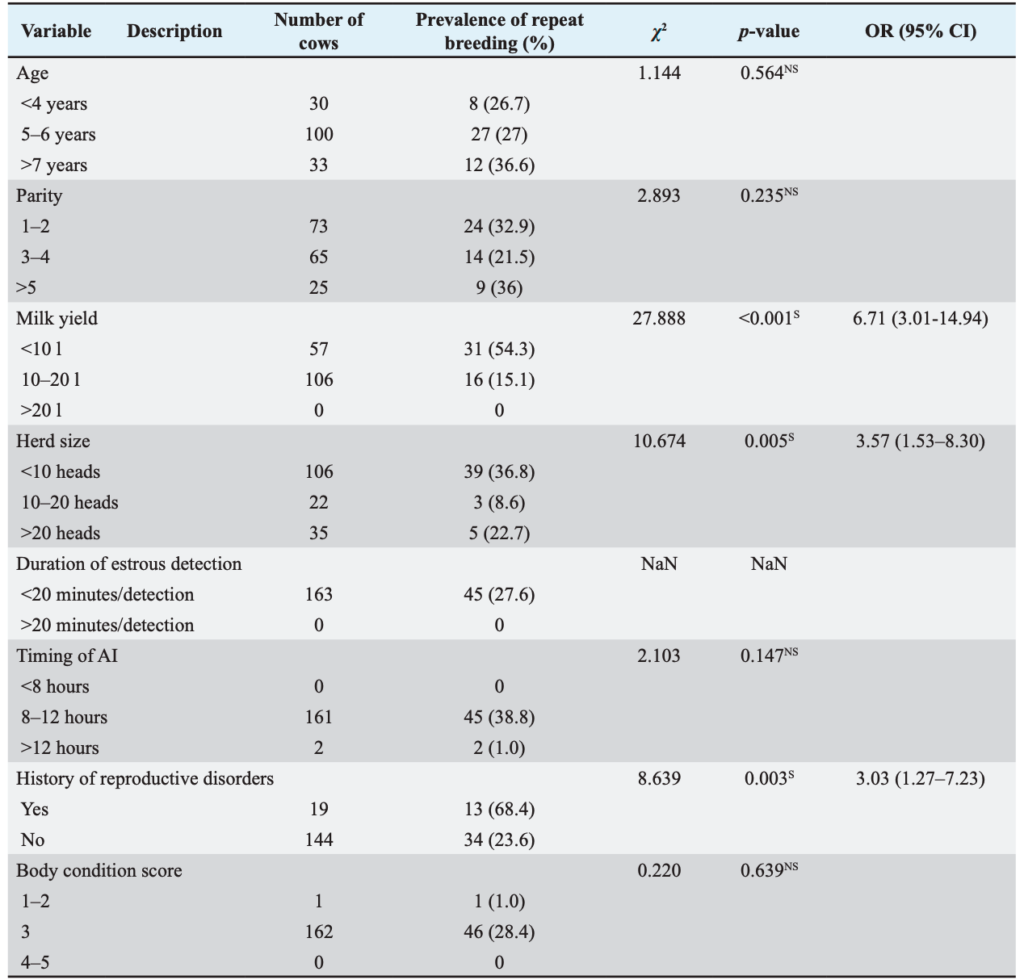
The findings reveal that repeat breeding is not a rare problem. At the cow level, 28.8% of the 163 cows were classified as repeat breeders. At the farmer level, 60.4% of the 48 farmers had at least one repeat-breeding cow in their herd.
But what makes some cows more likely to experience this problem?
The researchers identified several important risk factors. Cows producing less than 10 liters of milk per day were 6.71 times more likely to experience repeat breeding than cows producing 10–20 liters per day. Cows belonging to herds with fewer than 10 animals had 3.57 times higher odds of repeat breeding than cows in larger herds. Most importantly, cows with a previous history of reproductive disorders had a 3.03 times higher chance of becoming repeat breeders.
These findings show that fertility cannot be separated from the overall condition and history of an animal. A cow’s reproductive performance may reflect nutritional status, previous reproductive problems, herd management, and other factors that influence her ability to conceive.
For smallholder farmers, the message is especially important. A cow that fails to conceive repeatedly may require additional breeding services while remaining less productive. Over time, these seemingly small reproductive problems can add up to significant financial losses.
This study therefore supports Sustainable Development Goal (SDG) 1: No Poverty. Improving reproductive efficiency in dairy cattle can help smallholder farmers reduce unnecessary costs, maintain milk production, and strengthen the economic sustainability of their livestock businesses.
The solution is not simply “breed the cow again.” Instead, farmers and veterinarians need to look deeper: monitor reproductive history, pay attention to milk production, improve management, and identify reproductive problems early.
Sometimes, improving a farmer’s livelihood begins with something as fundamental as helping a cow become pregnant at the right time.
Reference
DOI: 10.5455/OVJ.2025.v15.i9.61
Contact:
Drh. FIka Yuliza Purba
+62 812-6388-348
fikapurba@med.unhas.ac.id