

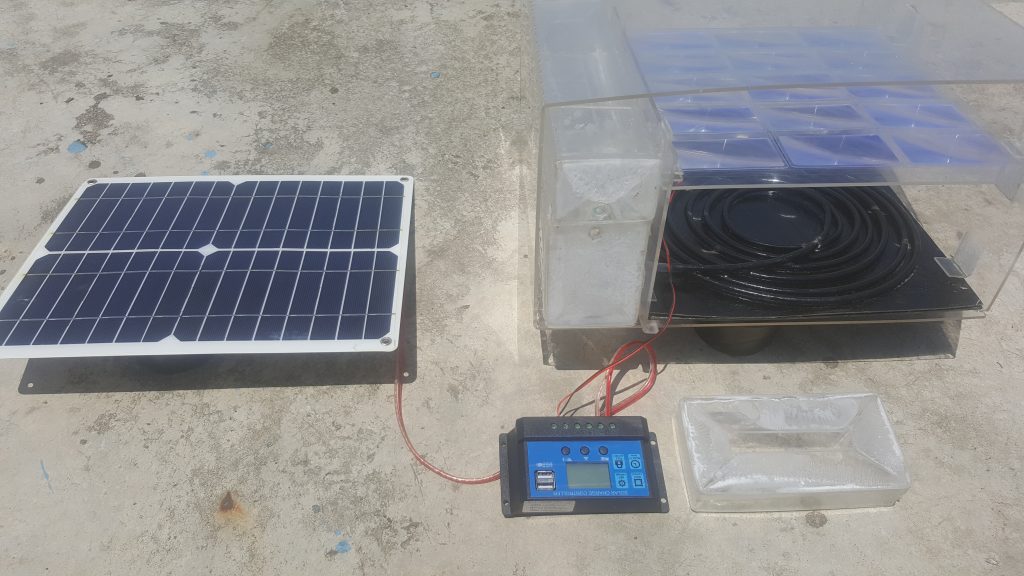
Access to clean drinking water remains an important challenge, particularly for communities living in remote and coastal areas where conventional water infrastructure is difficult to establish. Responding to this challenge, a research activity entitled “Utilization of Seawater as a Source of Drinking Water and Fuel with Solar Survival Kits in Remote Areas” was conducted through PTUPT Dikti in 2020. The activity explored the potential of solar energy as a simple and sustainable solution for producing drinking water from seawater.
The main objective of this research was to develop a portable solar collector that could function as a survival kit, particularly for people living or carrying out activities in areas with limited access to fresh water and electricity. The system was designed as a desalination device capable of converting artificial seawater into drinking water by utilizing solar energy. To improve the concentration of solar radiation, the portable collector was equipped with a Fresnel lens. This component helps focus sunlight onto the designated heating area, increasing the thermal energy available for the desalination process.
The basic principle of the system is relatively simple. Solar radiation is collected and concentrated by the Fresnel lens, generating heat that can be used to evaporate water. During evaporation, dissolved salts and other non-volatile substances remain behind, while the water vapor can subsequently be condensed into fresh water. Through this process, seawater can potentially become a source of drinking water without relying heavily on conventional electricity-based desalination systems.
The development of a portable solar survival kit offers an interesting opportunity for emergency situations, remote communities, and areas affected by natural disasters. A system based on renewable solar energy can provide an alternative approach to addressing basic water needs while reducing dependence on fossil fuels and centralized infrastructure. The activity had no specified number of participants (N/A), as the available activity information focuses primarily on the research and development of the technology.
This research also contributes to the achievement of the Sustainable Development Goals (SDGs). In particular, it supports SDG 1: No Poverty, by promoting technological solutions that can help improve access to essential resources in underserved communities. It is also relevant to SDG 4: Quality Education, because research and technological innovation provide opportunities to develop scientific knowledge, practical skills, and environmentally responsible approaches to solving real-world problems.
Furthermore, the activity reflects SDG 17: Partnerships for the Goals, particularly through research and innovation supported within the PTUPT Dikti framework. Collaboration among researchers, educational institutions, government-supported programs, and other stakeholders is essential to transform scientific findings into technologies that can provide meaningful benefits to society.
Overall, the solar survival kit demonstrates how renewable energy and scientific innovation can be combined to address fundamental human needs. By utilizing abundant sunlight to support seawater desalination, this research presents a promising concept for developing practical, portable, and sustainable water solutions for remote and resource-limited environments.