
MAKASSAR, Indonesia 19 July 2026/VICTORY/ –
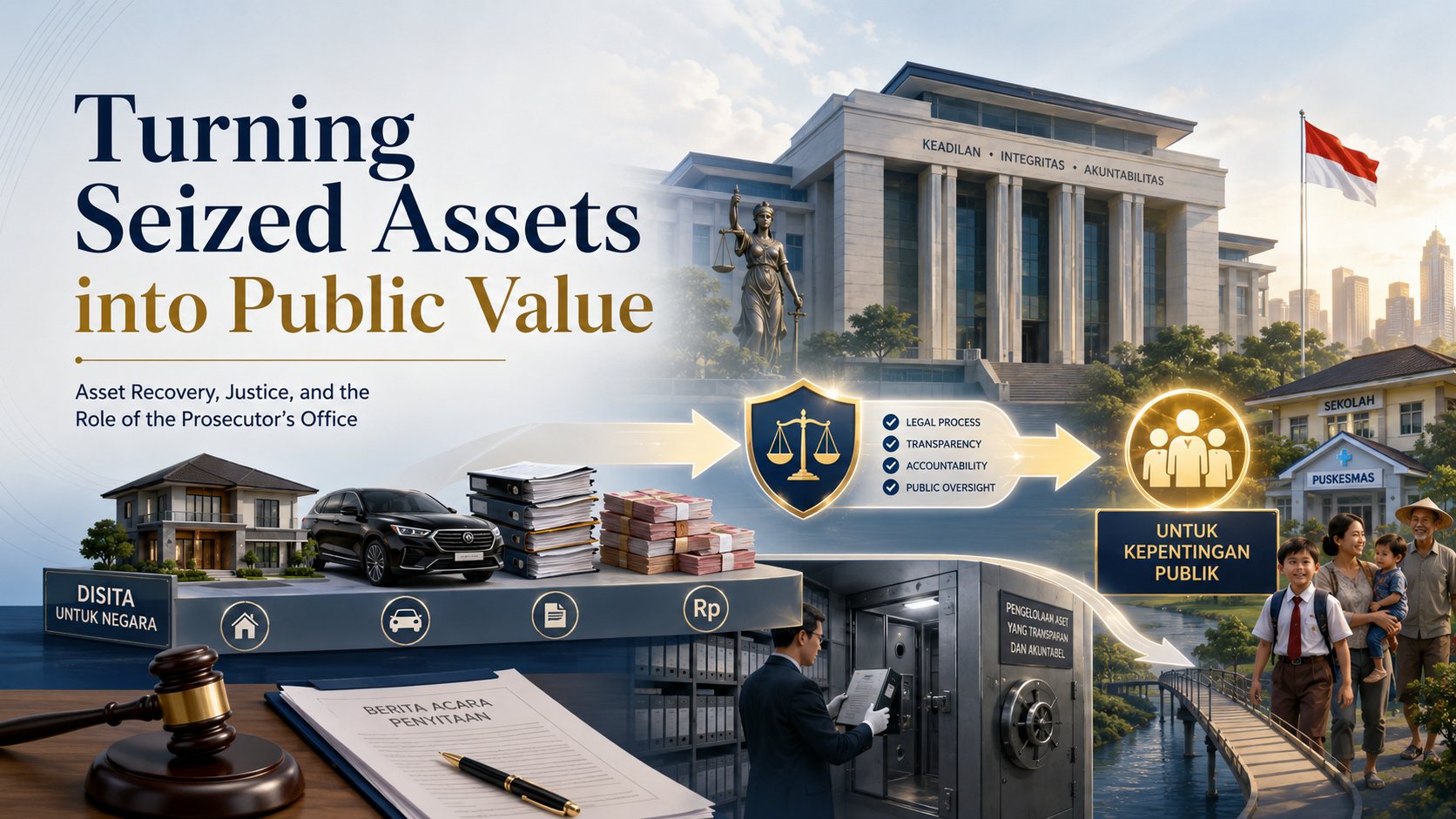
What happens after investigators seize a house, vehicle, business asset, or bank account linked to corruption? Many people assume the job is finished once the property is taken. In reality, seizure is only the beginning. When an asset is stored for years, poorly maintained, or delayed in auction, its value may fall sharply. A vehicle can deteriorate, a building can become damaged, and storage costs can continue to rise. Consequently, the state may recover far less than the amount originally lost.
The source metadata is as follows: Article title: “Optimizing the Management of Seized Goods: The Strategic Role of the Prosecutor’s Office in Asset Recovery from Corruption Crimes”; Journal: Pakistan Journal of Life and Social Sciences; Publisher: The Elite Scientific Forum, Pakistan; Publication date: 2025. The article, written by Tenriawaru, Syamsul Bachri, and Nur Azisa, appeared in Volume 23, Issue 1, pages 3184–3203. The manuscript was accepted on 22 January 2025.
The study explains that fighting corruption should not stop at sending offenders to prison. The money and property gained through corruption must also be traced, secured, managed, and returned to the state. Otherwise, offenders or related parties may continue enjoying the proceeds, while the public bears the loss. This is why asset recovery has become an essential element of modern anti-corruption policy.
Indonesia’s Prosecutor’s Office plays a central role because it executes final court decisions, including decisions ordering assets to be confiscated for the state. These assets may be sold through auction, with the proceeds deposited as non-tax state revenue. The study reports that in 2020, the Attorney General’s Office contributed IDR 935.49 billion in non-tax state revenue. Approximately IDR 381.25 billion, or 40.75 percent, came from managing confiscated objects and state-confiscated goods.
However, the system faces serious practical problems. Supporting documents may be incomplete, court decisions may be unclear, and goods may accumulate in storage facilities. Indonesia also has too few State Confiscated Objects Storage Houses, known as Rupbasan, compared with the number of districts and cities they are expected to serve. Limited warehouses, budgets, specialist appraisers, and institutional coordination can cause delays and reduce asset values.
The article therefore calls for an integrated recovery system that is effective, efficient, transparent, and accountable. The Prosecutor’s Asset Recovery Center is important for coordinating this work, but success also depends on cooperation among prosecutors, courts, police, financial authorities, auction offices, and storage institutions.
This issue directly supports SDG 1: No Poverty, because corruption diverts resources intended for public welfare and vulnerable communities. It advances SDG 4: Quality Education by improving public understanding of corruption and asset recovery. It also contributes to SDG 17: Partnerships for the Goals through stronger cooperation among institutions. The central lesson is clear: recovering corruption assets is not merely about taking property away. It is about returning stolen public value before that value disappears.
Reference:
https://doi.org/10.57239/PJLSS-2025-23.1.00253.
Contact :
Dr. Nur Azisa
+62 896-5492-8727
nur.azisa@unhas.ac.id