ABOUT US
Tropical Ecology and Biodiversity Conservation (TREDIC) Research Group
Indonesia’s tropical climate and its geographical position between Asia and Australia make the archipelago one of the most biologically diverse regions on Earth. Although it covers only about 1.3% of the world’s land area, Indonesia is recognized as one of the world’s 17 megadiverse countries. Around 10% of the world’s flowering plant species occur in Indonesia, many of which are endemic. The country also hosts approximately 12% of the world’s mammals and 17% of its bird species. Despite this extraordinary richness, many organisms—especially plants and insects—remain taxonomically undescribed.
Indonesia’s more than 17,000 islands create diverse habitats that promote speciation. Species dispersing between islands encounter new environmental conditions and undergo adaptation and natural selection, leading to the emergence of new species. Consequently, many species are endemic to individual islands. While this uniqueness contributes to Indonesia’s biodiversity significance, it also increases vulnerability, as endemic species are highly sensitive to habitat degradation.
Rapid population growth and land conversion for agriculture have placed increasing pressure on natural ecosystems. As habitats shrink, many species have become endangered, and some have already disappeared. At the same time, public understanding of biodiversity’s ecological roles remains limited. Species often provide critical ecosystem services—for example, dragonflies help control planthopper pests, bats pollinate crops such as durian, birds of prey regulate rodent populations, and geckos contribute to the control of disease-carrying insects.
The Tropical Ecology and Biodiversity Conservation Research Group (TREDIC) was established to address these challenges. Working with international collaborators, TREDIC focuses on documenting undescribed species, monitoring threatened biodiversity, studying the ecology of priority species and their habitats, and understanding how environmental degradation and climate change interact to affect biodiversity. The group also investigates the resilience of tropical ecosystems in Indonesia.
Beyond research, TREDIC is committed to public education and capacity building. Through initiatives such as summer field schools for young researchers, the group promotes awareness of biodiversity conservation and the sustainable management of natural resources.
Our Mission
- Revealing and documenting tropical terrestrial biodiversity.
- Deepen understanding of the systematics and evolution of tropical biota, especially terrestrial biota.
- Analyzing the reciprocal impacts between biodiversity loss and climate change.
- Developing an understanding of priority species ecology and adaptation in anthropogenic landscapes.
- Improving understanding of the resistance and resilience of tropical ecosystems.
Our Aims
- Explore and monitor Indonesia’s tropical land biodiversity to understand the distribution, dynamics, and changes in biodiversity as a basis for conservation policy.
- Examine the kinship relationships, evolution, and adaptation of tropical species to strengthen understanding of the origins and development of biodiversity.
- Study the phenomenon of climate change and analyze its impact on biodiversity, and develop mitigation and adaptation strategies to maintain biodiversity.
- Studying the ecology of priority species and their adaptability in fragmented and urban environments to support conservation efforts in areas with anthropogenic disturbances.
- Researching the resistance and resilience of tropical ecosystems to natural disturbances and human activities to support sustainable ecosystem management and restoration.
- Encourage the application of research results for conservation and environmental policy.
- Building collaborative networks and cross-disciplinary research capacity worldwide.
Our Research Sub-Theme
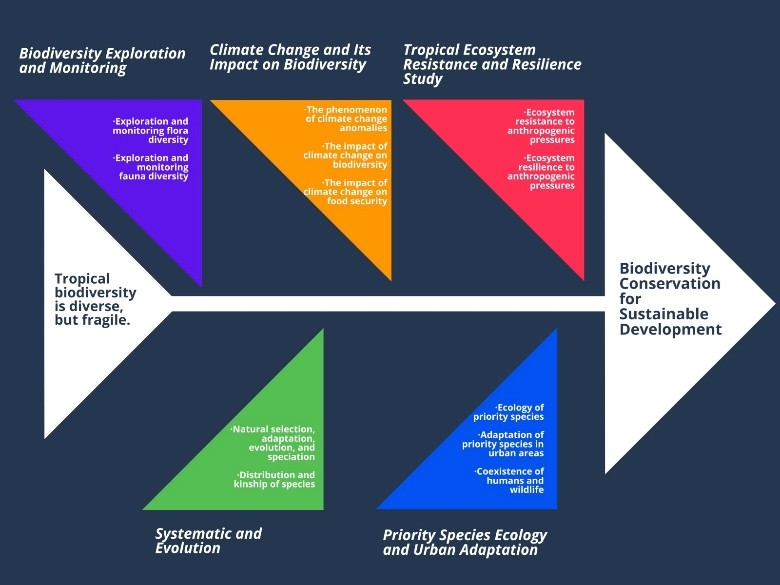
- Biodiversity exploration and monitoring.
- Systematic and evolution.
- Reciprocal impact. between biodiversity loss and climate change.
- Priority species ecology and urban adaptation.
- Tropical ecosystem resistance and resilience study.