


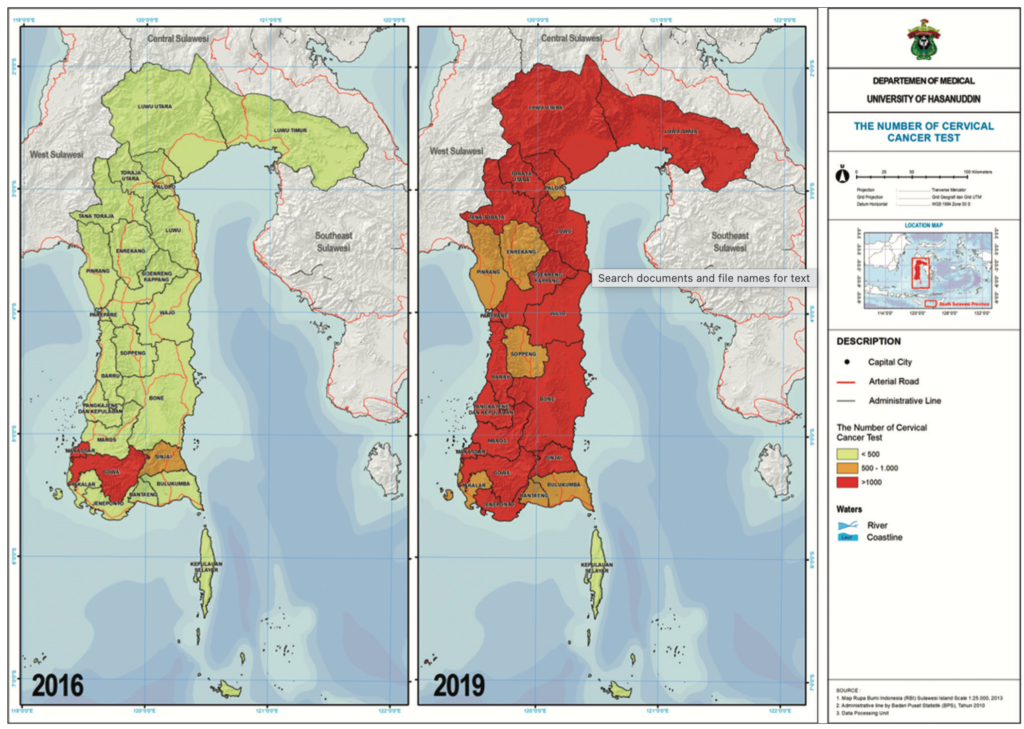
MAKASSAR, Indonesia Feb 03 2025 /STEPMIC/– That is the powerful idea behind a published study titled “Geospatial Analysis of Cervical Cancer Distribution in South Sulawesi Province,” which appeared in the Open Access Macedonian Journal of Medical Sciences, published by the Open Access Macedonian Journal of Medical Sciences, on 2022 Sep 10. The article shows that cervical cancer is not only a medical issue, but also a spatial one: where people live can shape how easily they access screening, information, and early treatment. The study focused on South Sulawesi and examined screening data from 24 districts and cities between 2016 and 2019. Using geospatial methods such as Global Moran’s I and Local Moran’s I, the researchers mapped patterns of cervical cancer distribution, risk, and clustering. Their analysis found that in 2016 there were several hotspot areas, one cold-spot cluster, and a number of spatial outliers. By 2019, the pattern had improved, but two hotspot clusters still remained, especially in rural areas.
This finding matters because cervical cancer remains a serious public health challenge. The article explains that Indonesia has a very high burden of cervical cancer, and that prevention must be strengthened to stop more women from being diagnosed too late. In South Sulawesi, the number of women taking the VIA screening test increased from 2016 to 2019, while the proportion of positive results decreased. This suggests that prevention efforts were moving in the right direction. Still, the persistence of hotspot areas means that progress has not been equal everywhere.
This issue is closely linked to SDG 3: Good Health and Well-Being. A healthier society depends not only on hospitals and doctors, but also on early detection, fair access to services, and better public health planning. The study makes clear that rural women may face greater obstacles, including limited information, lower participation in screening, and geographic barriers. By identifying where risk is concentrated, geospatial analysis can help governments and health institutions target education campaigns, screening programs, and funding more effectively.
The study also speaks to SDG 17: Partnerships for the Goals. Public health problems like cervical cancer cannot be solved by one sector alone. This research relied on screening data from the Provincial Health Office of South Sulawesi and was supported by the Faculty of Medicine, Universitas Hasanuddin. That cooperation shows how data, academic research, and public institutions can work together to produce practical knowledge for society.
In the end, this article offers a simple but important message: disease prevention becomes stronger when we understand not only who is at risk, but also where risk is concentrated. Maps are not just tools for geography classrooms. In the context of cervical cancer, they can become tools for justice, prevention, and hope. When health policies are guided by evidence and directed toward underserved areas, more women can gain the chance for early detection and a healthier future.
Reference:
DOI: https://doi.org/10.3889/oamjms.2022.10417
Contact:
Dr. dr. Alfian Zainuddin, MKM
a.alfian@med.unhas.ac.id