

Description
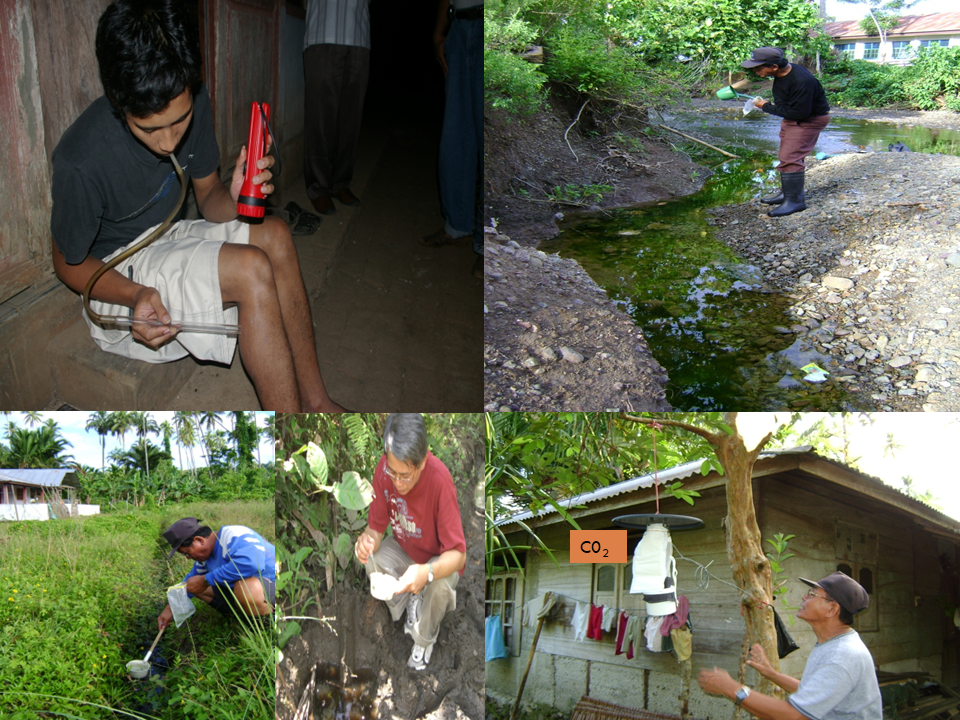
There are two species of malaria vector in South Halmahera e.g. An. farauti and An. Punctulatus. These species are more outdoor biting. Densities of An. punctulatus and An.farauti in South Halmahera always very low, MBR: 0-0.166. These species bite actively from 18.00-06.00, though the biting peaks are varied between species and places. The experiment using Tent trap with Goat in South Halmahera is look promising and need to be continued.

Description
Malaria is still a major public health problem in Indonesia. The prevention efforts implemented to date are still partial so that the results obtained have not been maximized and for this reason it is necessary to carry out integrated and comprehensive prevention efforts. Malaria transmission includes 4 aspects that interact dynamically with each other, namely human host factors, parasite factors, anofeles mosquito factors and environmental factors. Various malaria control efforts carried out by the World Health Organization (WHO) in Africa and various other regions have failed because there is no balance in handling the factors mentioned above. The research activities proposed in this proposal include the development of a fact-based malaria control pattern in Indonesia, by choosing one area in West Sulawesi Province as a model. Based on the availability of human resources as well as the vision and mission carried out, Hasanuddin University took the initiative to start an integrated activity in controlling malaria and various other vector borne diseases, through a comprehensive approach to the various factors above.
Description
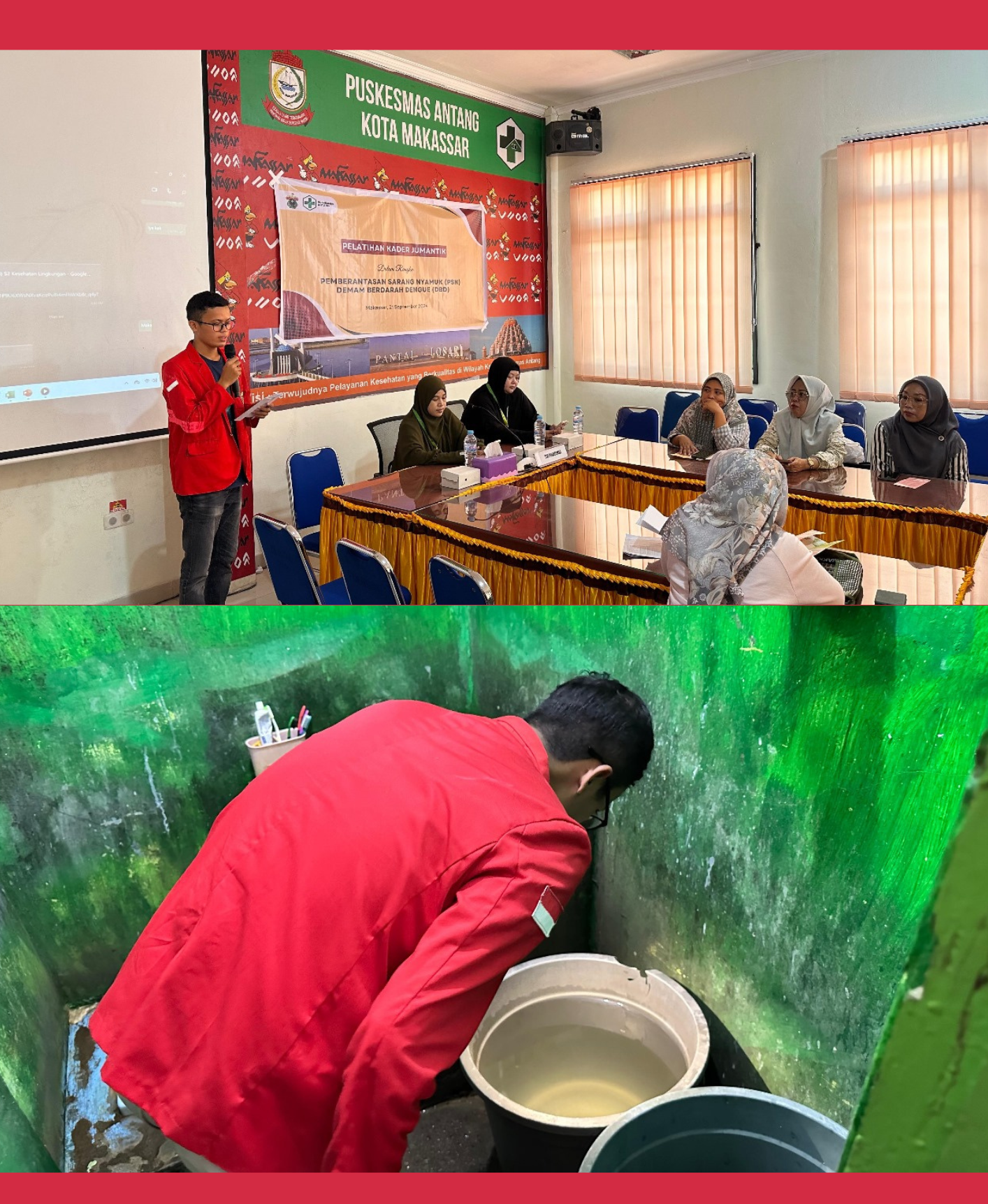
Dengue fever (DHF) is an infectious disease caused by the dengue virus and transmitted through mosquito vectors, where the main vector is the Aedes aegypti species mosquito. DHF is still a public health problem in the world. This was revealed by WHO which has included DHF as one of the global health threats among 10 other diseases. This type of research is a quasi experiment with a pre test-post test control group design approach. The study population involved the community of Antang Village and Bitowa Village, both sufferers and non-sufferers of DHF. The research sample was taken using proportional stratified random sampling technique. The research sample used reached 126 samples. Based on the results of the study, there was an influence before and after the jumantik cadre training on knowledge (Antang (p-value = 0.003), Bitowa (p-value = 0.003)), attitude (Antang (p-value = 0.025), Bitowa (p-value = 0.000)), and action (Antang (p-value = 0.000), Bitowa (p-value = 0.000)). Larval density was significantly different in Antang (CI = 3.3% and DF = 3, and in Bitowa (CI = 3.9% and DF = 2). There is an effect of jumantik cadre training on the behavior of 3M Plus Mosquito Nest Eradication (PSN) for dengue hemorrhagic fever in Antang and Bitowa villages.

Description
Dengue fever (DHF) is a disease caused by dengue virus transmission through the mosquito Aedes Aegypti and is still a major public health problem in Indonesia. Therefore, it requires the role of various levels of society in Mosquito Nest Eradication (PSN) efforts, one of which is the Empowerment of Larva Monitoring Students. This study is to determine the effectiveness of Student Larva Monitors based on knowledge, attitudes and actions as well as the presence of Aedes Aegypti in the environment where the respondents live. This study used Quasi Experimental Two Group pre-posttest design. Sampling using Purposive Sampling technique, namely students at SMPN 49 Makassar and SMPN 21 Makassar students as many as 60 respondents. The instruments used were questionnaires, pocket books, leaflets, etc. Measurements taken were observation of the presence of larva, filling out questionnaires of knowledge, attitudes and actions. Larva monitoring training and counseling on dengue and mosquito nests eradication efforts significantly reduced the presence of Aedes Aegypti larvae based on the results of pre-test and post-test analysis of the presence of Aedes Aegypti larvae, p value = 0,00 in the intervention group and p value = 0,50 in the control group, as well as the influence of knowledge, attitudes and actions of respondents regarding DHF and mosquito nests eradication with the presence of larva, with p value = 0,00, while for the influence of the presence of larval monitoring students with the knowledge of family members obtained p value = 0,69. Larva monitoring pupils in Rappocini District are impacted by the presence of Aedes aegypti larva in their homes. Respondents\' knowledge, attitudes, and behaviors about DHF and attempts to eliminate DHF mosquito nests with Aedes aegypti larvae are all impacted. The presence of larvae monitoring students in Rappocini District, however, has little bearing on family members\' awareness of DHF or their attempts to remove DHF mosquito nests from their houses.
Keywords: DHF, Knowledge, PSN, Attitude, Simantik, Action