

Behind every bar of chocolate lies a long biological journey that begins in cacao plantations. Yet, before cacao beans can be transformed into one of the world’s most beloved foods, they face a serious challenge: pod rot disease. This hidden microbial battle not only threatens cacao productivity, but also affects the livelihoods of millions of smallholder farmers who depend on cacao cultivation. On 19 May 2026, an important scientific milestone related to this issue was presented at Ghent University, Belgium, through an international conference highlighting innovations in plant disease research and sustainable agriculture.

The activity, entitled “When a Cocoa Pod Rots: The Hidden Microbial Battle Behind Chocolate’s First Step,” showcased a scientific poster developed by the PRG research team focusing on cacao disease interactions and microbial dynamics. During the conference, the poster received international recognition after being nominated and awarded the Best Poster Presentation. The nomination was presented by Prof. Eduardo De La Peña, who served as Vice Chair of the symposium and became an important international partner in promoting collaborative cacao research between Indonesia and the global scientific community.
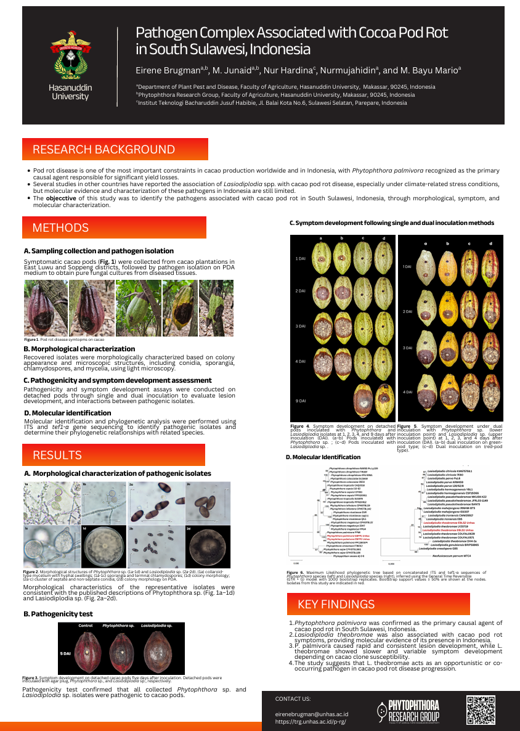
This achievement reflects growing international attention toward Indonesia’s contribution to plant protection science, especially in cacao disease management. The research highlighted how microbial communities interact within infected cacao pods and how understanding these interactions can help researchers design more sustainable disease mitigation strategies. By exploring the unseen biological processes occurring inside diseased cacao pods, the study contributes to the development of environmentally responsible agricultural practices that support healthier crops and more resilient farming systems.
The activity also emphasized the importance of science communication in connecting research findings with broader public understanding. Through accessible visual presentations and interdisciplinary discussion, participants were encouraged to see cacao diseases not merely as agricultural problems, but as global challenges linked to food security, biodiversity, farmer welfare, and sustainable development. The conference created opportunities for knowledge exchange between researchers, students, and international collaborators from various scientific backgrounds.
This international recognition strongly aligns with several Sustainable Development Goals (SDGs). In particular, the activity supports SDG 1: No Poverty, as healthier cacao production systems can improve the economic stability of smallholder farmers who rely on cacao as a primary source of income. The conference also reflects SDG 4: Quality Education through scientific learning, international academic exchange, and the involvement of young researchers in global research environments. Furthermore, the collaboration and acknowledgment from international scholars demonstrate the implementation of SDG 17: Partnerships for the Goals, highlighting the importance of global cooperation in addressing agricultural and environmental challenges.
The participation of young researchers played an important role in the success of the activity. Eirene Brugman, S.P., M.Sc. represented the academic spirit of interdisciplinary research and scientific engagement in the field of plant protection and cacao pathology. The conference itself involved 3 participants from Hasanuddin University, and a total of 300 participants from 22 countries, creating a focused yet impactful platform for intensive discussion and academic networking.
Ultimately, this recognition at Ghent University demonstrates that scientific discoveries originating from cacao plantations in Indonesia can contribute meaningfully to international conversations on sustainable agriculture, food systems, and environmental resilience. It also reinforces the idea that understanding the microscopic world inside a rotting cacao pod may hold the key to protecting the future of chocolate production worldwide.


