

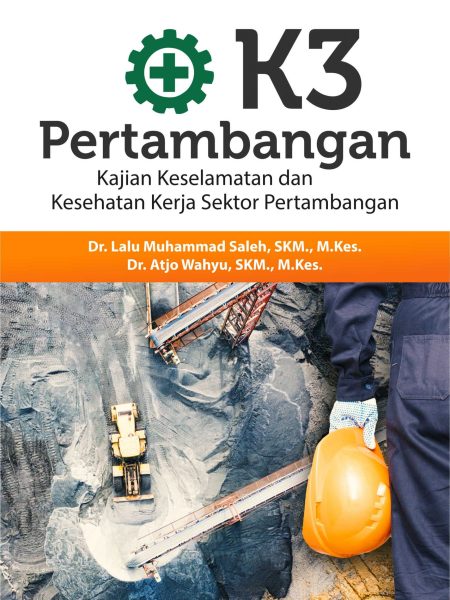
K3 Pertambangan, Kajian Keselamatan dan Kesehatan Kerja Sektor Pertambangan (Mining OHS Book: A Study on Occupational Health and Safety in the Mining Sector)
Mining activities produce essential products that are highly beneficial for daily life. These include oil and gas used as fuel for vehicles and power plants, copper for water pipes, bauxite for kitchen utensils, gold for jewelry, and many others that will be explained in Chapter II. This book provides a comprehensive explanation, extensively referencing books, official websites of mining-related organizations, and review journals. Occupational health and safety is still rarely discussed in the mining industry, despite its crucial role in the economic development of many countries. The industry must be carefully regulated to ensure sustainability while considering all supporting aspects, such as improving human resource quality to prevent occupational diseases, workplace accidents, and various occupational health risks. If workers fall ill, it will inevitably impact the company’s productivity. This book consists of twelve sections: Sections 1 to 4 discuss the introduction, the mining industry, mining-related laws and regulations, and hazards and risks in mining. Chapters 5 to 8 cover hazards and risks in the oil and gas mining sector, hazard and risk control in mining, hazard and risk control in oil and gas mining, and occupational diseases (OD) in mining. Chapters 9 to 12 explore human error in mining, mining management, global mining issues, and first aid in mining.
- ISBN
- Authors
- Year
- Publisher
- Pages
978-623-02-0096-0
Lalu Muhammad Saleh, Atjo Wahyu
2019
Deepublish
221
Keselamatan Dan Kesehatan Kerja Kelautan: Kajian Keselamatan Dan Kesehatan Kerja Sektor Maritim (Maritime Occupational Health and Safety Book: A Study on Occupational Health and Safety in the Maritime Sector)
As the world’s largest maritime nation, Indonesia possesses vast marine, coastal, and small island areas that play a strategic role in national economic development. Indonesia’s maritime territory covers 5.8 million km², or about two-thirds of the country\'s total area, including 3.1 million km² of territorial waters and 2.7 million km² of the Indonesian Exclusive Economic Zone (EEZ). Indonesia consists of 17,504 islands, with a coastline stretching approximately 95,181 km. Around 80% of industries and 75% of major cities are located in coastal areas. Additionally, 70% of Indonesia’s 60 oil and gas basins are offshore, containing an estimated 9.1 billion barrels of crude oil reserves. Most of Indonesia\'s tourism attractions are also related to the sea, coastlines, and small islands. Furthermore, Indonesia is rich in marine resources, particularly fisheries. The country is known for having the world’s largest Marine Mega-Biodiversity, including 8,500 fish species (37% of the world’s fish species), an annual marine catch of approximately 6.5 million tons, 555 species of seaweed, and 950 species of coral reef biota. Indonesia also has extensive aquaculture areas, with 2.96 million hectares for brackish water farming and 12.55 million hectares for marine aquaculture (KKP, 2014). Beyond its economic and ecological value, Indonesia’s strategic geopolitical location between the Pacific and Indian Oceans makes it a highly dynamic region in global political, defense, and security affairs. This book consists of several chapters: Chapter 1 provides an introduction, Chapter 2 discusses maritime OHS management, Chapter 3 covers seafarers, Chapter 4 focuses on fishermen, Chapter 5 explores dock workers, Chapter 6 examines first aid in the maritime sector, Chapter 7 delves into hyperbaric conditions, and Chapter 8 presents a study on traditional fishermen.
- ISBN
- Authors
- Year
- Publisher
- Pages
978-602-475-981-0
Lalu Muhammad Saleh
2018
Deepublish
302

Epidemiologi K3 (Occupational Health and Safety Epidemiology)
The field of study that examines the frequency, distribution, and determinants of diseases is the most common definition used to describe the discipline of epidemiology. Epidemiologists systematically apply both deductive and inductive reasoning before drawing conclusions about events occurring within specific groups, particularly concerning diseases or health conditions affecting certain populations. This makes epidemiology an essential and indispensable field of study. Epidemiological studies aim to uncover cause-and-effect relationships between risk factors and specific diseases, thereby providing insights into the health status of populations. These findings are supported by analyzing field-based evidence and utilizing fundamental epidemiological measurements such as rates, ratios, and proportions. In terms of frequency measurement, this book discusses prevalence (point prevalence, period prevalence), incidence (incidence rate, incidence risk), and other key epidemiological assessments. This book is structured as a comprehensive synthesis of occupational health and safety epidemiology. Many critical aspects need to be considered when analyzing occupational health and safety (OHS) from an epidemiological perspective, ranging from the history of OHS epidemiology to the combination of risk prevention and control strategies through surveillance and risk assessment, among other topics. The explanations in this book are detailed and comprehensive, with extensive references from books and peer-reviewed journals to provide a well-rounded and evidence-based discussion.
- ISBN
- Authors
- Year
- Publisher
- Pages
978-623-02-2461-4
Lalu Muhammad Saleh, Iva Hardi Yanti
2021
Deepublish
198

Manajemen Teknik Relaksasi Otot Progresif Pada ATC (Progressive Muscle Relaxation Technique Management for Air Traffic Controllers)
This book explores the management of Progressive Muscle Relaxation (PMR) techniques for Air Traffic Controller (ATC) employees, serving as a continuation of the book Stress Management (A Case Study on Air Traffic Controller Employees). The author examines the impact of progressive muscle relaxation (PMR) on ATC employees, discussing several key topics, including: Understanding the ATC Profession, History of Relaxation Techniques, Progressive Muscle Relaxation (PMR), Implementation of PMR Techniques in ATC, Research Findings on Relaxation and Anxiety. This book provides a comprehensive explanation, incorporating references from books, nationally accredited journals, and international research papers. Psychological conditions are a significant occupational health and safety risk factor, especially in the aviation industry. ATC employees face immense pressure in controlling aircraft, requiring high levels of concentration, responsiveness, precision, and accuracy. Therefore, effective stress management strategies, such as Progressive Muscle Relaxation (PMR), are essential to help reduce psychological strain and enhance workplace well-being.
- ISBN
- Authors
- Year
- Publisher
- Pages
978-623-02-5960-9
Lalu Muhammad Saleh
2023
Deepublish
143