


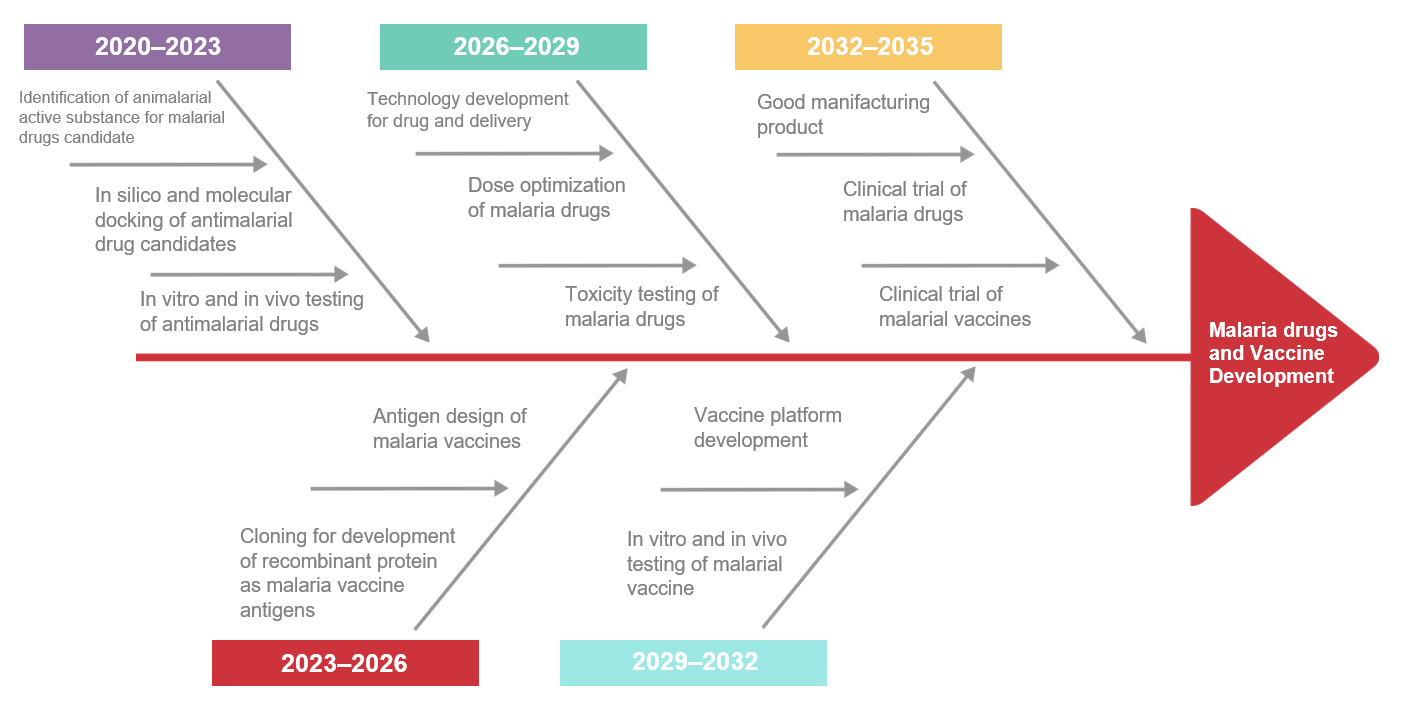
ROADMAP
Research Sub-Theme
Malaria Vaccine Development
Malaria remains a global health challenge, particularly in tropical regions. Significant progress has been made in malaria vaccine development, with RTS,S/AS01 (Mosquirix) approved by WHO in 2021 and R21/Matrix-M in 2023. R21 has demonstrated higher efficacy (~75%) compared to RTS,S. However, several challenges persist, including the complex life cycle of Plasmodium, antigenic variability, and limited immune durability, necessitating booster doses. Additional obstacles include production costs, distribution, and public acceptance. Further research, particularly on mRNA-based vaccines and herbal medicine, is expected to enhance the efficacy and accessibility of malaria vaccines. Global policy support and funding are crucial to optimizing the impact of vaccination in malaria control.
Vaccinology
Vaccinology plays a crucial role in preventing infectious diseases through vaccine development. Technological advancements have enabled the creation of various types of vaccines, including conventional vaccines (inactivated and live-attenuated), recombinant protein-based vaccines, viral vector vaccines, and mRNA vaccines. mRNA vaccines, such as those used for COVID-19, have demonstrated high efficacy and faster production rates. However, challenges in vaccinology remain, including long-term effectiveness, safety, stability, and vaccine distribution in regions with limited infrastructure. Additionally, pathogen variability and immune resistance can reduce vaccine effectiveness. Continuous research is essential to develop safer, more effective, and globally accessible vaccines
Infection And Immunity
Infection occurs when pathogens, such as viruses, bacteria, or parasites, successfully invade the body and overcome the host’s defense mechanisms. The immune system plays a crucial role in detecting and neutralizing pathogens through innate and adaptive immune responses. Innate immunity provides an initial defense via macrophages, neutrophils, and dendritic cells, while adaptive immunity involves T cells and B cells, which establish immunological memory. However, pathogens often develop immune evasion mechanisms, such as antigenic mutations and modulation of the host immune response, which can hinder immune defense effectiveness. Recent studies highlight the role of immunotherapy and vaccination in enhancing protection against infections. A deeper understanding of pathogen-immune interactions is essential for developing more effective prevention and therapeutic strategies.
Malaria Drug Discovery
Malaria remains a global health threat requiring effective therapies to reduce morbidity and mortality. Malaria drug discovery focuses on developing novel compounds that can target Plasmodium spp. with high efficacy and minimal resistance risk. Drugs such as artemisinin and its derivatives have been the primary treatment; however, emerging resistance in certain regions necessitates the search for new drug candidates. Recent strategies include molecular screening-based drug discovery, inhibition of essential metabolic pathways, and combination therapies to enhance efficacy and prevent resistance. Major challenges include high development costs, clinical effectiveness, and distribution in endemic areas. Continuous research utilizing bioinformatics and medicinal chemistry approaches is essential for developing more effective and sustainable malaria treatments.
Antimalarial Drug Mechanism
Antimalarial drugs target various stages of the Plasmodium spp. life cycle to inhibit parasite growth and replication. The primary mechanisms include inhibition of hemoglobin metabolism by chloroquine, disruption of mitochondrial metabolic pathways by atovaquone, and inhibition of nucleic acid biosynthesis by primaquine and antifolates. Artemisinin and its derivatives act by generating free radicals that damage parasite proteins and membranes. Although these drugs are effective, resistance to antimalarials, particularly chloroquine and artemisinin, has emerged in several endemic regions. Consequently, recent research focuses on combination therapies and the development of novel molecular targets to enhance efficacy and prevent resistance. A deeper understanding of drug action mechanisms is crucial for discovering more effective and sustainable malaria treatments.