MAKASSAR, Indonesia Maret 1 2026/MARGO/ In the 1970s, the coastal area of Kuri Caddi in South Sulawesi was a dense, thriving mangrove forest. But economic ambitions—national targets to boost shrimp production—led entrepreneurs to convert these mangroves into aquaculture ponds. The gamble failed. Many ponds were abandoned after ecological collapse, and the area suffered from declining water quality, coastal erosion, and tidal flooding. The mangroves were gone, and so was the productivity they once supported.
But this is not a story of permanent loss. In 2012, a community-based rehabilitation program led by Blue Forest (formerly Mangrove Action Project Indonesia) began restoring seven hectares of unproductive ponds back into mangrove ecosystems using the Ecological Mangrove Restoration (EMR) approach. Today, the area has seen a significant increase in mangrove cover, with local communities reporting reduced erosion, increased crab and fish catches, and less flooding.
A study published on 1 March 2026 in the Egyptian Journal of Aquatic Biology and Fisheries (Publisher: The Egyptian Society for the Development of Fisheries and Human Health) titled “Pond Water Quality Under Different Mangrove Cover in Kuri Caddi, Maros, Indonesia” set out to answer a critical question: does the level of mangrove cover actually affect the water quality entering traditional fish ponds?
Researchers from Hasanuddin University and the Blue Forest Foundation sampled water at seven stations with different mangrove cover levels—dense, moderate, and no mangroves. They measured temperature, salinity, turbidity, pH, dissolved oxygen, biochemical oxygen demand, nitrate, nitrite, phosphate, and plankton abundance.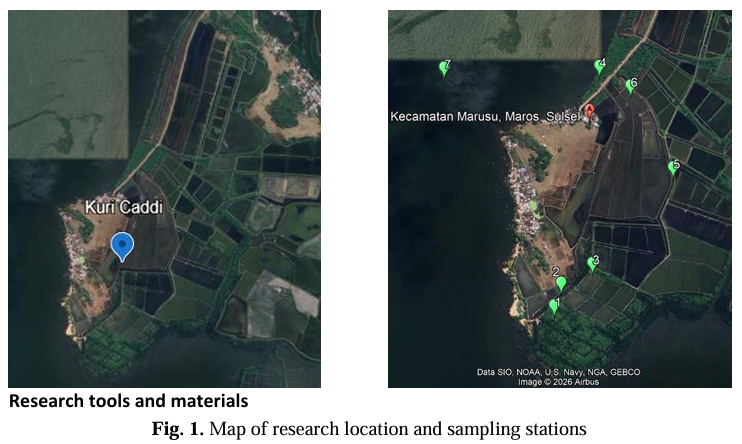
The results were encouraging—and surprising. Water quality across all sites was generally within acceptable ranges for aquaculture. Temperature averaged 29-31°C, salinity 32-34 ppt, and dissolved oxygen 3.6-7.0 mg/L. Interestingly, the statistical analysis (Pearson correlation) found no significant direct relationship between mangrove cover level and any water quality parameter. In other words, water quality was relatively stable regardless of whether the inlet channel passed through dense, moderate, or no mangroves.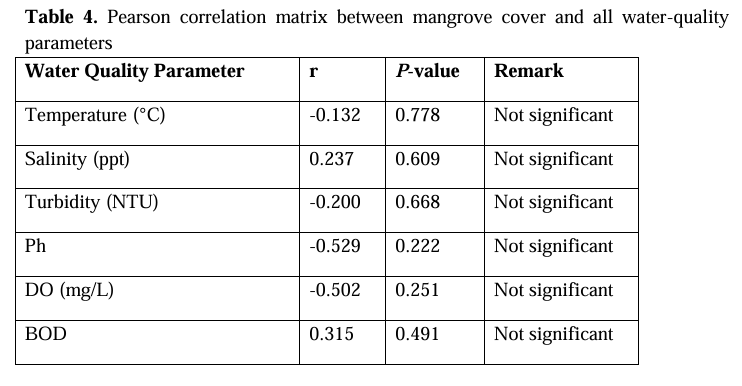
But does this mean mangroves don’t matter? Not at all. The researchers suggest that mangroves function as an ecological buffer—not by dramatically changing individual parameters, but by stabilizing the overall aquatic environment over the long term. They help trap sediments, regulate temperature, and provide a steady supply of organic matter that supports the food web. The relatively uniform water quality across sites may actually reflect the cumulative benefit of the rehabilitation effort, rather than the absence of an effect.
This research directly supports the United Nations’ Sustainable Development Goal 14: Life Below Water. By demonstrating that mangrove rehabilitation can support stable water quality for aquaculture, it promotes the sustainable use of coastal resources and the restoration of critical ecosystems. It also supports livelihoods (SDG 1) by helping coastal communities maintain productive ponds while protecting the environment. The story of Kuri Caddi shows that with patience, science, and community effort, even degraded landscapes can recover—and when they do, both people and nature benefit.
Reference
DOI:
https://journals.ekb.eg/article_491022_d3e749af263715262d2aa0875784b195.pdf
Contact:
Prof. Dr. Ir. Ambo Tuwo DEA
+628124206391
ambotuwo62@gmail.com