MAKASSAR, Indonesia September 1 2020/MARGO/ For coastal communities across Southeast Asia, the sandfish (Holothuria scabra) is more than just a sea cucumber—it is a lifeline. This humble creature, which burrows in sandy seabeds, commands high prices in international markets and provides essential income for thousands of poor fishing families. But overfishing has devastated wild populations. Aquaculture—raising sandfish in coastal ponds—has been promoted as a sustainable solution. Yet for more than 20 years, farmers have faced a frustrating problem: their sandfish keep dying, especially during the rainy season.
Why? The answer, as revealed in a study published on 1 September 2020 in the IOP Conference Series: Earth and Environmental Science (Publisher: IOP Publishing) titled “Low salinity reduces survival rate of a commercially important sea cucumber (Sandfish: Holothuria scabra),” comes down to one simple factor: freshwater.
Researchers from Hasanuddin University in Indonesia conducted two experiments to test how salinity—the saltiness of water—affects sandfish survival. In the first experiment, they suddenly dropped the salinity in tanks containing sandfish to various levels: 35, 30, 25, 20, 15, 10, and 5 parts per thousand (ppt). The results were striking. At salinities of 20 ppt and above, the sandfish remained active, moved around, and produced feces—signs of healthy life. But at 15 ppt and below, the animals stopped moving, stopped feeding, and within three days, their skin began to disintegrate. They were dead. 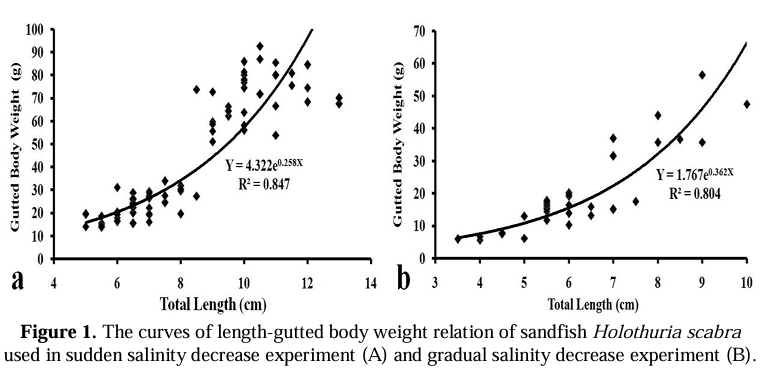
The second experiment mimicked a more realistic scenario: a gradual decrease in salinity, like what happens during prolonged rainy seasons. The researchers replaced small amounts of tank water with freshwater every 12 hours. Again, the results were clear. Mortality began when salinity dropped below 18 ppt—the salinity level of saltwater fish body fluids. By the time salinity reached 14 ppt—the salinity of freshwater fish body fluids—all the sandfish were dead.
The study calculated that the salinity at which 50% of sandfish would die was approximately 14.6 ppt. But the critical threshold was actually higher: below 18 ppt, survival rates began to plummet. The researchers concluded that sandfish, like other echinoderms, are highly sensitive to salinity changes because their bodies lack efficient regulatory systems. They simply cannot cope with water that is too fresh. 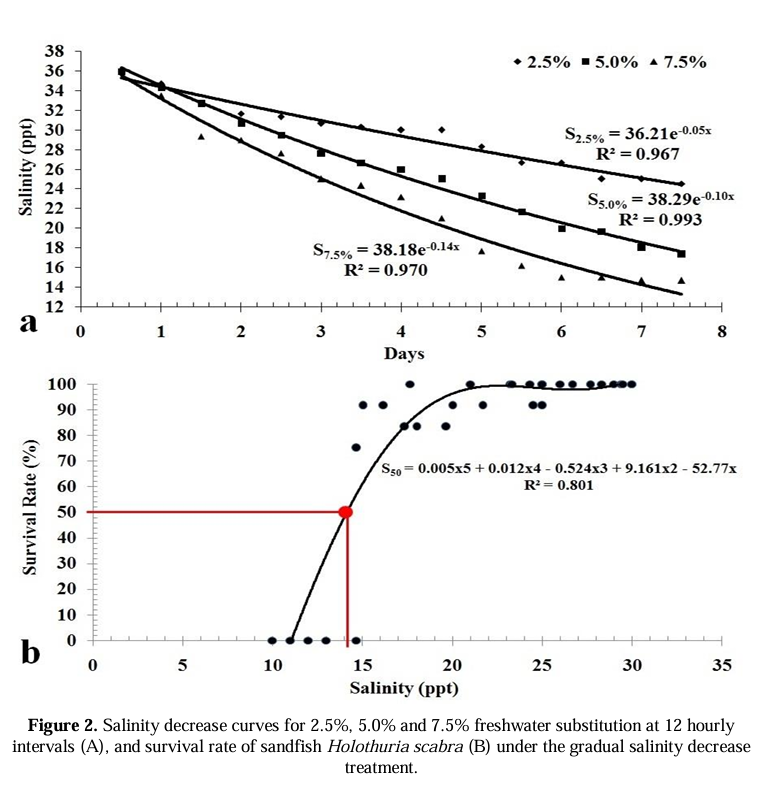
This research directly supports the United Nations’ Sustainable Development Goal 14: Life Below Water. By identifying the specific salinity threshold that threatens sandfish survival, it provides farmers with clear, actionable guidance: maintain pond salinity above 18 ppt, especially during the rainy season. This knowledge can transform aquaculture from a risky gamble into a reliable livelihood, protecting both endangered wild populations and the coastal communities that depend on them (SDG 1). With better management, the humble sandfish can continue to support families, sustain ecosystems, and contribute to food security for generations to come.
Reference
DOI:
https://iopscience.iop.org/article/10.1088/1755-1315/564/1/012088/pdf
Contact:
Prof. Dr. Ir. Ambo Tuwo DEA
+628124206391
ambotuwo62@gmail.com