



Description
This study analyses the influence of the current account, inflation, and political stability on exchange rate dynamics in
ASEAN-5 countries during 2010–2024. A quantitative approach is applied using annual data from the IMF, World Bank,
and BIS, estimated through panel data regression with the optimal specification determined by Chow, Hausman, and
Lagrange Multiplier tests. The findings show that stronger current account balances foster domestic currency
appreciation, while higher inflation contributes to depreciation, consistent with balance of payments and purchasing
power parity theories. Political stability exerts a positive effect by improving market confidence and encouraging
capital inflows. Policy recommendations highlight the need for coordinated monetary and fiscal policies alongside
institutional reforms to strengthen currency resilience. The main limitations relate to the use of annual data and the
heterogeneity across countries. The study provides original evidence on the joint role of economic and political
fundamentals in sustaining exchange rate stability in emerging economies, underscoring the multidimensional nature
of currency dynamics and their broader policy implications.
JEL Classification: F3, F30, F31, F32
Keywords: Current Account, Inflation, Political Stability, Exchange Rate
Description
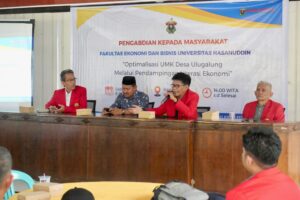
The Community Service (PKM) Team of the Internal Grant Program for Main Performance Improvement (Hibah-KIPKU) of the Faculty of Economics and Business, Hasanuddin University, in collaboration with Bank Unhas, conducted a training activity titled "Optimizing MSEs in Ulugalung Village Through Economic Literacy Mentoring." The activity took place at the Ulugalung Village Office, Eremerasa District, Bantaeng Regency.
The PKM FEB Unhas team was led by Prof. Dr. Anas Iswanto Anwar, SE., MA., with team members Dr. Agus Bandang, Drs. Bakhtiar Mustari, SE., M.Sc., and several students. In his remarks, Prof. Anas emphasized that community service activities are part of the implementation of the Tri Dharma of Higher Education, which aims to apply science, technology, and the arts directly to the community. He stated that strengthening community capacity through this type of mentoring is expected to accelerate economic development and improve welfare.
The Head of Ulugalung Village, Haleko HB., expressed his appreciation and welcomed this activity. He stated that this was the first training activity of its kind in Ulugalung Village and was expected to provide tangible benefits to local Micro and Small Enterprises (MSEs).
During the presentation session, Dr. Agus Bandang emphasized the importance of increasing MSE competitiveness by strengthening the quality of human resources. Nur Rezky Amalia then presented on Family Financial Planning, while Taufik Hidayat, a representative from Bank Unhas, discussed Financial Inclusion as an effort to expand public access to formal financial services.
The event was attended by approximately 25 participants, consisting of MSEs and housewives in Ulugalung Village. Participants were enthusiastic and actively engaged in discussions throughout the session. The training concluded with a group photo session and the distribution of door prizes as a token of appreciation.

Description
The aim of this research is to increase skills and knowledge about managing financial and digital literacy among Micro and Small Business actors in Bantaeng Regency, South Sulawesi Province. Referring to the partner problems stated above and the objectives of this community outreach activity, the benefits that can be obtained by the target community (UMK actors) are understanding and skills on how to utilize free time and manage financial and digital literacy.

Description
The need to build a credible and independent BUMDes so that it can contribute greatly to village income in particular and society in general. The need to encourage community empowerment, especially lower-middle income communities and micro, small, and medium enterprises (MSMEs) requires comprehensive support from financial institutions. So far, MSMEs have been constrained by access to funding from formal financial institutions. To overcome these obstacles, many non-bank financial institutions have grown and developed in society that carry out business development and community empowerment services, both established by the government and the community. These institutions are known as microfinance institutions (LKM). However, many of these LKMs do not yet have legal entities and business licenses. In order to provide a strong legal basis for the operationalization of LKM, on January 8, 2013, Law Number 1 of 2013 concerning Microfinance Institutions was enacted.

Description
The financial inclusion program in Asia has begun to be carried out intensively, focusing on increasing public access, especially for people who have yet to enjoy banking services. This makes financial inclusion one of the development focuses in the financial sector in various countries, especially in the Asian region. This study compares the financial inclusion level and socioeconomic variables’ influence on financial inclusion in Asian countries in 2010–2022. To compare the level of financial inclusion in several Asian countries, the Index of Financial Inclusion (IFI) analysis method was used, while to examine the relationship between socioeconomic variables on financial inclusion, the Ordinary Least Square (OLS) method was used with an estimation technique, in the Fixed Effects Model approach. The results of this study indicate that, in general, financial inclusion in several Asian countries is mainly influenced by the usability dimension. In addition, only the variable GDP per capita is partially influential. While other variables, namely, the unemployment rate and population in rural areas, significantly influence the financial inclusion index.

Description
A rise in food prices has a big impact in a country such as Indonesia, especially in poorer households who spend more than 60 percent of their budget on food. Changes in food prices, even small ones, create uncertainty and are a sensitive political issue.
In this report we are able to show how commodity price rises across ten staple foods can affect the ability of households to purchase those different foods, and how much extra money they need to maintain their standard of living.
A range of domestic and international factors has been behind substantial food price rises in Indonesia since 2019. To better understand this the report looks at a price surge from 2019 to 2022 at provincial level in South Sulawesi and considers variables such as whether families live in urban or rural areas, if they receive welfare and the size of the family. A second analysis on the time period from 2021 to 2022 is based on five market clusters in the province and different levels of inflation, across ten essential commodities such as rice, chicken meat and sugar. Using modelling it is possible to gain insights that can help policymakers with decisions on how to best support households. For instance we know consumers spend the most on rice at a massive 57.3 percent of the food budget and the least on beef at just 0.6 percent. If prices of beef, chicken meat, sugar and red chilli rise even a little, people will buy considerably less of these foods. Larger families or those that receive welfare support tend to spend less of their budget on rice and sugar, but more on other foods except beef. While smaller families and those not on welfare spend more on rice and sugar but less on other foods Governments already provide assistance such as food vouchers and these findings show that policies could be targeted to suit household differences. For example, people in Makassar might need less help compared to other areas. Or there could be more focus on items that have seen the biggest price increases with assistance directly linked to buying these specific foods. At another level the information could generate a broader discussion about the factors affecting food prices, such as supply chains, and what action can be taken at a government level. This report shows that data can be used to calculate the impact of food price rises on different kinds of households which allows for more considered decision-making when trying to mitigate the effects or help ease concerns around food security. We recommend utilising this analysis and data to inform economic decision making while also considering the longer-term drivers of food supply and price fluctuations that need addressing.