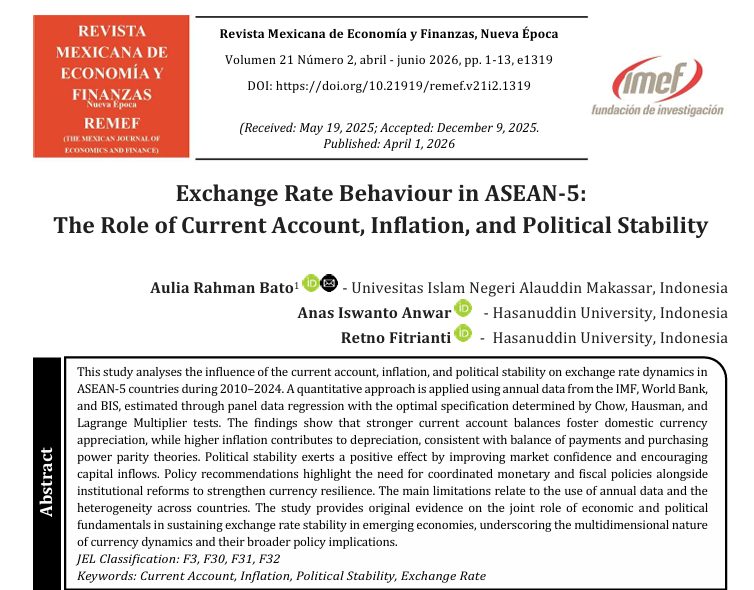

Makassar, April 14 2026 – In today’s interconnected world, exchange rates are not just numbers on financial screens—they shape the cost of living, influence job creation, and determine how countries compete globally. A recent study titled “Exchange Rate Behaviour in ASEAN-5: The Role of Current Account, Inflation, and Political Stability” provides important insights into how economic and political factors interact to influence currency stability in Southeast Asia.
Published in THE MEXICAN JOURNAL OF ECONOMICS AND FINANCE by FUNDACION DE INVESTIGACION on April 1, 2026, this research highlights how countries like Indonesia, Malaysia, Thailand, the Philippines, and Singapore manage the delicate balance between economic growth and stability. The study emphasizes three key drivers of exchange rates: current account balance, inflation, and political stability.
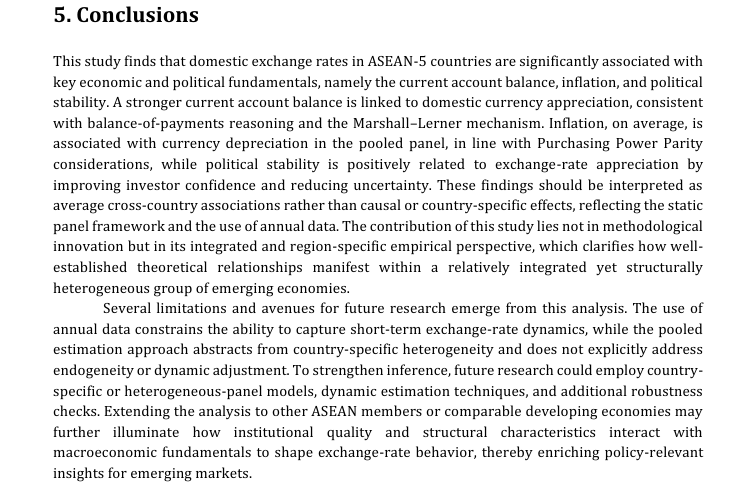
At its core, the research reveals a simple but powerful message: strong economic fundamentals lead to stronger currencies. When a country exports more than it imports—reflected in a healthy current account balance—its currency tends to appreciate. This means greater confidence from global markets and more stable economic conditions. On the other hand, high inflation weakens a currency by reducing its purchasing power, making goods more expensive both domestically and internationally.
However, what makes this study particularly relevant is its inclusion of political stability as a crucial factor. A stable political environment builds trust among investors, encourages capital inflows, and ultimately strengthens the national currency. In contrast, uncertainty in governance can trigger capital flight and exchange rate volatility, even if economic indicators appear stable.
This discussion is closely linked to SDG 1: No Poverty, SDG 4: Quality Education, and SDG 17: Partnerships for the Goals. Stable exchange rates contribute to poverty reduction (SDG 1) by maintaining purchasing power and preventing sudden increases in the cost of living. When currencies are stable, essential goods such as food and fuel remain affordable, protecting vulnerable populations.
Furthermore, the dissemination of research like this supports SDG 4: Quality Education, as it translates complex economic concepts into knowledge that can be understood and applied by students, policymakers, and the general public. By bridging the gap between academic research and public understanding, such studies empower societies to make informed economic decisions.
Equally important is SDG 17: Partnerships for the Goals, which is reflected in the collaborative nature of the research. The study uses international data sources such as the IMF, World Bank, and BIS, demonstrating how global cooperation enhances the quality and relevance of economic analysis. This kind of partnership is essential for addressing shared challenges in an increasingly interconnected global economy.
Ultimately, the findings remind us that exchange rate stability is not achieved through a single policy but through a combination of sound economic management and strong institutions. For ASEAN-5 countries—and other developing economies—the lesson is clear: sustainable growth requires not only economic strength but also political credibility and international collaboration.
In a rapidly changing global landscape, understanding exchange rates is no longer just the domain of economists. It is a shared responsibility that affects everyone—from policymakers to everyday citizens.
References: DOI: https://doi.org/10.21919/remef.v21i2.1319
Contact:
Anas Iswanto Anwar