


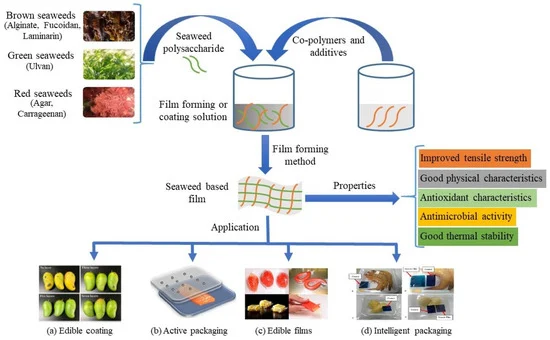
Enhancing Sareul Seaweed Polysaccharides as Modified Biopolymers for Sustainable Food Packaging Led by Nur Umriani Permatasari and funded by an internal grant from Hasanuddin University, this research explores the potential of Sareul seaweed polysaccharides (Sargassum sp., Eucheuma cottonii, Ulva lactuca) as renewable biopolymers for eco-friendly food packaging. Conducted under the Polymer Chemistry Research Group, the study integrates natural additives—ketapang leaf extract (Terminalia catappa), dragon fruit peel extract (Hylocereus sp.), and butterfly pea flower extract (Clitoria ternatea)—to enhance the mechanical properties, bioactivity, and functional performance of these biopolymers. Seaweed polysaccharides, including alginate, carrageenan, and ulvan, offer significant advantages as biodegradable, biocompatible, and environmentally friendly materials. Leveraging Indonesia’s abundant seaweed resources, particularly in South Sulawesi, this research aligns with sustainable material innovations to address the environmental challenges posed by plastic-based food packaging.
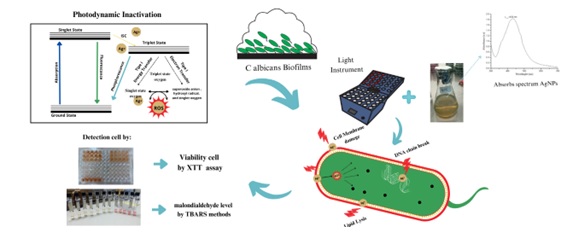
Research has been developed with a focus on several aspects, namely the synthesis and characterization of chlorophyll compounds in papaya and moringa leaf extracts, bioactive properties (antioxidants and toxicity) of papaya and moringa leaf extracts, a combination of bioactive properties on antimicrobial activity of biofilms, a combination of chlorophyll compounds and silver nanoparticles in the photodynamic inactivation (PDI) mechanism, and the effectiveness of PDI success from various combinations of photosensitizer alloys (moringa leaf chlorophyll, papaya leaf chlorophyll and AgNPs) with various types of light instruments (Laser and LED) and species of pathogenic microorganisms (Candida albicans and Staphylococcus aureus). Photodynamic Inactivation is a technique to inhibit the growth of microbial biofilms through the formation of Reactive Oxygen Species (ROS). This study aims to analyze the potential of Laser light and LED light of various wavelengths in activating chlorophyll and silver nanoparticles (AgNPs) to produce ROS and kill Candida albicans and Staphylococcus aureus biofilm cells. The effectiveness of treatment in this study was assessed through cell viability represented by the Optical Density (OD) value and malondialdehyde (MDA) levels. There were four main treatment groups used as samples, namely the control group (C-), the photosensitizer group (C+), the light group (L), and the combination of light and photosensitizer (CL) group. The duration of light exposure ranged from 1 to 10 minutes at varying ranges in each part of the study with laser or LED output power of no more than 100 mW. The lighting instrument control was built on the Arduino UNO microcontroller system. All PDI treatment results with various treatment combinations were analyzed after quantification preparation with a coloring method consisting of the XTT assay for cell viability values and the Thiobarbituric Acid Reactive Substances (TBARS) assay for malondialdehyde (MDA) levels.
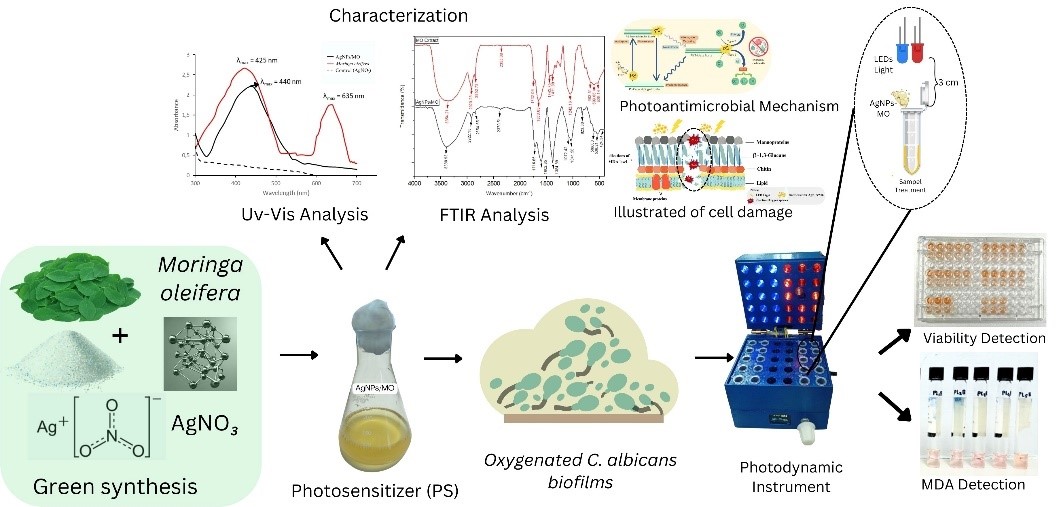
This study used AgNPs biosynthesis agents reduced with Moringa oleifera leaves as a photoantimicrobial agent in the photoinactivation mechanism. The antimicrobial ability of AgNPs can be enhanced by activation of diode laser energy using the antimicrobial photodynamic therapy (PDT) method. AgNPs act as nano photosensitizers (NPs), which are substances that absorb light energy to produce various reactive oxygen species that will inactivate microbes. PS nano will absorb more light energy and have a greater penetration ability into biofilms. The objectives of this study include obtaining nano-photosensitizer agents from green synthesis silver nanoparticles with Moringa oleifera, which have good stability through PSA, SEM, and absorbance tests. Testing the anticandida ability of nano-photosensitizer agents, silver nanoparticles from green synthesis Moringa oleifera with and without laser activation. Testing the antimicrobial ability of nano-photosensitizer agent silver nanoparticles from green synthesis Moringa oleifera with and without laser activation. The potential of AgNPs-MO agents is obtained optimally by using AgNPs-MO photosensitizers with blue LEDs on the sample experiencing a fairly high increase of 60.48% - 76.81%. For AgNPS-MO photosensitizer with red LED, there was an increase in the percentage of inactivation of 65.06% - 76.22%.