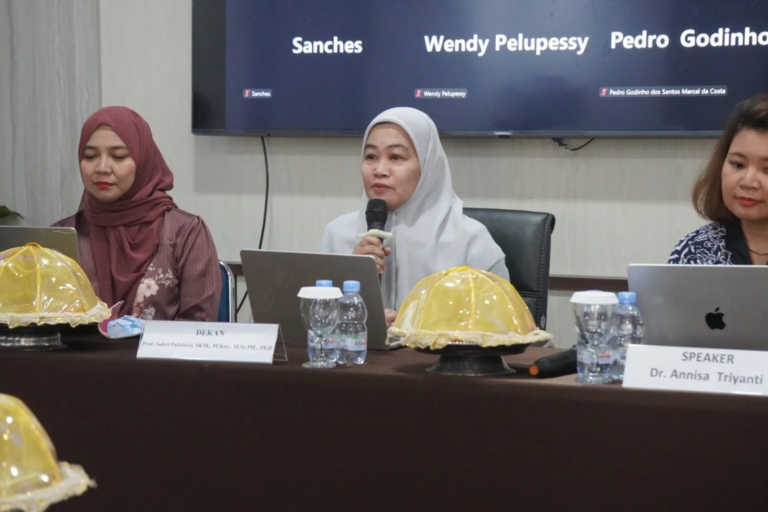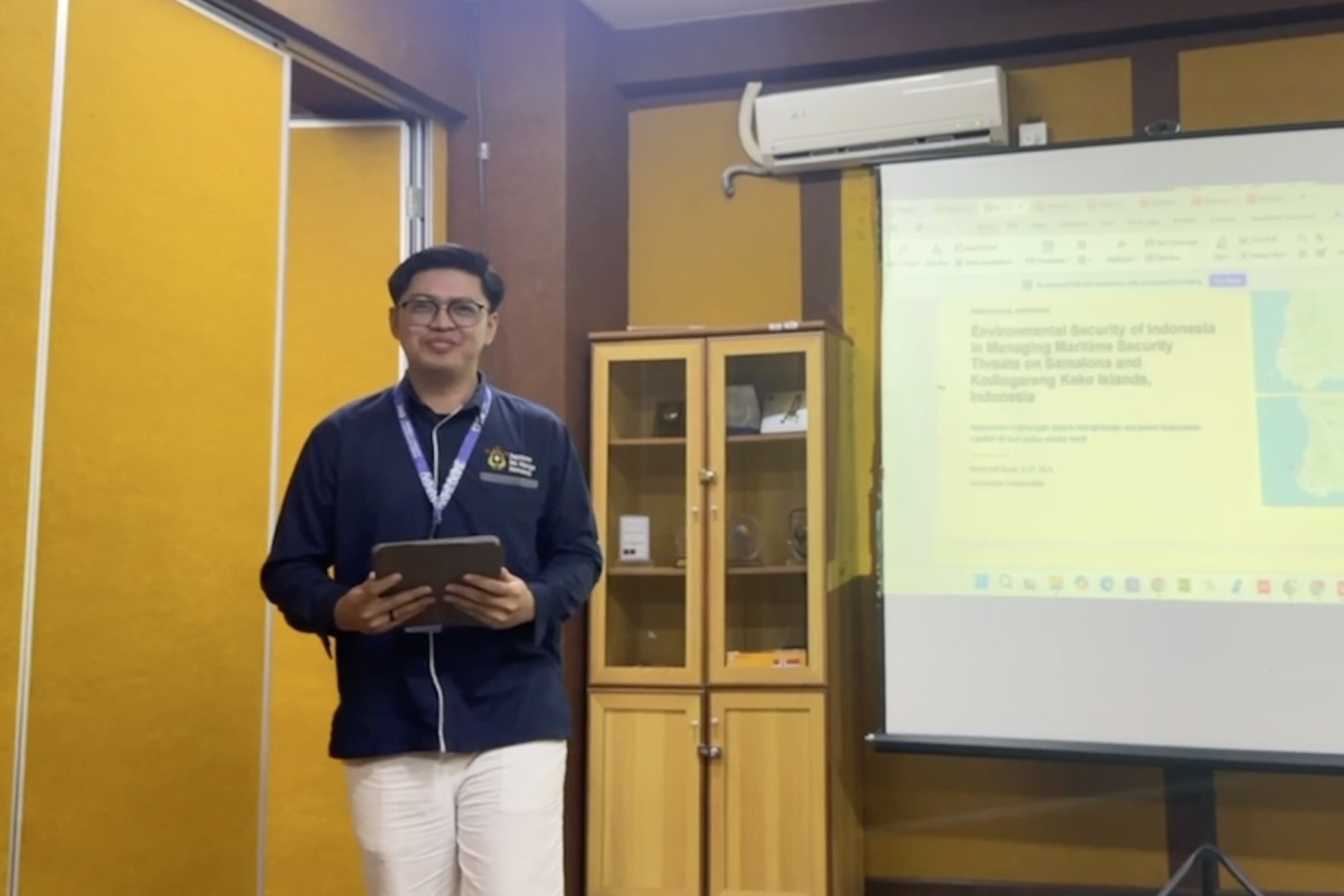

On 13 October 2026, an academic presentation titled “Environmental Security of Indonesia in Managing Maritime Security Threats on Samalona and Kodingareng Keke Islands, Indonesia” was delivered at Universitas Presiden, Kota Jababeka, Cikarang, as part of the XVII National Convention of the Indonesian International Relations Association (VENNAS XVII AIHII). The session was led by presenter Munif Arif Ranti, representing the research team, and drew 200 participants from 70 universities across Indonesia.
The study behind the presentation took place on two small tourist islands, Samalona Island and Kodingareng Keke Island in Makassar, South Sulawesi. Rather than focusing on sudden disasters, the research examined coastal and marine damage as a cumulative process known as “slow violence”: harm that unfolds gradually and quietly through abrasion, coral reef degradation, marine debris, and damaged coastal protection structures. Because such changes rarely make headlines, their long-term consequences for island communities are easily overlooked.
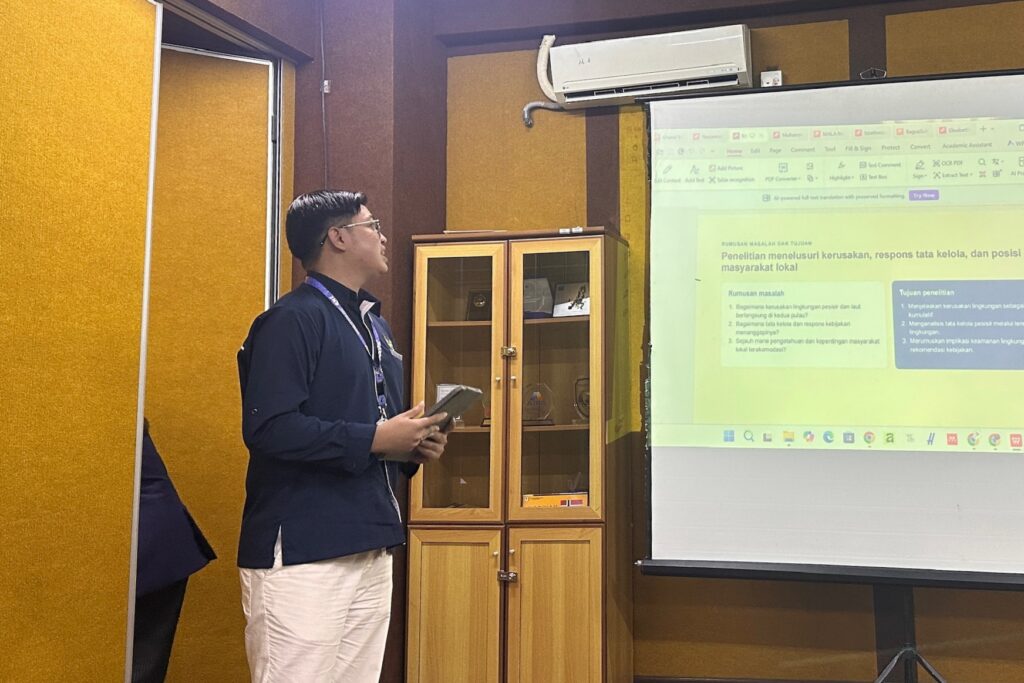
Mr. Ranti and the research team also analysed coastal governance through the lens of environmental justice, asking who bears the burden of environmental damage and who has a voice in managing it. Such a perspective moves the conversation beyond environmental protection alone, toward fairness and shared responsibility. From this analysis, the presentation outlined implications for environmental-maritime security, showing that ecological decline can weaken community resilience, threaten livelihoods, and ultimately undermine maritime stability.
The session concluded with practical policy recommendations: nature-based solutions to protect shorelines, community-based coral reef restoration, integrated waste management, zoning aligned with environmental carrying capacity, and responsible ecotourism. These measures emphasise that protecting small islands requires cooperation between governments, tourism actors, and local residents.
This activity is closely connected to several Sustainable Development Goals (SDGs). Most directly, it supports SDG 14: Life Below Water, by generating evidence on protecting coral reefs, reducing marine pollution, and managing coastal ecosystems sustainably. It contributes to SDG 1: No Poverty, since healthy reefs and clean shorelines underpin the tourism and fishing livelihoods on which island communities depend. It advances SDG 4: Quality Education, as the presentation shares research-based knowledge with students, lecturers, and scholars, strengthening environmental literacy within higher education. Finally, it embodies SDG 17: Partnerships for the Goals, bringing together 70 universities in a shared space for exchanging ideas and building collaboration across institutions.
Ultimately, the presentation reminds us that environmental threats do not always arrive with dramatic force. Sometimes they accumulate quietly, grain by grain of sand and fragment by fragment of coral, until a community’s safety and prosperity are at risk. By bringing the voices of Samalona and Kodingareng Keke into a national academic forum, Munif Arif Ranti and the research team have helped place small-island environmental security on the wider agenda, encouraging scholars and policymakers to act before gradual harm becomes irreversible loss for coastal communities and future generations.