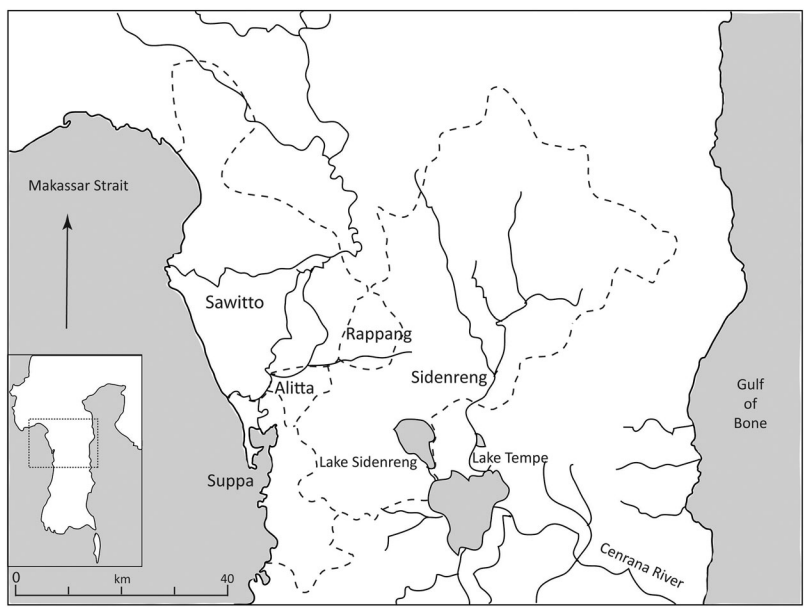

MAKASSAR, Indonesia, April 16 2026 /TRG-MCRG/ – History is often written by winners, but it is remembered through stories. On the west coast of South Sulawesi, a persistent memory lives on in the royal manuscripts known as lontara’. It tells of a mysterious, wealthy woman named Wé Tépulingé who emerged from the sea at the port of Lawaramparang. Carrying golden cooking pots and spoons, she didn’t just arrive; she founded a dynasty.
Tracing the Malay Connection
A recent study titled “Possible Traces of Early Malay Settlement in South Sulawesi”, published in the journal Indonesia and the Malay World (Taylor and Francis, 24 May 2022), suggests these legends are more than just myths. Authors Muhlis Hadrawi, Nuraidar Agus, and Hasanuddin argue that Wé Tépulingé represents a valid memory of 15th-century Malay settlers from Melaka.
At that time, Melaka was the “super-hub” of Southeast Asia. The researchers point to several fascinating “smoking guns” connecting this Malay powerhouse to the Bugis kingdom of Suppa:
- The Name: “Wé Tépulingé” literally translates to “complete in goods” or “very rich” in the Bugis language, reflecting the arrival of a wealthy foreigner.
- The Palace: The royal palace in Suppa was named Lamalaka. Local tradition says its central post was made from a massive wooden beam that floated all the way from Melaka.
- The Color Yellow: In Melaka, yellow was a sacred color reserved for royalty, a tradition that remains a strict etiquette in Suppa to this day.
History Meets Sustainability
While this research uncovers our past, it deeply resonates with SDG 17: Partnerships for the Goals. This United Nations Sustainable Development Goal emphasizes that progress occurs through international cooperation and knowledge sharing. The story of Suppa is a 500-year-old example of this principle. The arrival of Malays didn’t lead to conflict; instead, Wé Tépulingé married a local leader, La Bangéngé, combining Malay “civilizational patterns” with Bugis governance to create a flourishing maritime trade zone.
Archaeology supports this, showing that by the 15th century, Suppa was a thriving gateway for agricultural products and ceramics. This “stranger-king” dynamic shows how cross-cultural partnerships, the very essence of SDG 17, can spark the development of sophisticated societies.
Why This Matters Today
Understanding these early migrations reminds us that Southeast Asia has always been a “melting pot” of ideas and people. By looking at the metadata of our history, we see that the prosperity of ancient Sulawesi was built on the waves of maritime partnership. Just as the Malays and Bugis once collaborated to build the kingdoms of Ajattappareng, today’s global challenges require us to bridge cultures and borders to build a sustainable future.
Reference:
DOI: https://doi.org/10.1080/13639811.2022.2027696
Contact:
Prof. Dr. Muhlis Hadrawi, S.S., M.Hum.
+62 813-5545-0639
muhlisbugis@yahoo.com