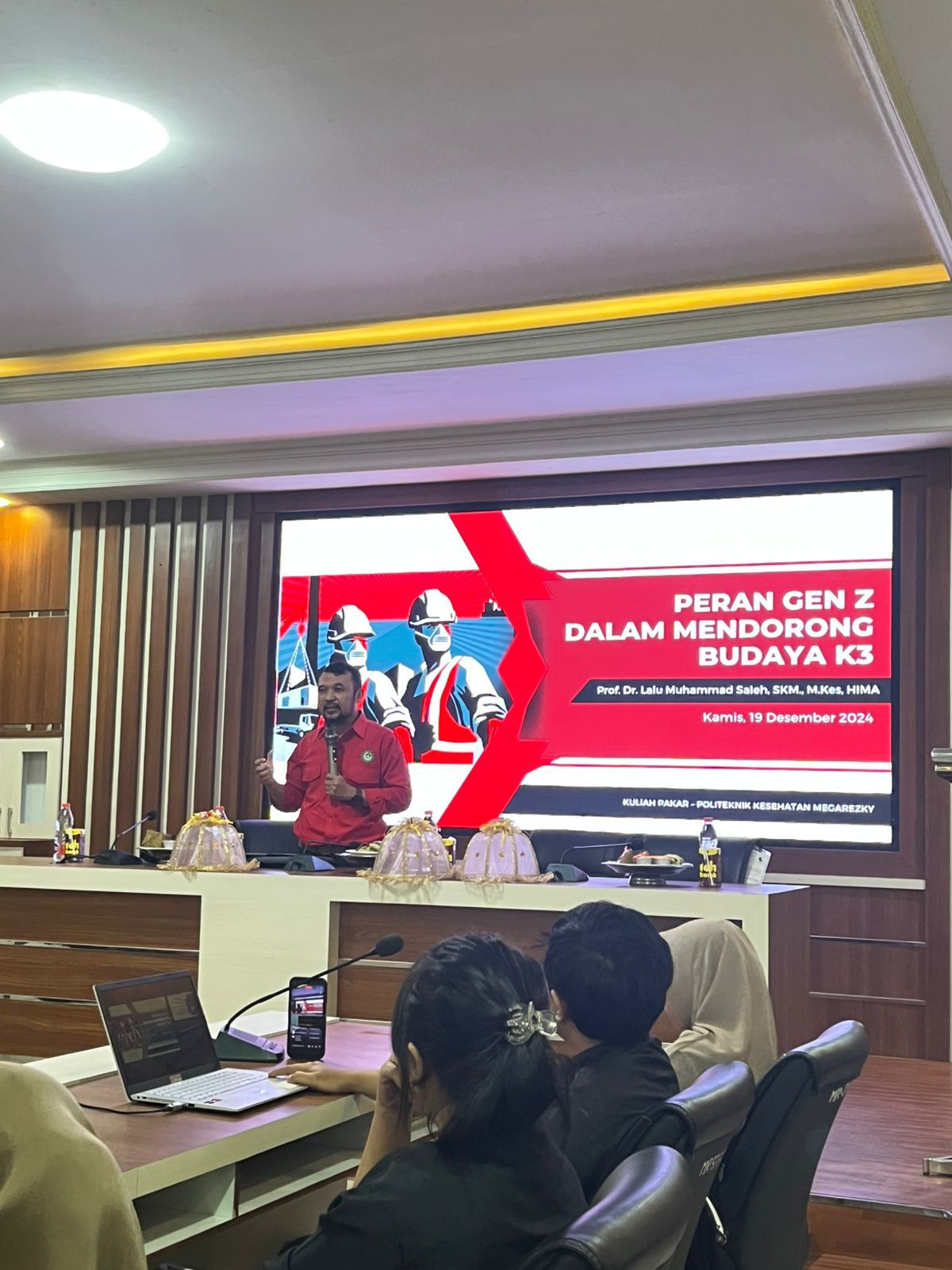

Lecturers from the Master of Occupational Safety and Health Study Program, Faculty of Public Health, Hasanuddin University, hosted a guest lecture focusing on the importance of occupational safety and health (OSH) culture, particularly for Generation Z. The lecture, themed “The Role of Gen Z in Supporting Occupational Safety and Health Culture,” emphasized the need for specific attention to this demographic.
The event primarily discussed how Gen Z can contribute to fostering an OSH culture in daily life, especially in the workplace. It highlighted the challenge of an inadequate ratio between labor inspectors and the objects of supervision. The guest lecture featured Prof. Dr. Lalu Muhammad Saleh, SKM., M.Kes, HIMA, a lecturer in the Master of Occupational Safety and Health Study Program and Head of the Sub-Directorate of the Occupational Safety and Health Insurance System, as the keynote speaker. The event took place at Megarezky University, Makassar, South Sulawesi, Indonesia.
The program aimed to deepen Gen Z’s understanding of their potential, the urgency of implementing an OSH culture, and their active involvement in supporting it. Prof. Lalu underscored the significance of Gen Z in the present and future development of Indonesia.
Gen Z, defined as those born between 1997 and 2012, makes up 27.94% of Indonesia’s population. Growing up in the digital era with abundant access to information, Gen Z possesses multitasking abilities, high levels of creativity and innovation, and the capacity to communicate on a global scale.
Occupational safety and health involve a unified effort to create safe, healthy, and prosperous work environments, free from accidents and occupational diseases. According to Prof. Lalu, a robust OSH culture is essential for ensuring a secure, healthy, and productive workplace. However, modern workplaces face challenges due to rapid technological advancements, globalization, and evolving work patterns.
“Thus, the involvement of Gen Z in supporting a culture of occupational safety and health is very important,” explained Prof. Lalu. With their creativity and innovative mindset, Gen Z can introduce new methods for implementing OSH, such as data-driven approaches, safety campaigns through social media, and the application of wearable technology. Furthermore, leveraging their social media skills, Gen Z can effectively disseminate information about OSH best practices to a broader audience.