


MAKASSAR, Indonesia Apr 24 2026/MALRESVEK/ – Malaria prevention has long relied on tools like insecticide-treated bed nets and indoor spraying. But what happens when people live and sleep in places where walls don’t exist—and mosquitoes bite outdoors? A recent study published in Malaria Journal offers promising answers.
The article, titled “Effectiveness of a transfluthrin emanator and insecticide-treated barrier screen in reducing Anopheles biting in a temporary shelter in Sumatra, Indonesia,” was published by BMC on April 7, 2025. The study explores innovative ways to protect communities living in forested areas where traditional malaria interventions are difficult to apply.
In parts of Sumatra, indigenous communities such as the Orang Rimba often live in temporary shelters made only of tarpaulin roofs without walls. These open structures leave people highly exposed to mosquito bites—especially from Anopheles mosquitoes, the primary carriers of malaria. Even though bed nets are available, they do not fully protect individuals who are active outside or before bedtime.
To address this challenge, researchers tested two alternative protection methods. The first is a transfluthrin spatial repellent (SE), a device that releases a chemical into the air to repel mosquitoes. The second is an insecticide-treated barrier screen, which acts as a physical and chemical shield surrounding the shelter. Both were compared with shelters that had no protection.
The results were striking. The study found that mosquito biting activity decreased by around 60–70% in shelters using either intervention compared to those without protection. This means that these tools can significantly reduce human exposure to malaria-carrying mosquitoes—even in outdoor or semi-outdoor environments.
Most Anopheles mosquitoes bite before midnight, especially between 6 PM–12 AM. Activity drops after midnight. This shows that protection is important early in the evening, not only during sleep. These two figures below tell a consistent story about how well each intervention protects people from mosquito bites.
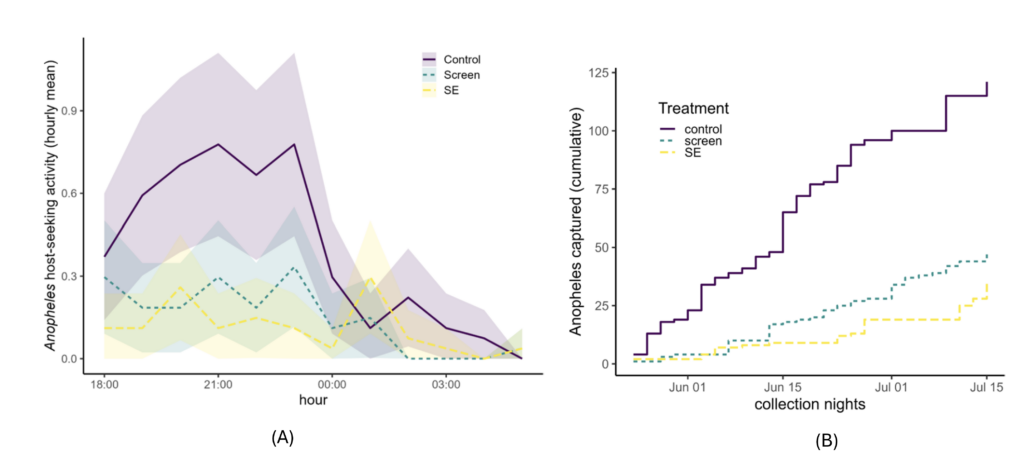
In Figure A, which shows mosquito activity hour by hour, the control group (no protection) clearly experiences the highest host-seeking activity, especially in the early evening. This is when most mosquitoes are actively searching for a host. The screen group shows a noticeable reduction—there are still bites, but fewer compared to the control. The spatial repellent (SE) group performs best, with the fewest mosquitoes attempting to bite across most hours. All three groups show a drop in activity after midnight, but the key difference is how much exposure happens before that point—when people are still active and not fully protected by bed nets.
In Figure B, which shows the total number of mosquitoes collected over time, the pattern becomes even clearer. The control group accumulates mosquitoes quickly, ending with the highest total. The screen group increases more slowly, indicating partial protection. Meanwhile, the SE group has the lowest cumulative count throughout the study, meaning it consistently reduces mosquito exposure better than the other two.
Interestingly, most mosquito activity occurred early in the evening, before midnight. This highlights a critical gap in current malaria prevention strategies, which often focus on nighttime protection while people are sleeping. By targeting mosquitoes in outdoor settings and earlier hours, these new tools could fill an important gap in malaria control.
The findings are especially relevant for regions where environmental changes—such as deforestation and plantation expansion—are increasing human contact with mosquito habitats. As mosquito behavior adapts, innovative solutions like spatial repellents and barrier screens become essential.
Beyond its scientific contribution, this study also supports global development goals. It directly contributes to SDG 3: Good Health and Well-being by advancing malaria prevention strategies. It also aligns with SDG 4: Quality Education, as it promotes knowledge transfer and scientific innovation, and SDG 17: Partnerships for the Goals, through collaboration between international researchers and Indonesian institutions. Importantly, it supports SDG 1: No Poverty, since reducing malaria can lessen healthcare costs and improve productivity in vulnerable communities.
In simple terms, this research shows that protecting people from malaria is not just about what happens inside the home—but also outside. Without any protection, people are exposed to the highest number of mosquito bites. Using a screen can reduce some bites, but a spatial repellent (SE) provides even better protection. By adapting interventions to real-world living conditions, we move closer to a future where malaria can be effectively controlled—even in the most challenging environments.
Reference
DOI: 10.1186/s12936-025-05285-x
Contact: Prof. dr. Din Syafruddin, Ph.D
+62 811-9898-766
dinkarim@yahoo.com; syafruddin@unhas.ac.id


