


MAKASSAR, Indonesia April 10 2026/LIMAR/ – In a world driven by technology and innovation, education plays a vital role in shaping skilled professionals. One area where learning meets real-world application is welding technology. A recent scientific study sheds light on how understanding welding parameters can improve both technical skills and industrial outcomes.
The research focuses on Shielded Metal Arc Welding (SMAW), a widely used technique in construction and manufacturing. It explores how different levels of electrical current affect the mechanical properties of two commonly used metals: low carbon steel AISI 1010 and stainless steel SUS304. These materials are essential in various industries due to their strength and durability.
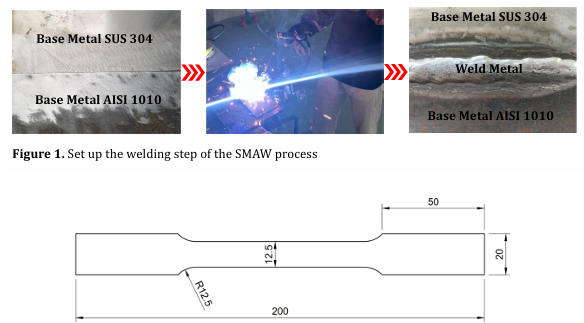
At first glance, welding may seem like a simple process—joining two metals using heat. However, the reality is much more complex. When two different metals are combined, known as dissimilar welding, the results can vary significantly depending on how the process is controlled. Incorrect settings can lead to weak joints, reducing the safety and lifespan of structures.
This is where the study becomes important, especially in the context of education. By analyzing how welding current influences tensile strength and hardness, the research provides valuable insights that can be used in teaching and training. Students and technicians can learn not only the theory but also the practical impact of their decisions during welding.
The findings show that selecting the appropriate welding current leads to stronger and more reliable joints. This knowledge can be directly applied in classrooms, workshops, and vocational training programs, helping learners understand the connection between scientific principles and real-world results.
This research strongly supports Sustainable Development Goal (SDG) 4: Quality Education. SDG 4 emphasizes inclusive and equitable education, as well as the development of relevant skills for employment. By integrating research findings into technical education, institutions can better prepare students for careers in engineering and industry.
Moreover, improving educational quality in technical fields has long-term benefits. Skilled workers contribute to safer construction, more efficient manufacturing, and overall economic growth. In this way, education becomes a bridge between knowledge and sustainable development.
What makes this study especially valuable is its accessibility. The concepts can be taught in a practical, hands-on way, making it easier for learners to grasp complex engineering ideas. This aligns perfectly with modern educational approaches that emphasize experiential learning.
In conclusion, this research demonstrates that even small improvements in understanding technical processes can have a big impact on education and industry. By connecting scientific research with practical training, we can create a more skilled and knowledgeable workforce ready to face future challenges.
Reference:
DOI 10.1088/1742-6596/3103/1/012028
Contact:
Rudi
+62 853-3693-6342
rudi.amme@unhas.ac.id


