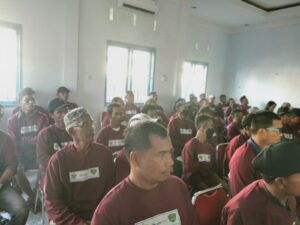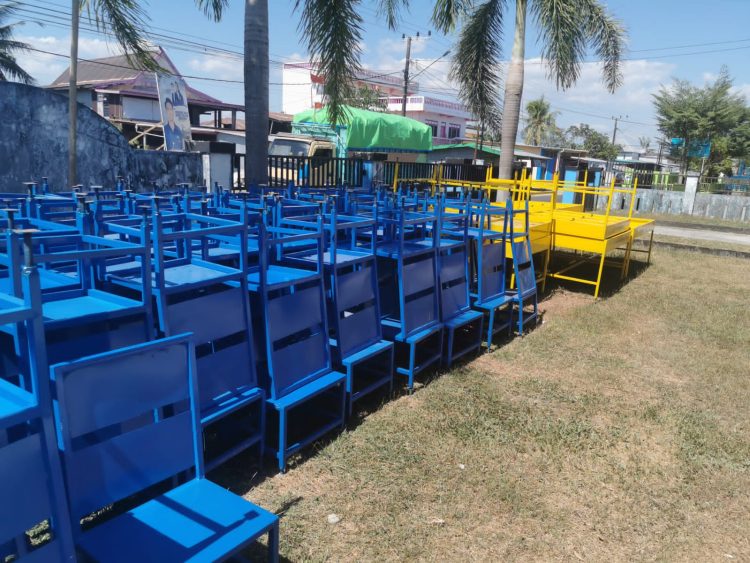
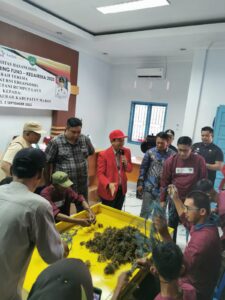
Seaweed industry is one of the most growing marine sector of industry in South Sulawesi. It is generally assumed that, seaweed workers are vulnerable to experience workplace injury and occupational disease. This study aims to explore determinants of occupational safety and health (OSH) problems among seaweed workers in Takalar District, South Sulawesi, Indonesia. The research is a quantitative study using cross sectional study design. Questionnaires survey were distributed among 105 seaweed workers from four districts in Takalar Regency. The data were analyzed using chi-square test and Odds Ratio (OR) analysis. The results showed that the main OHS problems among seaweed workers were work injury, work fatigue, and low back pain. Work fatigue was associated with pulse > average, work period > 1 year and duration of sunlight exposure > average. Meanwhile, work injury was associated with being female, work period > 1 year and working > 8 hours. Moreover, type of work such as maintenance, processing and all type of work were associated with low back pain. This study recommends to local government and other stakeholders to conduct interventions based on the findings of this research. A further research is needed to provide a longitudinal database on OSH problems among this subgroup of workers that help decision makers to plan a better and effective intervention.
BACKGROUND: In Indonesia, particularly in the coastal area, there is a growing number of seaweed farmers who work in the informal sector as a home-based industry. It is generally assumed that this sub-group of workers is also experiencing work fatigue. AIM: This research aims to explore information-related factors that are associated with fatigue among seaweed workers. METHODS: The study was conducted in Takalar Regency, South Sulawesi, Indonesia. The research used a mixedmethod design combining quantitative and qualitative approach. One hundred sixty-one samples were taken from four districts Mangarabombang, Mappakasunggu, Sanrobone, and North Galesong. RESULTS: More than half of the respondents feel fatigue 67.1%. Furthermore, based on bivariate analysis, it was found that there were significant associations between work hour p = 0.041 and work period p = 0.031 with work fatigue. For the qualitative approach, three focus group discussions were conducted to explore more information related to factors that were found associated with work fatigue from the quantitative study. This research found that a large number of employees experienced work fatigue. CONCLUSION: The factor that associated with work fatigue is work hour and work period. It is suggested that health providers and stakeholders related need to pay attention to this subgroup of the working population regarding their occupational health and safety problems.

Fatigue is a common condition for all workers after doing their job One of the informal sectors that has not yet received adequate occupational health services is seaweed workers. This research aims to determine the relationship between age, working time, work period, work attitude, workload, and work process of workplace fatigue on seaweed workers in Takalar district. The type of this research is an analytical observational with a cross sectional study approach. The samples in this study were 74 respondents using purposive sampling techniques. Data was obtained using the Work Fatigue Measurement Tool Questionnaire for fatigue and a Rapid Entire Body Assessment (REBA) Questionnaire sheet for work attitude. Chi-Square test was used to analise the relationship between variables. The results showed that workers experienced 27% working fatigue and 73% of workers who did not experience work fatigue. As for the relationship between age (p=0.006) and work process (p=0.030) with work fatigue, and no relationship between the length of work (p=0.183), the working period (p=0.429), the working attitude (p=0.319), and the workload (p=0.080) with work fatigue. It is suggested that worker need to pay attention to have sufficient rest time and stretch in between jobs in order to prevent work fatigue.

Objective: In this study, we researched to determine the relationship between body mass index (BMI) and work posture/position with the musculoskeletal disorders (MSD) in fishermen. Method: This type of research is analytic survey research with a cross-sectional study. There were 224 people as the population in this study with 56 samples as respondents. Nordic Body Map (NBM) and Rapid Entire Body Assessment (REBA) were used as a questionnaire instrument. Results: The result of the Chi-square test shows that the BMI variable has a p-value of p = 0.848 where the p-value is p > 0.05. This means BMI has no significant relationship with MSD. Meanwhile, the work posture/position variable has a p-value of p = 0.000 where the p-value is p < 0.05, which means that there is a significant relationship with MSD. Conclusions: BMI was not associated with MSD. This is possible because fishermen who have normal and abnormal BMI both have complaints of MSD. Meanwhile, work posture/position has a significant relationship with complaints of MSD in fishermen. This is because the posture of fishermen when working with tools when doing research looks very risky.
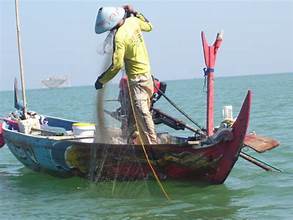
Objective: In this study, we conducted a research to determine the relationship between ages, working period, and smoking habit with the musculoskeletal disorder in fishermen. Method: This type of research is analytic survey research with a cross-sectional study. The population in this study totaled 224 people with 56 samples as respondents. Nordic Body Map (NBM) and Rapid Entire Body Assessment (REBA) were used as a questionnaire instrument. Results: The result showed that the age variable has p = 0.658 and the smoking habit has p = 1.000, this indicates that age and smoking habit variables do not have a significant relationship with musculoskeletal disorders. Meanwhile, the working period variable has a result of p = 0.015, it can be said that the work period has a significant relationship with musculoskeletal disorders. Conclusion: The respondents who were quite old were still fit for work and did not have as many musculoskeletal complaints as they should be for their age. Likewise with the smoking habit of fishermen who are more enthusiastic and motivated to work. Meanwhile, the work period has more influence on the complaints of musculoskeletal disorders among fishermen.

Musculoskeletal disorders that occur in workers are influenced by factors. The factors highlighted in this study are the length of work and type of work. This study aims to determine the relationship between work duration and type of work with musculoskeletal disorders in fishermen in the UKK (Occupational Health Efforts) Post, Maros Regency. This type of research is analytic survey research with cross-sectional study/cross-sectional design. The population in this study totaled 224 people. Sampling when this research took place was carried out by accidental sampling. The results of this study indicate that there is a significant relationship between the length of work with musculoskeletal disorders in fishermen at the UKK post of fishermen in Maros Regency. There is a significant relationship between the types of work with musculoskeletal disorders in fishermen at the UKK fishermen post in Maros Regency. Length of work is the factor that has the greatest influence on musculoskeletal disorders in fishermen at the fishermen\'s UKK post in Maros Regency. In order to do stretches both before and after every activity, for fishermen aged> 45 years, be careful in carrying out activities and minimize awkward attitudes/work positions and always participate in every meeting, guidance, and health examination conducted by the occupational health program manager.

Safety climate in the workplace and safety behaviour of workers need attention to be able to assess what factors are the causes of safe action for workers. This study aims to determine the effect of safety climate on safety behaviour with safety motivation as an intervening variable on contractor workers at PT X. The type of research is analytical observational with a cross sectional design. Questionnaires were given to 380 respondents. The data were analyzed using path analysis to see the direct and indirect effects of safety climate on safety behaviour. The results showed, 361 respondents (95%) with good safety climate, 367 respondents (96.9%) with good safety motivation, and 348 respondents (91%) with good safety behaviour. The path analysis showed that there was no direct influence of safety climate on safety behaviour in contractor workers at PT X (p value >0.05). However, the safety climate indirectly affects safety behaviour through safety motivation (p value = 0.001). It is recommended to workers that they need to maintain and increase their motivation so the safe work behaviour will still create.