Live Streaming Workshop on Diabetic Foot Ulcer Management in Collaboration of Universitas Hasanuddin dan Universitas Medika Suherman
April 27, 2026
Live Streaming Workshop on Diabetic Foot Ulcer Management in Collaboration of Universitas Hasanuddin dan Universitas Medika Suherman
Makassar, Indonesia – On April 27, 2026, a live-streamed workshop ondiabetic foot ulcer (DFU) management was conducted at Griya Afiat Makassar in collaboration with Universitas Medika Suherman. The session was delivered via Zoom, representing a practical implementation of telenursing in nursing education. The workshop was facilitated by Saldy Yusuf, PhD, and Takdir Tahir, MD, from the Indonesian Diabetic Foot Care Research Group (TRG).
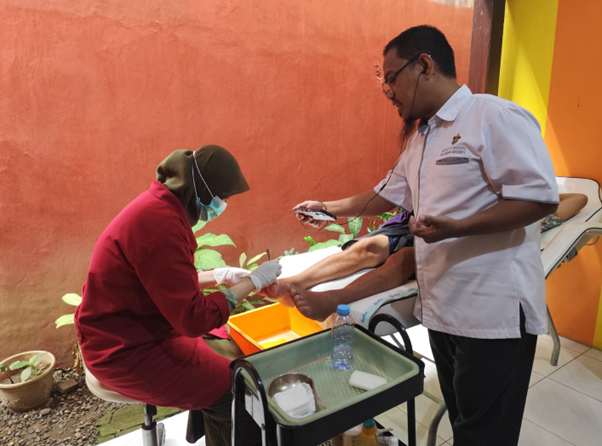
Lecturer demonstrating diabetic foot ulcer management procedures to nursing students during a live-streamed workshop session
The session commenced with informed consent obtained from both the patient and family, ensuring adherence to ethical standards in clinical education. A live demonstration of DFU management was then conducted, featuring a Wagner grade III case with clinical presentation of hypergranulation tissue. Participants were able to directly observe essential wound care procedures, including wound cleansing, debridement techniques, dressing application, and management of wound edges.
Following the clinical demonstration, the session continued with a theoretical discussion emphasizing evidence-based practice (EBP) in DFU management. Key concepts presented included the application of SMART thinking and SMART dressing approaches in DFU care, as well as the emerging potential of artificial intelligence (AI) in supporting DFU assessment and clinical decision-making processes.
The second session was delivered by Takdir Tahir, who presented on the topic of malignant wound management based on EBP principles. The discussion encompassed a bioscellular perspective of wound pathology and explored various nursing intervention modalities relevant to complex wound care.
The workshop was moderated by Hana Priscilla Prudence Sohilait, S.Kep., Ns., M.Kep., representing Universitas Medika Suherman.
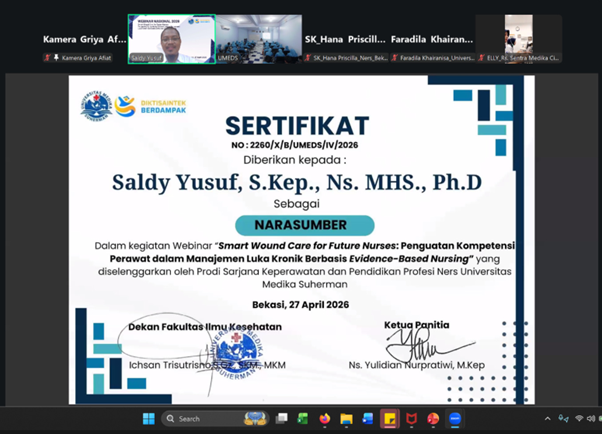
Presentation of a certificate of appreciation to the speaker in recognition of their contribution to the workshop
This activity highlights the growing integration of digital health technologies in nursing education and reinforces TRG’s commitment to advancing clinically relevant, technology-enhanced learning aligned with contemporary healthcare demands.
Alignment with Sustainable Development Goals (SDGs): This activity primarily contributes to SDG 3 (Good Health and Well-being) through the implementation of evidence-based diabetic foot ulcer management and direct clinical demonstration. It also supports SDG 4 (Quality Education) by enhancing nursing students’ competencies through experiential and technology-assisted learning. Furthermore, this initiative aligns with SDG 9 (Industry, Innovation and Infrastructure) through the integration of telenursing and artificial intelligence.