
MAKASSAR, Indonesia Feb 10 2026/FSRG/ – Environmental policies often aim to empower communities by giving them a greater role in managing forests, land, and natural resources. But participation does not always mean that power is redistributed. Sometimes, the same processes designed to empower people can also create new forms of control.
According to our published paper titled The SPA-Cube Framework: An Integrated Approach for Analysing Power Dynamics in Environmental Governance that was published on journal MethodX by Elsevier on 3 February 2026, this is an important challenge when studying environmental governance. Power is not always visible in formal decisions, laws, or who sits at the table. It can also operate through informal networks, control over agendas, dominant ideas, and assumptions about what or who needs to be changed. These forms of power can shift as a policy moves from planning to implementation and beyond.
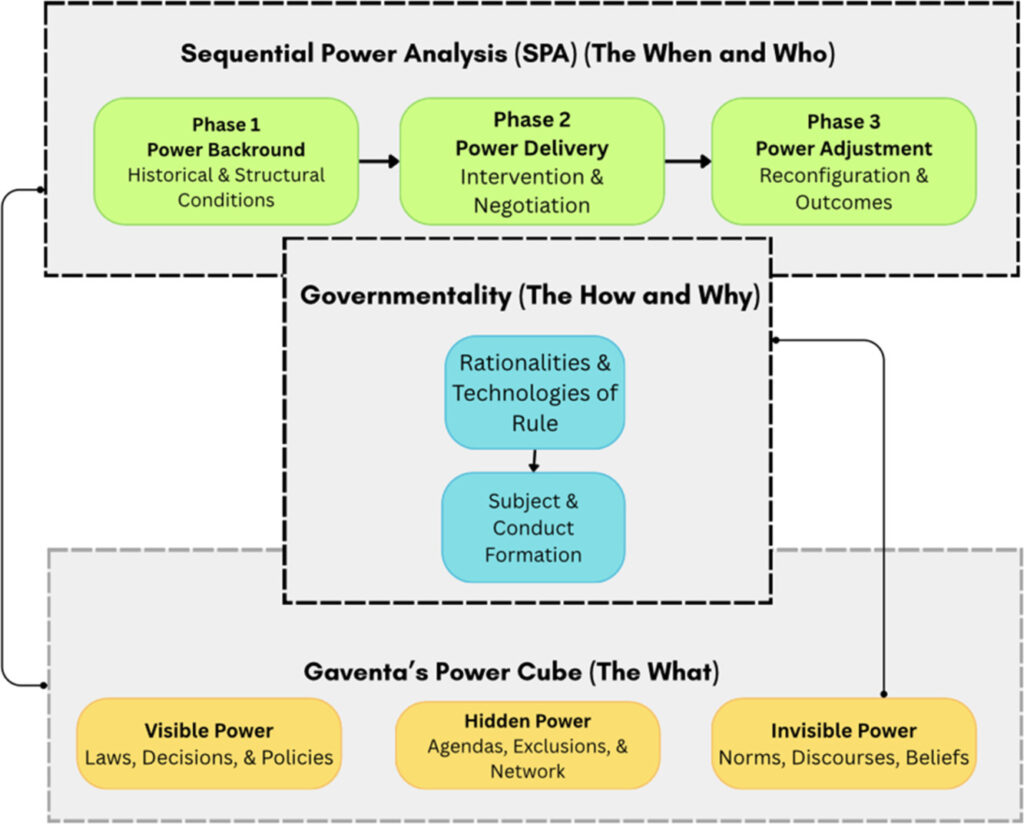
The SPA-Cube Framework was developed as a way to make these changes easier to trace. It brings together three approaches to understanding power.
The first is Sequential Power Analysis (SPA), which looks at how power develops over time. It asks what power relations existed before an intervention, how different actors navigate power during implementation, and what changes after the intervention. These three stages are referred to as Power Background, Power Delivery, and Power Adjustment.
The second is Gaventa’s Power Cube, which helps identify the different ways power can appear. It looks at visible, hidden, and invisible forms of power, as well as the different spaces where decisions are made and the different levels at which power operates. This means looking beyond formal institutions to include informal networks, participatory spaces, grassroots organising, and relationships between local, national, and global actors.
The third is governmentality, which focuses on how power works through ideas, knowledge, and governing practices. It asks how certain issues become defined as problems, what kinds of knowledge are treated as legitimate, and how tools such as mapping, certification, monitoring, and reporting shape the behaviour and identities of people involved in governance.
The value of putting these approaches together is that they tell a more complete story. Instead of simply asking who has power, the framework asks when power changes, what form it takes, where it is exercised, and how it works.
The framework was developed and tested through a 36-month critical ethnographic study of the recognition process of the Punan Batu, a nomadic hunter-gatherer community in Kalimantan, Indonesia.

The case revealed an important tension. Formal recognition was a significant achievement for the community. Yet some of the participatory tools used in the recognition process, including mapping and institutional formalisation, also made Punan Batu mobility and social practices more legible to the state. In the process, practices that had previously been more fluid could become translated into forms that were easier to categorise and regulate.
This does not mean that recognition or participation is necessarily negative. Rather, it shows why the effects of environmental interventions cannot always be understood through their stated objectives alone.
A policy may open new opportunities while also creating new dependencies. It may give a community a formal voice while changing the conditions under which that voice is recognised. Existing relationships of power may not disappear either. They can adapt and take new forms after an intervention. The Punan Batu case, for example, showed how earlier patron-client relationships could be reconfigured into new forms of intermediary dependency following recognition.
This way of looking at power matters for environmental governance more broadly. Conservation, social forestry, climate adaptation, and natural resource policies all involve decisions about people, places, knowledge, and access to resources.
So, when we ask whether a policy has worked, it may not be enough to look at whether its targets were achieved. We should also ask: Who gained a voice? Who was left out? Whose knowledge counted? What relationships changed? And what new forms of power emerged along the way?
The SPA-Cube Framework provides one way of asking these questions while keeping the history, actors, forms of power, and governing processes connected. Environmental governance shapes how resources are managed and how relationships between people, institutions, knowledge, and power evolve.
This articles contribute to SDG 4 (Quality Education) by making research findings and environmental knowledge more accessible to a wider audience. Through clear and engaging articles, the research is translated into accessible information that can support public learning, raise awareness of environmental and social issues, and encourage wider understanding of research beyond academic communities.
Reference
DOI: https://doi.org/10.1016/j.mex.2026.103814
We also promote this paper through our social media https://www.instagram.com/p/DUiOSWqEqgc/?img_index=1
Contact:
Prof. Dr. forest. Muhammad Alif K. Sahide
+62 823-9357-0098
muhammadalif@unhas.ac.id